
Post-Op Follow-Up Schedule That Prevents Prosthetic Delays (For Clinicians)
For many clinicians, the surgery is only the first step. What happens after the operation




Before a prosthetic is fitted, the body must be stable enough to accept new physical demands. Healing of the limb is only one part of readiness. The heart must tolerate higher energy use. The kidneys must handle metabolic stress and medications. The nervous system must support balance, control, and learning. When these systems are ignored, prosthetic outcomes suffer quietly and often unexpectedly.
At Robobionics, through close work with doctors and patients across India, we have seen how unmanaged comorbidities delay prosthetic use more often than poor motivation or technology limits. Many early prosthetic failures are not device-related. They are medical readiness issues that could have been anticipated and addressed earlier.
This article is written for medical doctors who guide patients toward prosthetic rehabilitation. It focuses on practical, real-world considerations for managing cardiac, renal, and neurological conditions before prosthetic fitting. These insights aim to help doctors make safer decisions, set realistic timelines, and improve long-term prosthetic success.
Using a prosthetic increases energy demand, balance effort, and cardiovascular workload. Even simple daily activities require more effort than before.
If underlying conditions are unstable, these added demands expose problems quickly.
A healed limb does not guarantee safe prosthetic use. The rest of the body must support standing, walking, gripping, and sustained effort.
Ignoring this leads to early fatigue, dizziness, or medical setbacks.
When comorbidities are managed early, prosthetic training becomes safer and more predictable.
Delays caused by medical instability are often preventable.
Walking with a prosthesis increases oxygen use and heart rate. Upper limb prosthetic use also raises cardiovascular demand through sustained muscle effort.
Patients with heart disease feel this increase quickly.
Hypertension, ischemic heart disease, heart failure, and arrhythmias are common in amputees.
Each condition affects tolerance differently.
Unmanaged cardiac issues lead to early exhaustion, breathlessness, and fear of activity.
Patients often withdraw silently when this happens.
A diagnosis alone does not define readiness. What matters is how much activity the patient can tolerate safely.
Doctors should assess daily function, not just reports.
Lightheadedness, excessive fatigue, or chest discomfort during basic activity are early red flags.
These signs often appear before major events.
Clearance from cardiology helps align expectations and safety limits.
Shared planning prevents emergency setbacks.
Heart failure often causes fluid retention, which complicates limb volume control and socket fit.
Doctors must manage edema aggressively but safely.
Some medications affect blood pressure during movement.
Doctors should adjust timing to support training.
Sudden activity increases worsen symptoms.
Slow, guided conditioning improves tolerance.
Standing and walking with a prosthetic can cause pressure swings.
Poor control increases fall and stroke risk.
Inconsistent medication use leads to unpredictable responses.
Doctors should reinforce adherence.
Patients often push themselves too hard.
Clear limits protect safety.
Arrhythmias can cause dizziness or fainting.
This is especially dangerous during early prosthetic standing.
Close observation during initial sessions reduces risk.
Doctors should plan this phase carefully.
Some patients need slower timelines.
Realistic planning protects confidence.
Kidneys regulate fluid, electrolytes, and medication clearance.
Prosthetic preparation stresses all three.
Chronic kidney disease is common, especially in diabetic patients.
Severity varies widely.
Fluid overload, electrolyte imbalance, and fatigue derail training.
These issues are often misattributed to poor motivation.
Renal patients often have strict fluid limits.
Compression and positioning must respect this balance.
Exercise alters potassium and sodium levels.
Doctors should monitor during increased activity.
Protein needs must balance renal limits.
Coordination improves safety.
Energy levels fluctuate across dialysis days.
Training schedules should align with peak energy.
Compression and positioning must avoid access sites.
Clear orders prevent complications.
Dialysis fatigue is real and limiting.
Doctors should plan gradual progression.
Some pain medications worsen renal function.
Doctors must choose carefully.
Infection risk and medication clearance must be balanced.
Renal dosing is critical.
Renal status changes over time.
Trend monitoring guides safe progression.
Balance, coordination, sensation, and learning all depend on the nervous system.
Prosthetic use stresses these systems.
Stroke, peripheral neuropathy, Parkinson’s disease, and spinal issues are common.
Each affects readiness differently.
Poor balance or sensation leads to falls and fear.
Confidence drops quickly.
Stroke often leaves uneven strength and control.
This complicates prosthetic alignment and training.
Learning new motor tasks may be slower.
Doctors should plan extra time.
Fall prevention must be central.
Safety planning protects progress.
Neuropathy reduces pain feedback.
Skin injuries may go unnoticed.
Feedback is limited, slowing learning.
Doctors should adjust expectations.
Frequent skin checks are essential.
Education reduces harm.
Stiffness and slow movement affect prosthetic control.
Training requires patience.
Motor performance varies with medication cycles.
Doctors should coordinate timing.
Energy levels change unpredictably.
Flexible plans work best.
Memory and understanding affect safety.
Simple instructions work better.
Caregivers play a larger role.
Doctors should include them early.
Goals may focus on safety over speed.
Clarity prevents frustration.
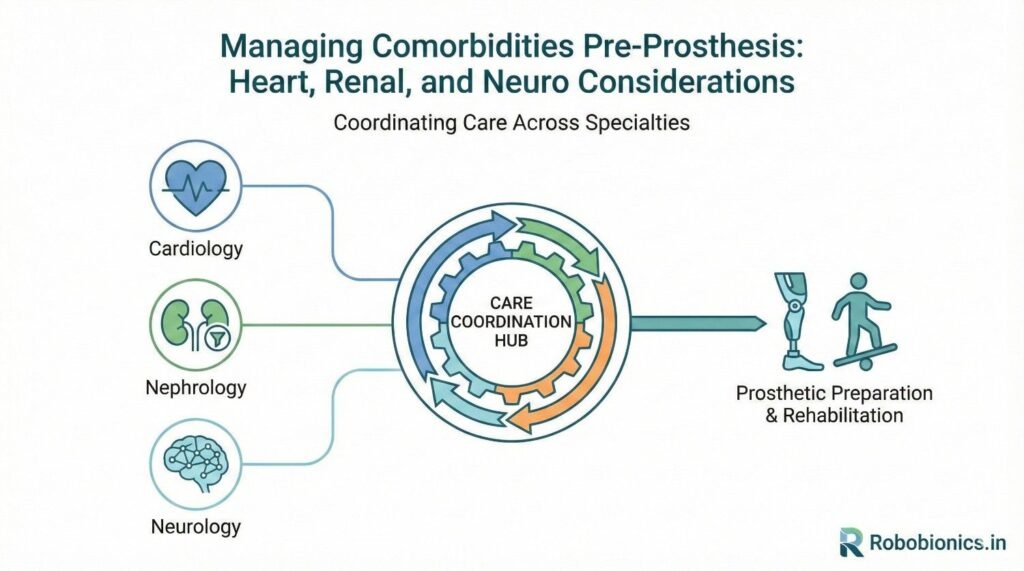
Managing one condition in isolation misses interactions.
Integrated planning improves outcomes.
Cardiology, nephrology, neurology, and rehab must align.
Doctors can lead this coordination.
Shared functional goals reduce conflict.
Alignment improves efficiency.
Rushing unstable patients leads to setbacks.
Measured progress prevents collapse.
Small activity increases reveal limits safely.
Doctors should observe trends.
Adjustments should feel normal.
Blame reduces honesty.
Most pre-prosthetic patients do not have just one medical condition. Heart disease often exists with diabetes. Renal issues often overlap with hypertension and neuropathy.
When conditions interact, their combined effect is greater than each alone.
Cardiac limits reduce endurance, renal limits affect fluid balance, and neurological limits affect balance and learning. Together, they narrow the safe activity window.
Doctors must plan within this smaller margin.
In multi-comorbidity cases, the goal is not fast prosthetic fitting. The goal is safe, sustained use.
This shift in mindset prevents repeated setbacks.
Patients with recent cardiac events, advanced kidney disease, or significant neurological deficits need closer monitoring.
Identifying risk early guides safer timelines.
Not all prosthetic goals require the same effort. Household mobility demands less than community ambulation.
Doctors should align goals with capacity.
Short, controlled trials of activity reveal tolerance better than assumptions.
These trials guide readiness decisions.
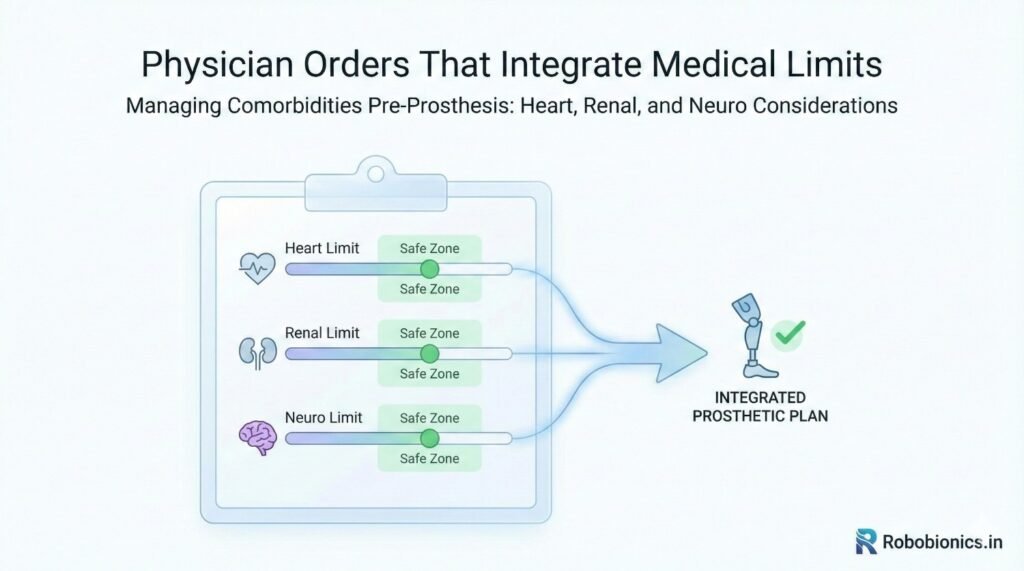
Orders should specify activity limits, rest needs, and warning signs.
This protects patients and care teams.
Standard rehab intensity may overwhelm medically complex patients.
Doctors should prescribe modified progression.
Clear triggers for medical review prevent silent deterioration.
This improves safety.
At home, monitoring decreases while demands increase.
Patients with comorbidities are vulnerable during this transition.
Patients need to know how much activity is safe at home.
Clear boundaries reduce fear and overexertion.
Medication timing affects balance, blood pressure, and energy.
Doctors should align medication schedules with activity plans.
Patients sense when information is withheld. Honest discussions prevent unrealistic expectations.
Trust improves adherence.
Limits should be framed as protection, not inability.
Language matters deeply.
Patients still need goals.
Doctors should help define safe progress.
Early training should be monitored for breathlessness, dizziness, confusion, or excessive fatigue.
These signs matter more than technical skill.
Reducing session frequency may be safer than shortening sessions.
Doctors should guide this balance.
A medical review soon after training begins catches problems early.
Proactive review prevents collapse.
Heart function, renal status, and neurological control evolve.
Prosthetic plans must adapt.
Medical decline often leads to reduced use.
Early adjustment preserves engagement.
Patients should know when and how to report changes.
Accessibility improves outcomes.
At Robobionics, we design prosthetic solutions considering endurance, balance, and energy limits.
Medical reality shapes design choices.
We rely on physician insight to guide safe progression.
Partnership reduces risk.
We track outcomes beyond fitting.
This learning improves future care.
When patients have heart, renal, or neurological conditions, informal clearance decisions increase risk. Small oversights can trigger large setbacks once prosthetic training begins.
Structured checklists help doctors slow down decision-making without delaying care.
Numbers like ejection fraction or creatinine matter, but function matters more. How the patient tolerates daily activity provides better insight than isolated values.
Doctors should prioritize real-world tolerance.
Readiness is not fixed. A patient may be ready one week and unstable the next.
Periodic reassessment prevents premature progression.
Some patients aim for household mobility. Others want outdoor independence or vocational use.
Medical status should shape which goals are realistic and safe.
High-demand prosthetic goals increase cardiovascular and neurological strain.
Doctors should help match ambition with capacity.
Success may mean safe transfers, reduced caregiver burden, or short walking distances.
Clear goal framing prevents disappointment.
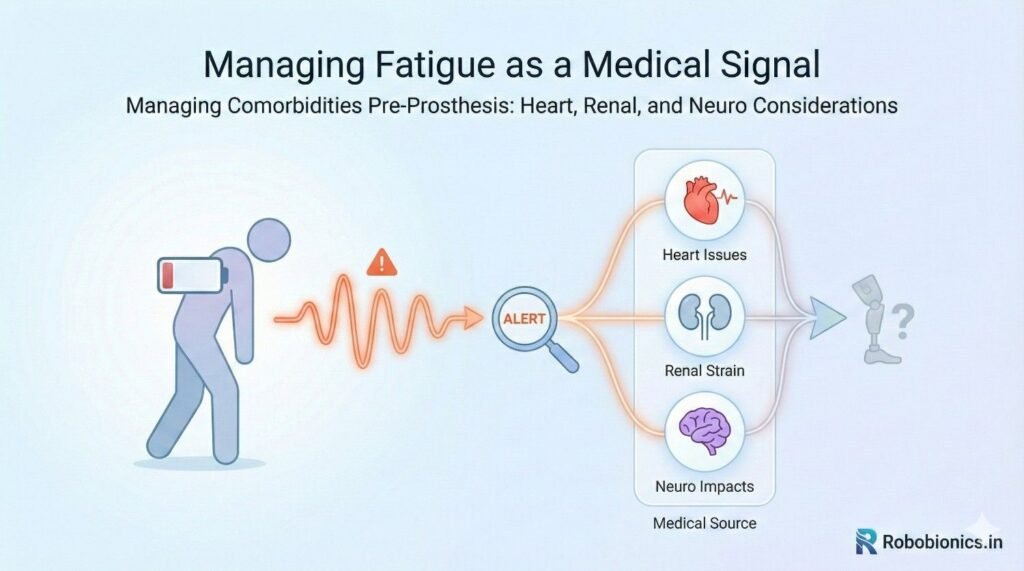
Fatigue appears before chest pain, dizziness, or collapse. It is often dismissed as normal recovery.
Doctors should treat fatigue as diagnostic information.
Conditioning fatigue improves with rest. Medical fatigue persists or worsens.
Understanding this difference guides safe progression.
Reducing frequency, adjusting timing, or changing posture may resolve fatigue without stopping training.
Fine-tuning protects momentum.
Poor sleep worsens blood pressure control, cognitive function, and balance.
Ignoring sleep undermines all other optimization efforts.
Pain, anxiety, medication effects, and positioning disrupt sleep.
Doctors should ask directly about sleep quality.
Better sleep improves endurance, learning, and mood.
Simple adjustments can produce meaningful gains.
Some patients experience blood pressure drops, heart rate instability, or temperature regulation issues.
These problems increase fall risk during early standing.
Diabetes, spinal injury, and neurological disease increase autonomic risk.
Early identification improves safety planning.
Gradual transitions, hydration guidance, and positional control reduce symptoms.
Doctors should guide these modifications.
Heart failure, renal disease, and neurological conditions all increase metabolic stress.
Undernutrition worsens tolerance to prosthetic use.
Protein needs must balance renal limits. Sodium intake affects cardiac stability.
Doctors should align nutrition advice with medical goals.
Weight loss or muscle wasting predicts poor prosthetic endurance.
Early intervention prevents decline.
Multiple medications increase confusion, dizziness, and fatigue.
This affects prosthetic safety.
Simpler schedules improve adherence and reduce side effects.
Doctors should review necessity regularly.
Some medications reduce alertness or balance.
Aligning timing improves performance.

Families may push patients to do more or restrict activity excessively.
Doctor guidance balances support and safety.
Families should know when to stop activity and seek help.
Clear signs reduce panic and delay.
Educated caregivers feel less fearful.
This improves home adherence.
A fall, hospitalization, or medical scare early on often leads to abandonment.
Prevention is far easier than recovery.
Starting slow is not failure. It is risk control.
Doctors should normalize this approach.
Small, safe successes rebuild trust in the body.
Confidence grows steadily.
Prosthetic rehabilitation does not begin with a device. It begins with the body’s ability to tolerate change. When heart, kidney, and neurological systems are stable and supported, prosthetic use becomes an extension of recovery rather than a medical gamble. When they are not, even the most motivated patient struggles quietly.
Managing comorbidities before prosthetic fitting is not about lowering expectations. It is about protecting outcomes. Patients with cardiac, renal, or neurological conditions often want independence just as strongly as anyone else. What they need is a pathway that respects biological limits while still moving forward.
The heart sets the ceiling for endurance. Prosthetic use increases energy demand, often by a significant margin. When cardiac conditions are unmanaged, patients experience early fatigue, breathlessness, and fear. These experiences reduce trust in their own bodies. Doctors who assess functional tolerance, adjust medications thoughtfully, and pace progression give patients confidence rather than caution.
The kidneys shape consistency. Fluid balance, electrolyte stability, and medication clearance all influence prosthetic readiness. Unstable renal status leads to swelling, weakness, and unpredictable responses to activity. These issues often masquerade as poor motivation or low effort. When renal limits are respected and planned for, training becomes smoother and safer.
The nervous system governs balance, learning, and awareness. Stroke, neuropathy, Parkinson’s disease, and cognitive impairment each affect prosthetic training differently. These conditions demand patience, clear communication, and strong safety planning. Ignoring neurological readiness exposes patients to falls and frustration that quickly erode confidence.
Complexity increases when these conditions overlap, which is common. In such cases, progress must be intentional rather than aggressive. Slower pacing often leads to faster long-term success because it avoids collapse. Doctors who prioritize stability over speed prevent cycles of progress and regression.
Medical optimization also requires attention to factors often overlooked. Sleep quality, nutrition, autonomic control, fatigue patterns, and medication burden all influence prosthetic tolerance. These elements rarely cause immediate failure, but they quietly shape whether progress is sustainable.
Clear physician guidance remains central. When doctors provide specific activity boundaries, review triggers, and progression plans, teams act with confidence. Patients feel protected rather than restricted. Families learn how to support without overstepping.
At Robobionics, we see the downstream effects of medical readiness every day. We see how well-managed comorbidities simplify prosthetic fitting, reduce training setbacks, and improve long-term use. We also see how overlooked medical issues create challenges that technology alone cannot solve.
Prosthetic success is not defined by speed. It is defined by durability. When medical systems are prepared, patients do not just start using prosthetics. They continue using them. They adapt. They grow stronger within their limits.
Managing comorbidities pre-prosthesis is not a delay. It is an investment. And when done well, it is one of the most powerful ways a doctor can protect patient independence, safety, and dignity.
For many clinicians, the surgery is only the first step. What happens after the operation

For trauma amputees, the journey does not begin at the prosthetic clinic. It begins much

Amputation after cancer is not just a surgical event. It is the end of one

When a child loses a limb, the challenge is never only physical. A child’s body