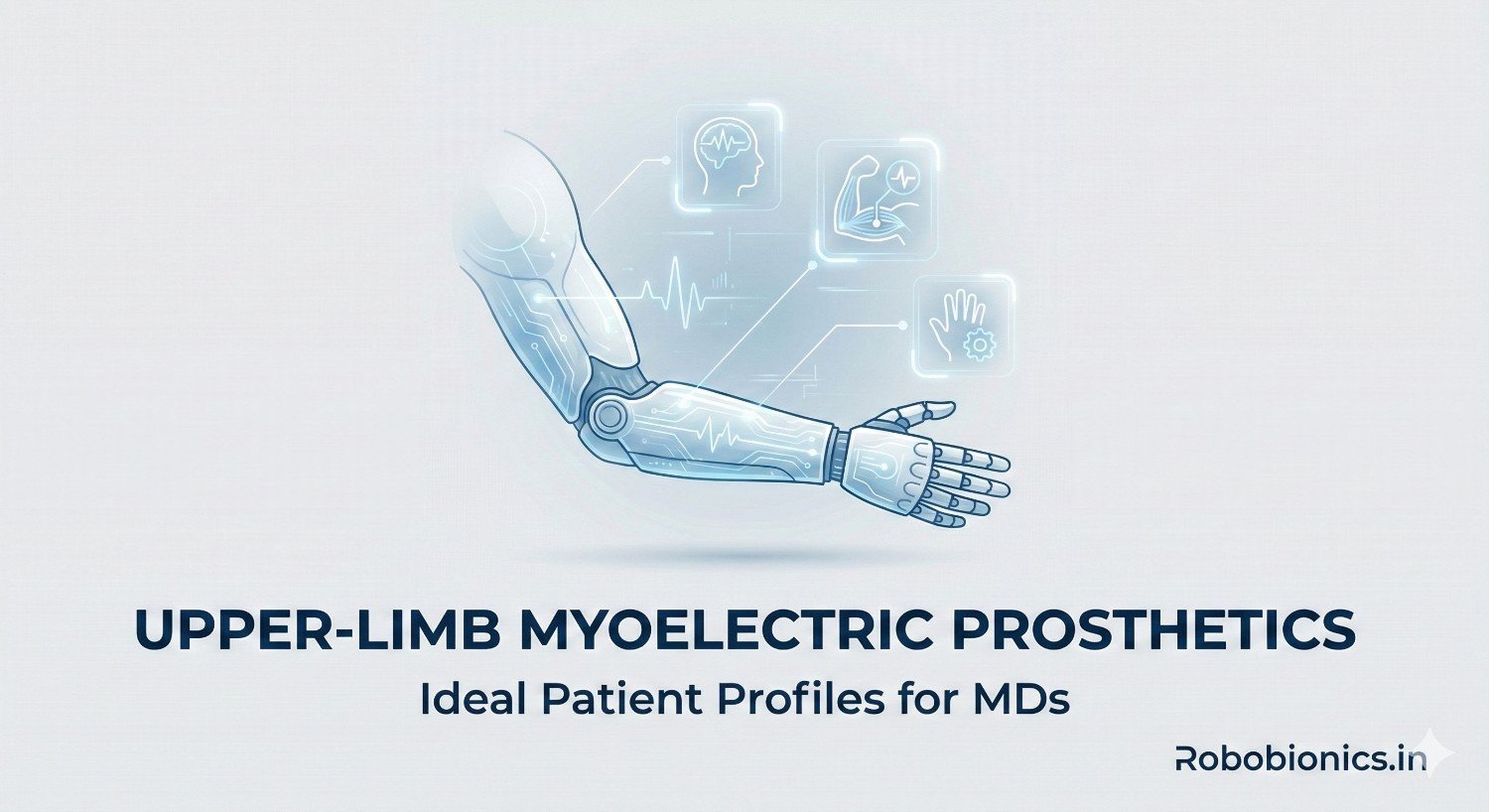
Upper-Limb Myoelectric Prosthetics: Ideal Patient Profiles for MDs

Upper-Limb Myoelectric Prosthetics: Ideal Patient Profiles for MDs

Upper-limb loss affects how a person works, communicates, and connects with the world, often more visibly than many other physical injuries. Myoelectric prosthetics offer powerful functional benefits, but they are not right for every patient or at every stage of recovery. For doctors, selecting the ideal candidate requires more than checking muscle signals; it demands a clear understanding of learning ability, motivation, daily needs, and long-term commitment.

This article explains the ideal patient profiles for upper-limb myoelectric prosthetics in a clear and practical way for MDs. It focuses on medical readiness, muscle control, cognitive ability, emotional preparedness, and real-life use, helping clinicians decide who will benefit most and how to guide patients toward successful adoption.

Understanding myoelectric prosthetics in clinical practice

How myoelectric control works in simple terms

Myoelectric prosthetics use natural muscle signals from the residual limb to open, close, or move the hand, which allows users to control the device by thinking about movement rather than using body-powered force.
These signals must be strong, repeatable, and well isolated for reliable control.
Understanding this basic principle helps doctors predict who will adapt well.

Why myoelectric devices demand active learning

Unlike passive or body-powered hands, myoelectric devices require the user to learn signal control, timing, and coordination through practice.
The device responds only as well as the user can train their muscles and attention.
This learning demand makes patient selection critical.

Matching technology to daily life needs

Myoelectric hands are most useful when patients need precise grip, better appearance, or reduced physical strain.
They may be unnecessary for patients with very limited functional demands.
Selection should always begin with real-life use cases.

Level of amputation and its impact on candidacy

Transradial amputations and control potential

Below-elbow amputations usually offer the best outcomes with myoelectric hands due to preserved forearm muscles.
These muscles produce clearer signals and allow finer control.
Transradial patients often adapt faster and with less fatigue.

More proximal amputations and added complexity

Above-elbow or shoulder-level amputations can still use myoelectric systems, but control becomes more complex.
Fewer available muscle sites and higher cognitive load slow learning.
Expectations must be adjusted carefully.

Limb length and socket stability

Adequate residual limb length improves socket fit and signal consistency.
Very short stumps may struggle with electrode placement.
Socket stability directly affects control reliability.

Muscle signal quality and consistency

Strength and isolation of muscle signals

Ideal candidates can activate specific muscle groups without unwanted co-contraction.
Clear separation between signals allows smoother control.
Poor isolation increases frustration.

Impact of muscle atrophy or scarring

Severe scarring or muscle loss can reduce signal strength.
These factors do not always exclude use, but they increase training needs.
Assessment should include dynamic testing, not just rest exams.

Effect of fatigue on signal control

Myoelectric control can degrade with fatigue.
Patients with low endurance may struggle with long use sessions.
Fatigue tolerance should be considered early.

Sensation, pain, and skin condition

Residual limb sensation and feedback

While myoelectric hands do not restore natural sensation, users rely on visual and pressure cues.
Patients must tolerate this indirect feedback style.
Those expecting natural feeling may be disappointed.

Pain and hypersensitivity issues

Persistent pain or severe sensitivity reduces tolerance to socket wear.
Pain also interferes with muscle control learning.
Pain management should come before fitting.

Skin health and electrode contact

Healthy skin ensures consistent electrode contact.
Frequent sweating, breakdown, or infection disrupts control.
Skin readiness is part of candidacy.

Cognitive and learning requirements

Understanding cause and effect

Users must understand how muscle activation leads to prosthetic movement.
This cognitive link is essential for progress.
Patients who grasp this concept early tend to succeed.

Attention and focus during training

Myoelectric training requires focused practice.
Distractibility slows learning and increases errors.
Doctors should assess attention capacity.

Memory and sequencing ability

Many myoelectric systems involve grip selection or mode switching.
Remembering sequences is necessary for functional use.
Cognitive screening helps set realistic expectations.

Psychological readiness for myoelectric use

Willingness to practice consistently

Daily practice is essential for mastering control.
Patients unwilling or unable to practice regularly struggle.
Motivation must be intrinsic.

Tolerance for early frustration

Initial control often feels unnatural and slow.
Patients who tolerate frustration adapt better.
Low frustration tolerance predicts abandonment.

Relationship with technology

Comfort with technology affects learning speed.
Patients open to devices and feedback adapt faster.
Fear of technology may require extra support.
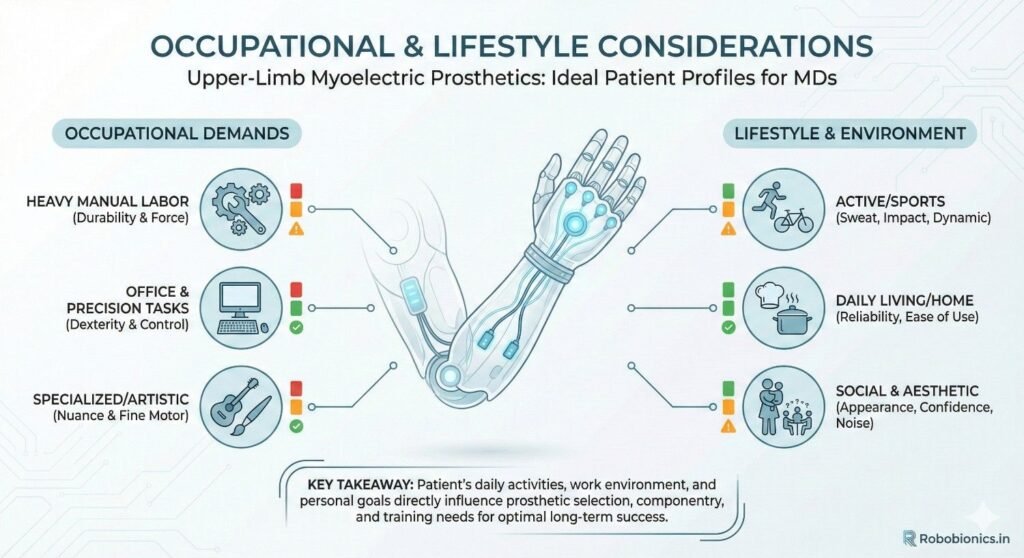
Occupational and lifestyle considerations

Work-related hand use demands

Jobs requiring fine motor control or frequent hand use benefit most from myoelectric hands.
Manual laborers may prefer durable alternatives.
Work context shapes device choice.

Daily living and social interaction

Tasks like eating, grooming, and social gestures are often easier with myoelectric hands.
Appearance can influence social confidence.
Lifestyle goals should guide selection.

Environment and maintenance capacity

Myoelectric devices need charging and basic care.
Patients must manage these tasks reliably.
Maintenance ability affects long-term success.

Age and developmental considerations

Pediatric and adolescent candidates

Children and teens can adapt well if cognitive readiness is present.
Growth requires frequent adjustments.
Family support becomes critical.

Older adults and learning pace

Age alone does not exclude candidacy, but learning pace may be slower.
Patience and support matter more than age.
Doctors should focus on adaptability, not years.

Timing after amputation

Early fitting can support brain adaptation, but readiness matters more than speed.
Delayed fitting remains effective when motivation is strong.
Timing should be individualized.

Social support and training environment

Role of family encouragement

Supportive families reinforce practice and care routines.
Overpressure can cause resistance.
Balanced support improves outcomes.

Access to rehabilitation services

Regular therapy sessions improve skill acquisition.
Limited access may slow progress.
This factor should be discussed openly.

Peer exposure and role models

Seeing others use myoelectric hands builds confidence.
Peer interaction reduces fear.
Doctors can facilitate these connections.

Setting realistic expectations

Function versus natural movement

Myoelectric hands restore function, not natural sensation.
Clear explanation prevents disappointment.
Expectation setting is clinical care.

Time required for mastery

Skill develops over months, not days.
Early progress may be subtle.
Patience is essential.

Redefining success for each patient

Success varies by individual goals.
Partial use can still be meaningful.
Clinicians should personalize outcomes.

Rehabilitation pathways for myoelectric prosthetic users

Early muscle training before device fitting

Successful myoelectric use often begins even before the prosthesis is fitted, because patients must learn how to activate and relax specific muscles in a controlled way.
Early muscle training builds awareness and confidence, which reduces frustration once the device is introduced.
Doctors who encourage pre-fitting training often see smoother transitions.

Structured learning after first fitting

Once the device is fitted, learning must follow a structured path that starts with simple open and close actions before moving to more complex grips.
Skipping basic control stages usually leads to confusion and poor long-term skill.
Structure provides predictability and safety during learning.

Role of occupational therapy in daily task training

Occupational therapy helps patients translate muscle control into real-life tasks such as eating, dressing, and object handling.
These daily wins build confidence faster than abstract exercises.
Functional success reinforces motivation.
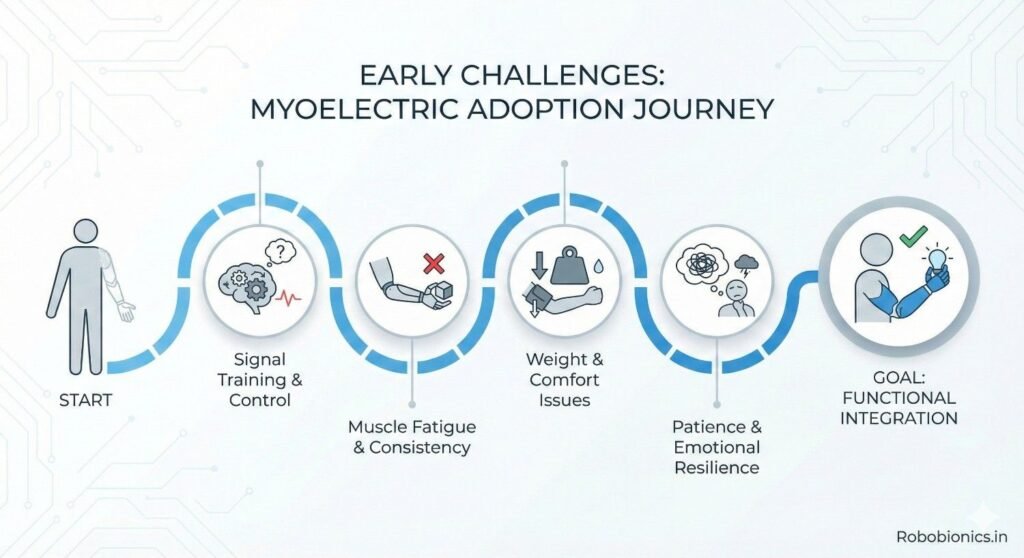
Early challenges during myoelectric adoption

Initial lack of control confidence

Many patients feel disappointed during early sessions

Many patients feel disappointed during early sessions because movements feel slow or inaccurate.
This phase is normal and temporary but must be explained clearly.
Doctors should normalize this experience to prevent early dropout.

Mental fatigue during training

Learning myoelectric control is mentally demanding, especially in the first weeks.
Patients may tire cognitively before they tire physically.
Shorter, focused sessions work better than long ones.

Comparing expectations with reality

Some patients expect instant smooth movement based on videos or demonstrations.
When reality differs, disappointment can arise.
Revisiting expectations protects morale.

Common reasons for myoelectric prosthetic failure

Poor muscle signal reliability

Inconsistent signals lead to unpredictable movement, which frustrates users.
This issue may arise from poor socket fit, fatigue, or muscle imbalance.
Technical review should always come before judging patient failure.

Low daily use after initial excitement

Some patients use the device less after the first few weeks.
This pattern often signals discomfort, fear, or unmet expectations.
Early follow-up helps identify the cause.

Difficulty integrating the prosthesis into routine

If the prosthesis remains a clinic-only device, long-term use is unlikely.
Integration into daily routines is essential.
Doctors should ask how often and where the device is used.

Long-term predictors of successful myoelectric use

Consistent practice habits

Patients who practice regularly, even briefly each day, develop smoother control over time.
Consistency matters more than session length.
Habit predicts mastery.

Adaptability to changing tasks

Myoelectric users must adjust grip and force across tasks.
Those who enjoy problem-solving adapt better.
Flexibility supports long-term success.

Comfort with device maintenance

Charging, cleaning, and basic care are part of ownership.
Patients who manage maintenance confidently experience fewer interruptions.
Practical ability supports adherence.

Comparing myoelectric and alternative prosthetic options

When body-powered devices may suit better

Some patients prefer body-powered hands due to simplicity and durability.
These devices may suit heavy labor or limited training access.
Choice should respect lifestyle needs.

Hybrid approaches and staged progression

Some users start with simpler devices and transition to myoelectric later.
This staged approach reduces overwhelm.
Progression can be planned.

Avoiding technology-driven decisions

The most advanced option is not always the best option.
Patient fit matters more than features.
Clinicians should guide, not sell.

Ethical considerations in recommending myoelectric prosthetics

Avoiding overpromise based on technology

Advanced technology can create unrealistic hope.
Doctors must ground recommendations in patient capability.
Honesty protects trust.

Respecting patient preference and autonomy

Some patients may decline myoelectric options after understanding demands.
This choice should be respected.
Autonomy is part of care.

Considering long-term sustainability

Cost, service access, and durability affect long-term success.
Sustainable solutions matter more than novelty.
Clinicians should consider the full journey.

Follow-up and reassessment over time

Skill evolution across months

Control improves gradually with practice.
Follow-up allows adjustment of training goals.
Progress should be reviewed regularly.

Changes in lifestyle or health

New jobs, health changes, or family needs can alter device use.
Reassessment ensures continued relevance.
Flexibility supports longevity.

Preventing abandonment through support

Early identification of frustration prevents abandonment.
Support and adjustment keep patients engaged.
Follow-up is preventive care.

Preparing patients for long-term adaptation

Accepting that mastery takes time

Patients should expect gradual improvement rather than sudden transformation.
This mindset reduces disappointment.
Time is a teacher.

Encouraging exploration without fear

Experimenting with grips and tasks builds skill.
Fear of mistakes limits learning.
Safe exploration supports confidence.

Reinforcing identity beyond the device

Patients should see the prosthesis as a tool, not a definition of self.
This perspective reduces emotional pressure.
Healthy identity supports resilience.
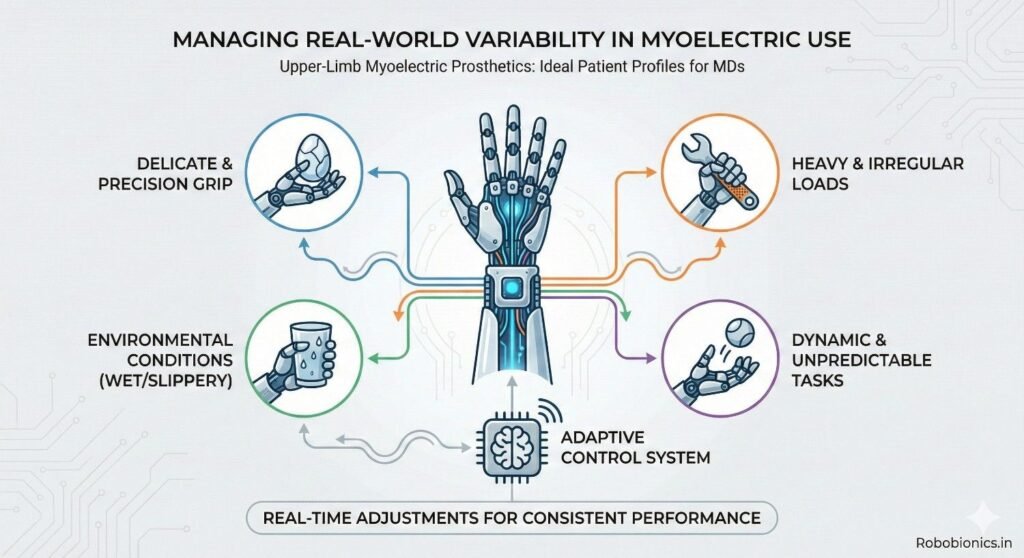
Managing real-world variability in myoelectric use

Performance differences between clinic and home

Many patients demonstrate good control during supervised clinic sessions, yet struggle to reproduce the same performance at home where distractions, fatigue, and uneven routines interfere.
This difference does not indicate failure, but rather highlights the need to assess readiness beyond controlled environments.
Doctors should ask patients how the prosthesis feels during real daily tasks, not only how it performs during therapy.

Environmental factors affecting control

Heat, sweat, dust, and humidity can affect electrode contact and signal quality, especially in Indian conditions.
Patients who can problem-solve around these challenges tend to maintain use more consistently.
Screening should include discussion of the patient’s living and working environment.

Adapting use across different contexts

A patient who succeeds with a myoelectric hand often learns when to rely on it and when to rest or switch strategies.
This adaptability supports long-term success more than rigid full-time use.
Doctors should frame flexibility as strength, not inconsistency.

Long-term adherence and prosthesis abandonment risk

Understanding why abandonment occurs

Myoelectric prosthesis abandonment rarely happens suddenly and is usually preceded by reduced daily use, frustration, or quiet disengagement.
These signs often appear weeks or months before complete non-use.
Early identification allows corrective action.

Clinical signals that predict dropout

Patients who stop practicing, avoid follow-up visits, or describe the device as “too much effort” may be struggling emotionally or technically.
These signals should prompt review of fit, expectations, and support rather than assumptions about motivation.
Timely intervention often restores engagement.

Preventing abandonment through early adjustment

Small changes in socket comfort, training pace, or daily goals can significantly improve adherence.
Doctors who encourage open discussion about difficulty reduce shame and withdrawal.
Proactive support protects long-term outcomes.

Role of expectation alignment over time

Expectations evolve after initial fitting

Patients often begin with optimistic expectations that naturally shift once daily challenges emerge.
This evolution is healthy when guided, but damaging when ignored.
Clinicians should revisit expectations at multiple stages, not only before fitting.

Managing disappointment without discouragement

When patients realize that the prosthesis will not fully replace a biological hand, disappointment may surface.
Acknowledging this honestly while highlighting functional gains helps patients recalibrate goals.
Balanced reassurance supports continued use.

Reinforcing functional wins beyond appearance

Small achievements such as holding cutlery, managing a phone, or performing work-related tasks often matter more than cosmetic outcomes.
Doctors should reinforce these functional wins consistently.
Recognition builds confidence and persistence.
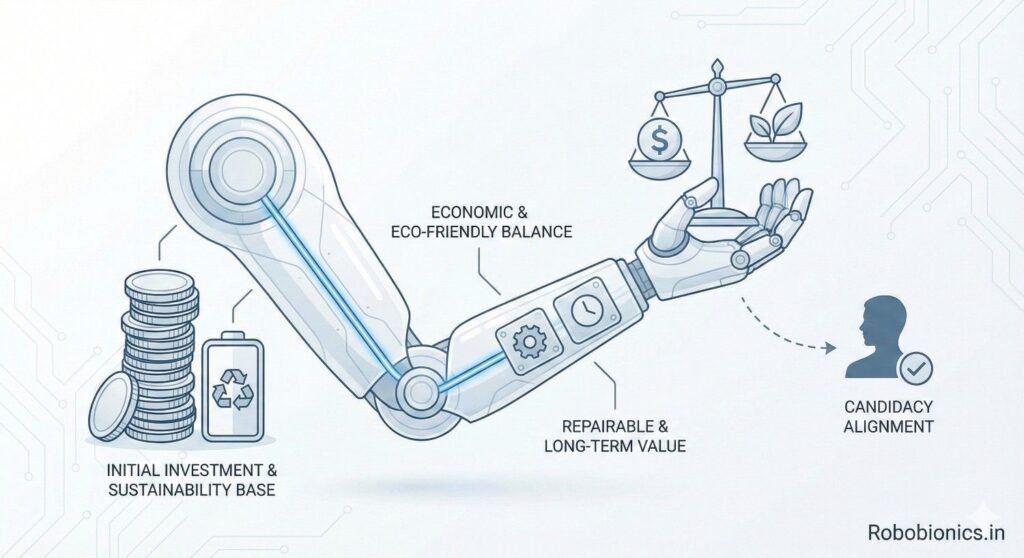
Economic and sustainability considerations in candidacy

Cost awareness as part of clinical screening

Myoelectric prosthetics require not only initial investment

Myoelectric prosthetics require not only initial investment but also long-term maintenance, servicing, and charging habits.
Patients who understand and plan for these realities cope better over time.
Financial stress can indirectly affect adherence.

Service access and follow-up feasibility

Patients living far from service centers or with limited follow-up access may struggle if frequent adjustments are needed.
This does not exclude candidacy, but requires realistic planning and device choice.
Clinicians should factor service pathways into recommendations.

Sustainability over novelty

A simpler, well-supported myoelectric solution often outperforms a complex system that cannot be maintained.
Doctors should prioritize durability and serviceability over feature count.
Long-term sustainability defines success.

Doctor-led counseling that improves outcomes

Framing myoelectric prosthetics as a skill

Patients benefit when doctors present myoelectric use as a learnable skill rather than an automatic solution.
This framing encourages patience and effort.
Skill-based framing reduces unrealistic expectations.

Normalizing difficulty and slow mastery

Patients who believe struggle is abnormal tend to disengage quickly.
Doctors who normalize difficulty as part of learning protect motivation.
Language choice matters.

Encouraging shared responsibility

When patients understand their active role in training, care, and feedback, outcomes improve.
Shared responsibility builds ownership.
Ownership sustains use.

Monitoring progress beyond motor control

Emotional response as an outcome measure

Confidence, willingness to try new tasks, and reduced avoidance often signal success earlier than technical metrics.
Doctors should monitor emotional adaptation alongside control quality.
Psychological comfort predicts durability.

Social reintegration markers

Returning to work, social interaction, or hobbies indicates meaningful prosthetic integration.
These markers often matter more to patients than grip strength.
Clinicians should ask about life participation regularly.

Adjusting goals as life changes

Life circumstances change, and prosthetic goals must evolve accordingly.
Reassessment ensures continued relevance of the device.
Adaptation sustains long-term value.

When myoelectric prosthetics are not the right choice

Recognizing mismatch early

Despite best screening, some patients discover that myoelectric use does not suit their preferences or lifestyle.
Recognizing this early prevents prolonged frustration.
Changing direction is responsible care.

Supporting alternative solutions without stigma

Choosing a different prosthetic option should never be framed as failure.
Respectful redirection preserves dignity and trust.
Clinicians should emphasize fit, not hierarchy.

Keeping the door open for future transition

Some patients may revisit myoelectric options later as circumstances change.
Leaving the option open maintains hope without pressure.
Timing matters.
A closing clinical perspective from Robobionics

Myoelectric success begins with the right patient match

At Robobionics, we have seen that upper-limb myoelectric prosthetics deliver their best outcomes when technology is matched thoughtfully to the person, not simply to the amputation level.
Patients who succeed are not defined by strength alone, but by learning ability, patience, daily needs, and emotional readiness.
Careful selection protects patients from frustration and protects clinicians from avoidable failure.

Why screening matters more than specifications

Advanced features and multiple grips mean little if the patient cannot train, adapt, and integrate the device into daily life.
When doctors screen muscle control, cognition, motivation, and lifestyle together, myoelectric prosthetics become tools for independence rather than unused equipment.
This screening is not restrictive; it is responsible care.

Setting the foundation for long-term use

Myoelectric hands reward consistency, curiosity, and gradual progress, which makes early expectation setting a powerful clinical tool.
Patients who understand that mastery takes time approach rehabilitation with patience and resilience.
Clear conversations early often decide whether the device becomes part of life or stays in a drawer.

Collaboration across the care team

Successful myoelectric adoption depends on close collaboration between doctors, therapists, prosthetists, and families.
Each team member sees different aspects of readiness and progress.
Shared insight leads to better timing, better training, and better outcomes.

Robobionics’ role in myoelectric prosthetic care

As an Indian prosthetics manufacturer, Robobionics designs myoelectric solutions like Grippy™ with a strong focus on usability, reliability, and real-world Indian conditions.
We work closely with clinicians to support patient selection, staged training, and long-term follow-up so that technology remains accessible and meaningful.
By combining thoughtful patient profiling with affordable innovation, we aim to help doctors restore function, confidence, and dignity through upper-limb myoelectric prosthetics.

Share:

More Posts

Partner With Us

REFUNDS AND CANCELLATIONS

Last updated: November 10, 2022

Thank you for shopping at Robo Bionics.

If, for any reason, You are not completely satisfied with a purchase We invite You to review our policy on refunds and returns.

The following terms are applicable for any products that You purchased with Us.

Interpretation And Definitions

Interpretation

The words of which the initial letter is capitalized have meanings defined under the following conditions. The following definitions shall have the same meaning regardless of whether they appear in singular or in plural.

Definitions

For the purposes of this Return and Refund Policy:

  • Company (referred to as either “the Company”, “Robo Bionics”, “We”, “Us” or “Our” in this Agreement) refers to Bionic Hope Private Limited, Pearl Haven, 1st Floor Kumbharwada, Manickpur Near St. Michael’s Church Vasai Road West, Palghar Maharashtra 401202.

  • Goods refer to the items offered for sale on the Website.

  • Orders mean a request by You to purchase Goods from Us.

  • Service refers to the Services Provided like Online Demo and Live Demo.

  • Website refers to Robo Bionics, accessible from https://robobionics.in

  • You means the individual accessing or using the Service, or the company, or other legal entity on behalf of which such individual is accessing or using the Service, as applicable.

Your Order Cancellation Rights

You are entitled to cancel Your Service Bookings within 7 days without giving any reason for doing so, before completion of Delivery.

The deadline for cancelling a Service Booking is 7 days from the date on which You received the Confirmation of Service.

In order to exercise Your right of cancellation, You must inform Us of your decision by means of a clear statement. You can inform us of your decision by:

  • By email: contact@robobionics.in

We will reimburse You no later than 7 days from the day on which We receive your request for cancellation, if above criteria is met. We will use the same means of payment as You used for the Service Booking, and You will not incur any fees for such reimbursement.

Please note in case you miss a Service Booking or Re-schedule the same we shall only entertain the request once.

Conditions For Returns

In order for the Goods to be eligible for a return, please make sure that:

  • The Goods were purchased in the last 14 days
  • The Goods are in the original packaging

The following Goods cannot be returned:

  • The supply of Goods made to Your specifications or clearly personalized.
  • The supply of Goods which according to their nature are not suitable to be returned, deteriorate rapidly or where the date of expiry is over.
  • The supply of Goods which are not suitable for return due to health protection or hygiene reasons and were unsealed after delivery.
  • The supply of Goods which are, after delivery, according to their nature, inseparably mixed with other items.

We reserve the right to refuse returns of any merchandise that does not meet the above return conditions in our sole discretion.

Only regular priced Goods may be refunded by 50%. Unfortunately, Goods on sale cannot be refunded. This exclusion may not apply to You if it is not permitted by applicable law.

Returning Goods

You are responsible for the cost and risk of returning the Goods to Us. You should send the Goods at the following:

  • the Prosthetic Limb Fitting Centre that they purchased the product from
  • email us at contact@robobionics.in with all the information and we shall provide you a mailing address in 3 days.

We cannot be held responsible for Goods damaged or lost in return shipment. Therefore, We recommend an insured and trackable courier service. We are unable to issue a refund without actual receipt of the Goods or proof of received return delivery.

Contact Us

If you have any questions about our Returns and Refunds Policy, please contact us:

  • By email: contact@robobionics.in

TERMS & CONDITIONS

Last Updated on: 1st Jan 2021

These Terms and Conditions (“Terms”) govern Your access to and use of the website, platforms, applications, products and services (ively, the “Services”) offered by Robo Bionics® (a registered trademark of Bionic Hope Private Limited, also used as a trade name), a company incorporated under the Companies Act, 2013, having its Corporate office at Pearl Heaven Bungalow, 1st Floor, Manickpur, Kumbharwada, Vasai Road (West), Palghar – 401202, Maharashtra, India (“Company”, “We”, “Us” or “Our”). By accessing or using the Services, You (each a “User”) agree to be bound by these Terms and all applicable laws and regulations. If You do not agree with any part of these Terms, You must immediately discontinue use of the Services.

1. DEFINITIONS

1.1 “Individual Consumer” means a natural person aged eighteen (18) years or above who registers to use Our products or Services following evaluation and prescription by a Rehabilitation Council of India (“RCI”)–registered Prosthetist.

1.2 “Entity Consumer” means a corporate organisation, nonprofit entity, CSR sponsor or other registered organisation that sponsors one or more Individual Consumers to use Our products or Services.

1.3 “Clinic” means an RCI-registered Prosthetics and Orthotics centre or Prosthetist that purchases products and Services from Us for fitment to Individual Consumers.

1.4 “Platform” means RehabConnect, Our online marketplace by which Individual or Entity Consumers connect with Clinics in their chosen locations.

1.5 “Products” means Grippy® Bionic Hand, Grippy® Mech, BrawnBand, WeightBand, consumables, accessories and related hardware.

1.6 “Apps” means Our clinician-facing and end-user software applications supporting Product use and data collection.

1.7 “Impact Dashboard™” means the analytics interface provided to CSR, NGO, corporate and hospital sponsors.

1.8 “Services” includes all Products, Apps, the Platform and the Impact Dashboard.

2. USER CATEGORIES AND ELIGIBILITY

2.1 Individual Consumers must be at least eighteen (18) years old and undergo evaluation and prescription by an RCI-registered Prosthetist prior to purchase or use of any Products or Services.

2.2 Entity Consumers must be duly registered under the laws of India and may sponsor one or more Individual Consumers.

2.3 Clinics must maintain valid RCI registration and comply with all applicable clinical and professional standards.

3. INTERMEDIARY LIABILITY

3.1 Robo Bionics acts solely as an intermediary connecting Users with Clinics via the Platform. We do not endorse or guarantee the quality, legality or outcomes of services rendered by any Clinic. Each Clinic is solely responsible for its professional services and compliance with applicable laws and regulations.

4. LICENSE AND INTELLECTUAL PROPERTY

4.1 All content, trademarks, logos, designs and software on Our website, Apps and Platform are the exclusive property of Bionic Hope Private Limited or its licensors.

4.2 Subject to these Terms, We grant You a limited, non-exclusive, non-transferable, revocable license to use the Services for personal, non-commercial purposes.

4.3 You may not reproduce, modify, distribute, decompile, reverse engineer or create derivative works of any portion of the Services without Our prior written consent.

5. WARRANTIES AND LIMITATIONS

5.1 Limited Warranty. We warrant that Products will be free from workmanship defects under normal use as follows:
 (a) Grippy™ Bionic Hand, BrawnBand® and WeightBand®: one (1) year from date of purchase, covering manufacturing defects only.
 (b) Chargers and batteries: six (6) months from date of purchase.
 (c) Grippy Mech™: three (3) months from date of purchase.
 (d) Consumables (e.g., gloves, carry bags): no warranty.

5.2 Custom Sockets. Sockets fabricated by Clinics are covered only by the Clinic’s optional warranty and subject to physiological changes (e.g., stump volume, muscle sensitivity).

5.3 Exclusions. Warranty does not apply to damage caused by misuse, user negligence, unauthorised repairs, Acts of God, or failure to follow the Instruction Manual.

5.4 Claims. To claim warranty, You must register the Product online, provide proof of purchase, and follow the procedures set out in the Warranty Card.

5.5 Disclaimer. To the maximum extent permitted by law, all other warranties, express or implied, including merchantability and fitness for a particular purpose, are disclaimed.

6. DATA PROTECTION AND PRIVACY

6.1 We collect personal contact details, physiological evaluation data, body measurements, sensor calibration values, device usage statistics and warranty information (“User Data”).

6.2 User Data is stored on secure servers of our third-party service providers and transmitted via encrypted APIs.

6.3 By using the Services, You consent to collection, storage, processing and transfer of User Data within Our internal ecosystem and to third-party service providers for analytics, R&D and support.

6.4 We implement reasonable security measures and comply with the Information Technology Act, 2000, and Information Technology (Reasonable Security Practices and Procedures and Sensitive Personal Data or Information) Rules, 2011.

6.5 A separate Privacy Policy sets out detailed information on data processing, user rights, grievance redressal and cross-border transfers, which forms part of these Terms.

7. GRIEVANCE REDRESSAL

7.1 Pursuant to the Information Technology Rules, 2021, We have given the Charge of Grievance Officer to our QC Head:
 - Address: Grievance Officer
 - Email: support@robobionics.in
 - Phone: +91-8668372127

7.2 All support tickets and grievances must be submitted exclusively via the Robo Bionics Customer Support portal at https://robobionics.freshdesk.com/.

7.3 We will acknowledge receipt of your ticket within twenty-four (24) working hours and endeavour to resolve or provide a substantive response within seventy-two (72) working hours, excluding weekends and public holidays.

8. PAYMENT, PRICING AND REFUND POLICY

8.1 Pricing. Product and Service pricing is as per quotations or purchase orders agreed in writing.

8.2 Payment. We offer (a) 100% advance payment with possible incentives or (b) stage-wise payment plans without incentives.

8.3 Refunds. No refunds, except pro-rata adjustment where an Individual Consumer is medically unfit to proceed or elects to withdraw mid-stage, in which case unused stage fees apply.

9. USAGE REQUIREMENTS AND INDEMNITY

9.1 Users must follow instructions provided by RCI-registered professionals and the User Manual.

9.2 Users and Entity Consumers shall indemnify and hold Us harmless from all liabilities, claims, damages and expenses arising from misuse of the Products, failure to follow professional guidance, or violation of these Terms.

10. LIABILITY

10.1 To the extent permitted by law, Our total liability for any claim arising out of or in connection with these Terms or the Services shall not exceed the aggregate amount paid by You to Us in the twelve (12) months preceding the claim.

10.2 We shall not be liable for any indirect, incidental, consequential or punitive damages, including loss of profit, data or goodwill.

11. MEDICAL DEVICE COMPLIANCE

11.1 Our Products are classified as “Rehabilitation Aids,” not medical devices for diagnostic purposes.

11.2 Manufactured under ISO 13485:2016 quality management and tested for electrical safety under IEC 60601-1 and IEC 60601-1-2.

11.3 Products shall only be used under prescription and supervision of RCI-registered Prosthetists, Physiotherapists or Occupational Therapists.

12. THIRD-PARTY CONTENT

We do not host third-party content or hardware. Any third-party services integrated with Our Apps are subject to their own terms and privacy policies.

13. INTELLECTUAL PROPERTY

13.1 All intellectual property rights in the Services and User Data remain with Us or our licensors.

13.2 Users grant Us a perpetual, irrevocable, royalty-free licence to use anonymised usage data for analytics, product improvement and marketing.

14. MODIFICATIONS TO TERMS

14.1 We may amend these Terms at any time. Material changes shall be notified to registered Users at least thirty (30) days prior to the effective date, via email and website notice.

14.2 Continued use of the Services after the effective date constitutes acceptance of the revised Terms.

15. FORCE MAJEURE

Neither party shall be liable for delay or failure to perform any obligation under these Terms due to causes beyond its reasonable control, including Acts of God, pandemics, strikes, war, terrorism or government regulations.

16. DISPUTE RESOLUTION AND GOVERNING LAW

16.1 All disputes shall be referred to and finally resolved by arbitration under the Arbitration and Conciliation Act, 1996.

16.2 A sole arbitrator shall be appointed by Bionic Hope Private Limited or, failing agreement within thirty (30) days, by the Mumbai Centre for International Arbitration.

16.3 Seat of arbitration: Mumbai, India.

16.4 Governing law: Laws of India.

16.5 Courts at Mumbai have exclusive jurisdiction over any proceedings to enforce an arbitral award.

17. GENERAL PROVISIONS

17.1 Severability. If any provision is held invalid or unenforceable, the remainder shall remain in full force.

17.2 Waiver. No waiver of any breach shall constitute a waiver of any subsequent breach of the same or any other provision.

17.3 Assignment. You may not assign your rights or obligations without Our prior written consent.

By accessing or using the Products and/or Services of Bionic Hope Private Limited, You acknowledge that You have read, understood and agree to be bound by these Terms and Conditions.