
Post-Op Follow-Up Schedule That Prevents Prosthetic Delays (For Clinicians)
For many clinicians, the surgery is only the first step. What happens after the operation



After surgery, the body heals in two ways at the same time. Tissues repair themselves, and movement patterns begin to change. If movement is not protected early, joints quietly stiffen, muscles shorten, and recovery slows down. These changes often go unnoticed until prosthetic training becomes difficult or delayed.
At Robobionics, working closely with surgeons, physicians, and rehabilitation teams across India, we have seen how early loss of range of motion creates long-term problems. Many prosthetic delays are not caused by wounds or pain alone, but by joints that no longer move freely. Once stiffness sets in, reversing it takes far more time and effort.
This article is written for medical doctors who guide patients through the post-operative phase. It focuses on clear, practical physician orders that preserve range of motion and prevent avoidable delays in prosthetic readiness. These insights come from real patient journeys and clinical experience, not ideal timelines.
After surgery, joints begin to stiffen within days if they are not moved properly. This stiffness develops quietly and often without pain.
By the time the wound looks healed, important movement may already be lost.
A prosthetic does not replace joint movement. It depends on it. Limited motion in the hip, knee, shoulder, or elbow directly limits prosthetic alignment and control.
Preserving motion early keeps future options open.
Many prosthetic delays are blamed on slow healing. In reality, they are caused by preventable contractures.
Clear physician orders reduce this risk significantly.
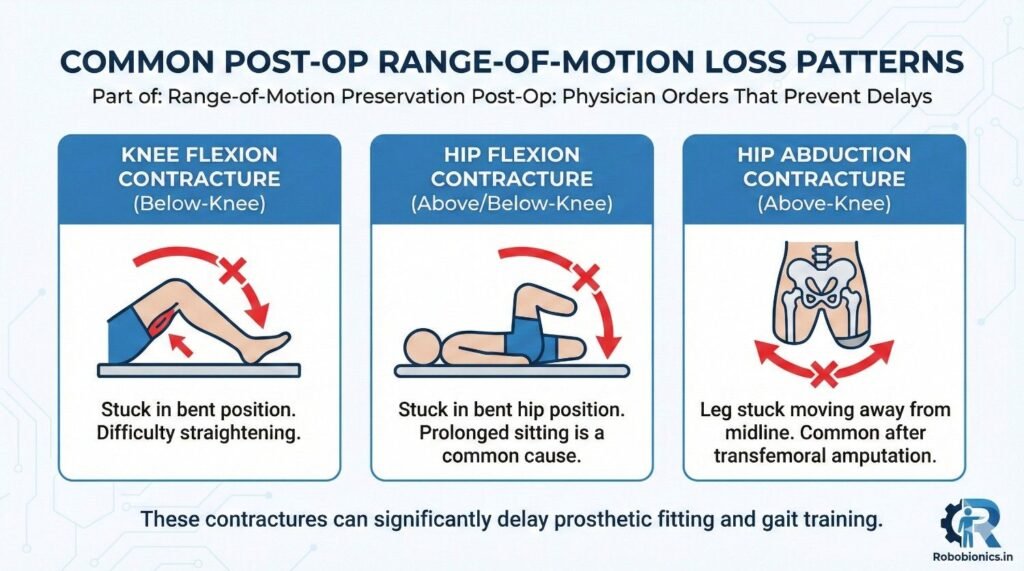
Hip and knee flexion contractures are common after lower limb surgery. They develop when patients stay seated or flexed for long periods.
Once established, these contractures delay standing and gait training.
Upper limb patients often protect the operated side, leading to shoulder and elbow stiffness.
This stiffness later limits reach, control, and prosthetic function.
Reduced limb movement often changes posture. The spine and core adapt poorly.
These changes affect balance and endurance during prosthetic use.
Patients follow what doctors emphasize. If motion is not mentioned clearly, it is often avoided.
Explicit physician orders legitimize early movement.
Many patients believe movement will harm healing. This belief increases stiffness.
Doctors must clearly state what movement is safe and necessary.
Clear orders guide nurses, therapists, and caregivers consistently.
Alignment prevents mixed messages.
This period sets the tone. Gentle positioning and passive movement can begin safely in many cases.
Delays here increase stiffness risk.
During this phase, tissues heal but joints stiffen rapidly.
Consistent daily movement is essential.
Once stiffness sets in, gains slow down.
Early prevention is always easier than later correction.
Extended sitting or pillow use under joints promotes contractures.
Doctors should specify neutral or extended positions clearly.
Alternating positions protects hip and spine motion.
Clear duration guidance improves compliance.
Simple positioning rules prevent hours of harmful posture.
Orders should be practical and realistic.
Early passive motion maintains joint health when active movement is limited.
Doctors should clarify who performs it and how often.
Active movement builds strength and control.
Clear timelines prevent overprotection.
Some movement is better than none.
Partial participation still preserves motion.
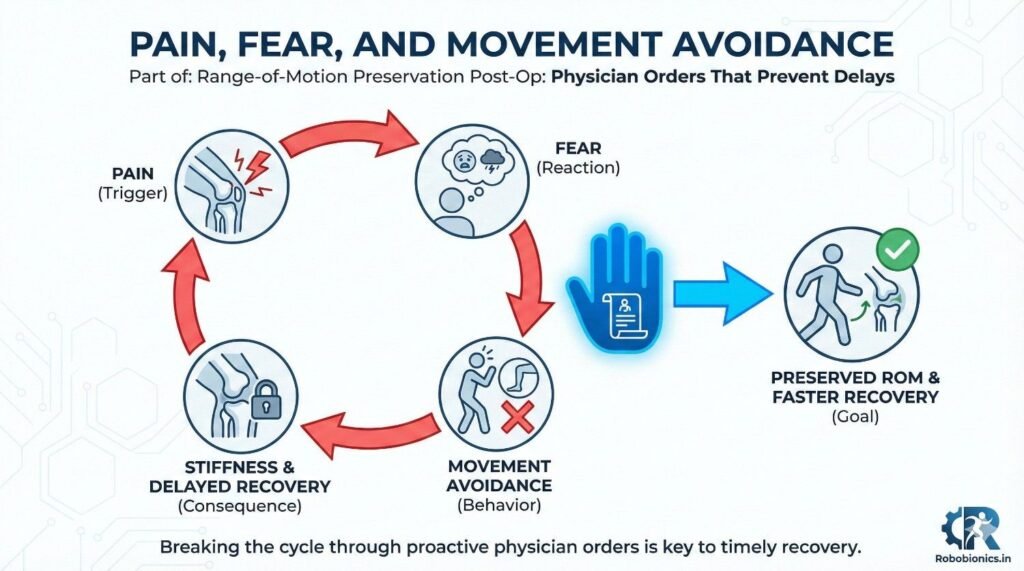
Pain causes patients to guard joints unconsciously.
Proper pain management supports movement.
Fear of damaging surgery limits effort more than pain.
Reassurance from physicians reduces fear.
Patients need to know that mild discomfort is normal.
Clear explanation prevents avoidance.
Orders should specify frequency, not just permission.
Specific guidance improves follow-through.
Moving through full available range prevents shortening.
Doctors should emphasize end-range tolerance.
Repeated documentation reinforces importance.
Consistency matters.
Therapists rely on physician guidance.
Clear orders reduce hesitation.
Some patients need modified intensity.
Doctors should remain involved.
Conflicting advice undermines compliance.
Unified communication improves outcomes.
Early loss often appears subtly.
Doctors should assess movement routinely.
Resistance signals emerging stiffness.
Early action prevents progression.
Avoidance often precedes measurable loss.
Behavior is an early warning sign.
After lower limb amputation, the hip joint becomes the main driver of posture, balance, and future gait, which makes early hip extension and abduction preservation a medical priority rather than a therapy preference.
Physician orders should clearly state daily hip extension positioning and movement expectations, because patients naturally remain in flexed positions that quietly shorten tissues and delay standing readiness.
For patients with knee involvement, loss of full extension creates immediate problems during prosthetic alignment and weight acceptance, even when strength appears adequate.
Doctors should emphasize maintaining full extension during rest and encourage controlled flexion and extension exercises that respect healing while preventing joint stiffness.
Even when the ankle is no longer present, the surrounding joints and soft tissues influence limb position and comfort inside the socket.
Clear guidance on limb positioning and residual limb mobility helps prevent rotational stiffness that later complicates prosthetic fit.
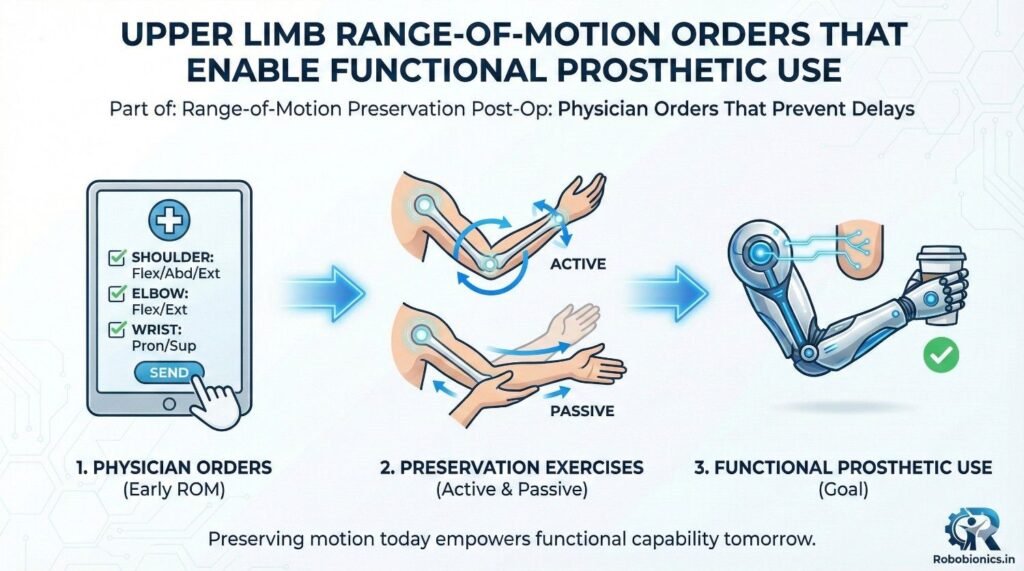
In upper limb amputations, the shoulder becomes the main functional joint, and even mild stiffness can severely limit prosthetic reach and control.
Physician orders should explicitly include daily shoulder flexion, abduction, and rotation within safe limits, rather than assuming these movements will occur naturally.
Elbow stiffness often develops due to protective guarding and sling overuse, which later limits fine control and endurance.
Doctors should clarify when slings are necessary and when elbow movement must begin to avoid unnecessary restriction.
Upper limb patients often develop neck and upper back stiffness due to altered posture and tension.
Including gentle cervical and thoracic mobility guidance prevents secondary pain that interferes with prosthetic training.
Orders such as maintain range of motion are too vague to change behavior, whereas specifying movements, frequency, and positions creates clarity and confidence.
Clear language reduces hesitation from nursing staff and therapists who may otherwise limit movement out of caution.
Stating how often and for how long movement should occur prevents underuse, especially during busy hospital routines.
Daily repetition protects joints more effectively than occasional longer sessions.
Orders should address both how patients move and how they rest, because poor resting positions undo the benefit of short exercise sessions.
This combined approach protects motion continuously.
In an effort to protect surgical sites, movement is sometimes delayed longer than necessary, allowing stiffness to develop unnoticed.
Protection and movement are not opposites and must be prescribed together.
When motion preservation is left entirely to therapy, gaps appear during non-therapy hours where poor positioning dominates.
Physician orders legitimize movement throughout the day, not only during sessions.
Early stiffness is often subtle and painless, leading to missed opportunities for quick correction.
Routine motion checks should be part of post-op medical review.
Pain medication should be used to support participation in movement, not to encourage complete rest.
Doctors should assess whether pain control improves function, not just comfort.
Patients often stop moving due to fear of pain rather than actual risk.
Explaining acceptable discomfort helps preserve motion safely.
When pain increases, modifying intensity or range is safer than stopping movement entirely.
This approach maintains joint health while respecting healing.
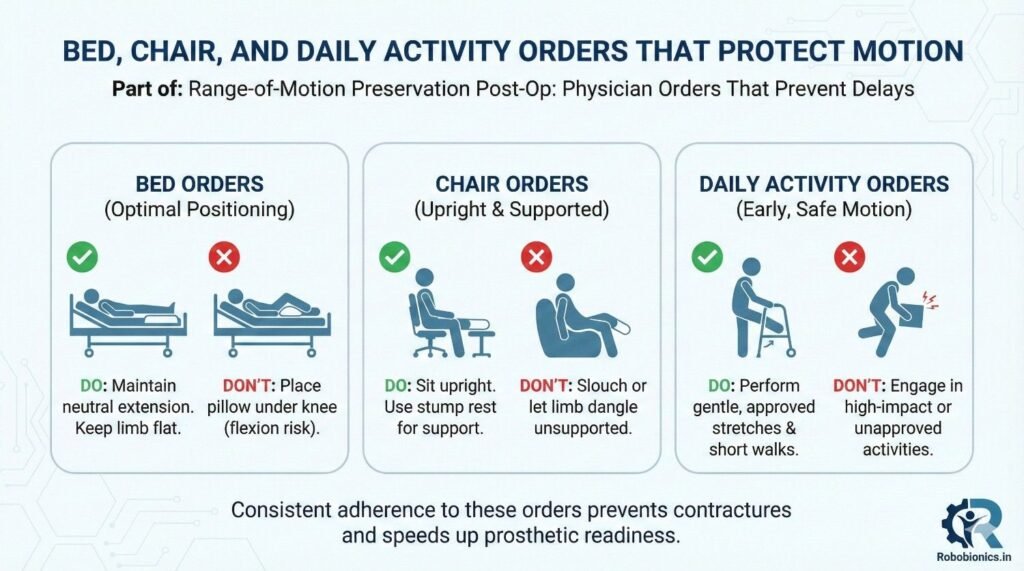
Most stiffness develops during rest, not exercise.
Clear instructions on bed and chair positioning prevent hours of joint shortening.
Remaining in one position for long periods increases stiffness.
Doctors should encourage regular position changes as part of daily care.
Simple activities like reaching, rolling, or standing transitions support motion naturally.
These activities feel less clinical and improve adherence.
Brief range-of-motion checks during rounds identify problems early.
This practice signals importance to the patient and team.
How a patient moves without instruction often reveals more than formal testing.
Guarding and avoidance signal emerging stiffness.
Small losses are easier to reverse than established contractures.
Early action saves weeks of rehabilitation later.
Families often encourage rest out of concern, unintentionally increasing stiffness.
Physician guidance helps families support safe movement.
Helping does not mean preventing movement.
Doctors should clarify how families can assist without restricting.
Early habits continue after discharge.
Clear guidance improves carryover.
Even when wounds heal well, stiffness delays prosthetic fitting, training, and confidence.
Preserving motion keeps timelines realistic.
Good joint motion allows better alignment and load distribution.
Comfort improves when joints move freely.
Patients with preserved motion learn prosthetic skills faster and with less pain.
Early physician orders protect long-term efficiency.
After the immediate post-operative phase, patients feel safer and pain often reduces, which paradoxically leads to less structured movement and more time spent resting in poor positions.
During this phase, physician orders carry even more importance because daily supervision reduces and habits begin to solidify without constant correction.
As wounds stabilize, physician orders should clearly shift language from protection-focused to preparation-focused, signaling that the body must now get ready for future prosthetic demands.
This shift helps patients understand that movement is no longer optional, but a necessary part of recovery.
In the subacute phase, joints tolerate more movement, yet stiffness can still develop if end-range positions are avoided.
Physician orders should continue to emphasize full available range, not just comfortable mid-range motion.
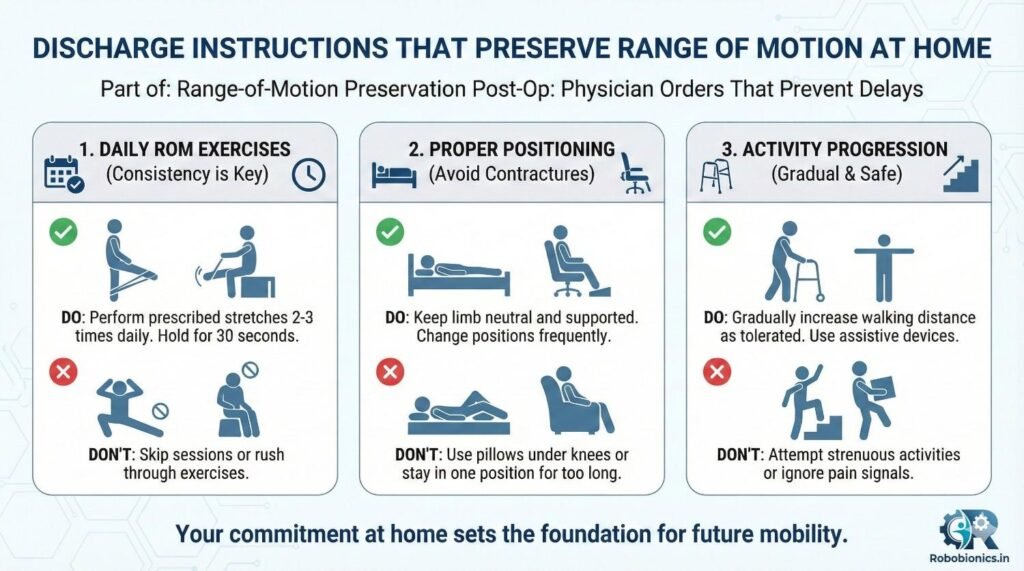
Once patients leave the hospital, professional supervision drops sharply while movement demands increase, creating a high-risk window for motion loss.
Clear discharge instructions help prevent regression during this transition.
Discharge instructions should use simple language that patients and families can recall without referring to paperwork constantly.
Short, clear movement expectations are more effective than long explanations.
Physician guidance should link motion to habits, not schedules alone.
Beds at home often lack hospital-level support, increasing the risk of prolonged flexed positions.
Doctors should give clear guidance on pillow placement and neutral alignment that works in real home settings.
Soft sofas and low chairs encourage poor posture and joint flexion.
Physician instructions should recommend firm seating and regular standing or repositioning.
Night-time is the longest continuous period of immobility.
Guidance on safe sleeping positions prevents overnight stiffness accumulation.
Most stiffness develops outside scheduled therapy sessions, during long periods of inactivity.
Physician orders should empower patients to move safely throughout the day.
Patients who understand why movement matters are more likely to self-initiate it.
Education supports independence and adherence.
Waiting for the next therapy session to move delays recovery.
Doctors should reinforce daily responsibility.
As patients resume more activity, fatigue often replaces pain as the main barrier to movement.
Doctors should address fatigue openly to prevent avoidance.
When patients feel tired, reducing intensity while maintaining frequency preserves motion better than stopping entirely.
This balance protects joints and confidence.
Linking daily movement to future prosthetic independence improves motivation during slower phases.
Purpose sustains effort.
Follow-up visits should include brief but intentional movement checks.
These checks signal continued importance.
Questions like which positions feel stiff in the morning reveal early contracture patterns.
Targeted questions improve detection.
Small changes in positioning or frequency often reverse early stiffness.
Early action prevents prolonged delay.
Limited motion increases localized pressure during prosthetic fitting.
Preserved motion protects skin integrity.
Stiff joints increase fall risk during early standing.
Maintaining motion improves safety.
Stiffness itself becomes a source of pain.
Preventing stiffness reduces future pain management needs.
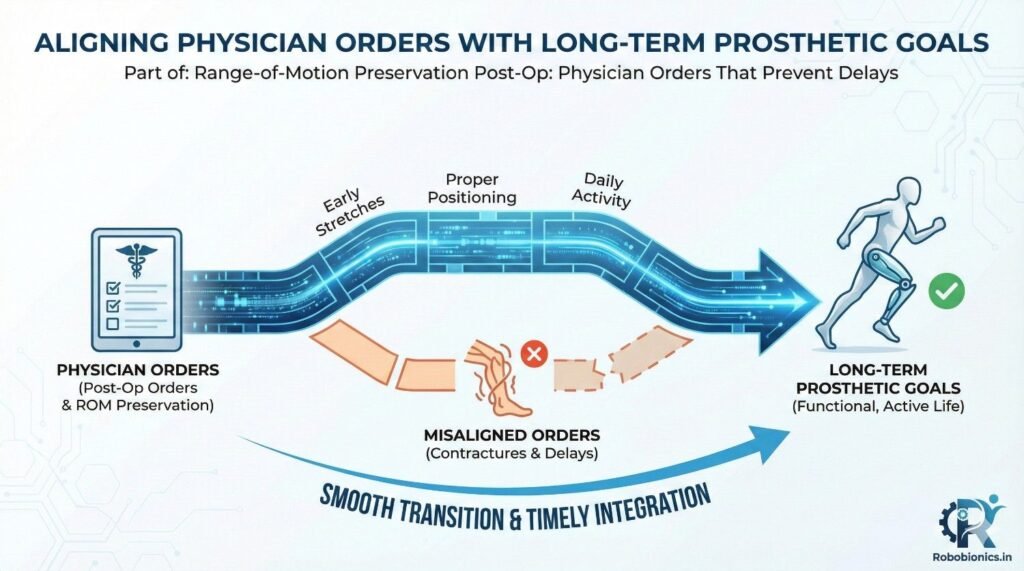
Every movement order should consider future prosthetic alignment and function.
This perspective improves relevance.
Patients follow instructions better when they understand purpose.
Explaining the prosthetic connection increases adherence.
Orders should evolve logically from surgery to prosthetic readiness.
Consistency builds trust.
When joints remain mobile, prosthetic fitting can begin as soon as wounds are ready. There is no need to pause rehabilitation to regain lost movement.
This keeps recovery timelines predictable and efficient.
Patients with preserved motion require fewer intensive therapy sessions later.
This reduces fatigue, cost, and frustration for patients and families.
Mobile joints allow smoother alignment and easier skill learning.
Training progresses faster with fewer setbacks.
Even small motion losses can permanently limit prosthetic function.
Early preservation protects long-term capability.
Free joints allow more natural posture and gait.
This reduces energy use and pain.
Preserving motion in one joint protects others from overuse.
This prevents secondary injuries.
Patients with preserved motion experience fewer complications that require readmission.
Clear orders reduce system burden.
When physician expectations are clear, therapy and nursing teams work more confidently.
Efficiency improves across care settings.
Patients feel more capable and informed.
This improves trust in care.
Many patients believe rest equals recovery.
Doctors must reframe motion as part of healing.
Understanding why motion matters increases compliance.
Education replaces fear with purpose.
Patients who move independently recover faster.
Autonomy builds confidence.
Pain-sensitive patients still need movement, but with careful pacing.
Doctors should adjust intensity, not frequency.
Older patients lose motion faster and regain it slower.
Early, consistent orders are especially important.
Competing injuries often limit movement.
Clear prioritization helps preserve key joints.
Patients often fear harming the surgical site.
Clear reassurance reduces avoidance.
Patients need specific guidance, not general advice.
Doctors should clarify expectations.
Missing one day is not failure, but repeated avoidance is risky.
Doctors should encourage return without guilt.
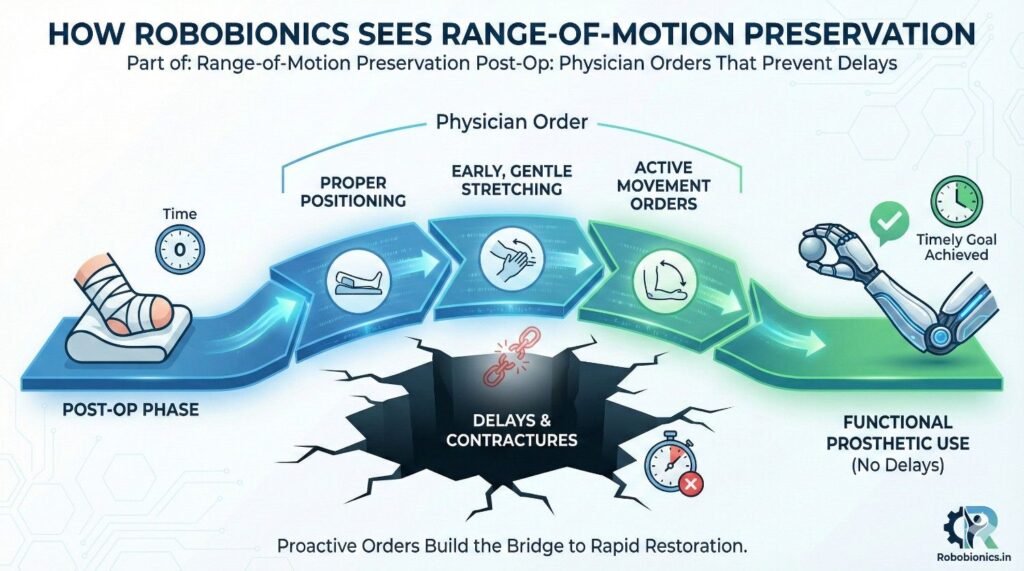
At Robobionics, we design for the bodies we see, not ideal models.
Preserved motion allows better design outcomes.
We see how stiffness delays fitting and training.
These lessons inform our collaboration with doctors.
Early medical guidance improves prosthetic success.
Collaboration benefits patients most.
Range of motion is often treated as a rehabilitation detail, something to be addressed later once wounds have healed and pain has settled. In reality, range-of-motion preservation is a medical priority that begins immediately after surgery. The physician orders written in the early post-operative period quietly shape whether joints remain mobile or stiffen over time. These decisions determine how smoothly a patient moves toward prosthetic readiness.
Stiffness develops faster than most people realize. Joints begin to lose motion within days when held in flexed or guarded positions. This loss is often painless at first, making it easy to miss. By the time stiffness becomes obvious, weeks may have passed, and reversing it requires significant effort. Early prevention is always simpler, safer, and more effective than later correction.
For patients who will use prosthetics, joint mobility is not optional. Prosthetics rely on the movement of existing joints to function well. Limited motion restricts alignment options, increases energy use, and causes discomfort during training. Even advanced prosthetic designs cannot compensate for stiff hips, knees, shoulders, or elbows. Preserving motion keeps future options open.
Physician orders play a unique role in this process. Patients trust and follow what doctors emphasize. When movement is clearly prescribed, it feels safe and necessary. When movement is mentioned vaguely or not at all, avoidance becomes the default. Clear orders guide not only patients, but also nurses, therapists, and caregivers, creating consistency across the care team.
Effective orders do more than permit movement. They specify positioning, frequency, and purpose. They explain what is safe, what discomfort is expected, and what should be avoided. They balance protection with preparation. This clarity reduces fear and prevents well-meaning overprotection that leads to stiffness.
The subacute phase and discharge period are especially vulnerable times. As supervision decreases and routines change, motion can be lost quickly if expectations are unclear. Discharge instructions that focus on simple, repeatable movement habits help patients maintain progress at home. Linking movement to daily routines increases adherence without adding complexity.
Range-of-motion preservation also protects against secondary problems. Stiff joints increase pain, alter posture, raise fall risk, and place extra stress on other joints. These issues complicate prosthetic fitting and training, often leading to delays that frustrate patients and providers alike. Preserving motion early prevents these downstream effects.
From a system perspective, clear physician orders reduce complications, shorten rehabilitation timelines, and improve patient satisfaction. Patients who maintain motion require fewer corrective interventions and adapt to prosthetics more smoothly. This efficiency benefits individuals and healthcare systems alike.
At Robobionics, our work with patients across India has shown us how often prosthetic delays begin long before fitting. They begin in the early post-operative period, when movement was not clearly protected. We also see how powerful early physician guidance can be in changing this trajectory. Patients who receive clear, consistent movement orders arrive at prosthetic fitting stronger, more confident, and better prepared.
Ultimately, preserving range of motion is about protecting possibility. It protects the possibility of timely prosthetic fitting, comfortable use, and long-term independence. The physician orders written today shape the options available tomorrow. When those orders prioritize movement with clarity and care, they prevent delays, reduce complications, and support better outcomes for every patient.
For many clinicians, the surgery is only the first step. What happens after the operation
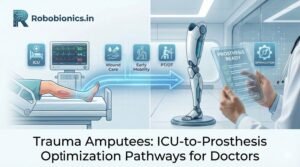
For trauma amputees, the journey does not begin at the prosthetic clinic. It begins much

Amputation after cancer is not just a surgical event. It is the end of one

When a child loses a limb, the challenge is never only physical. A child’s body