
Post-Op Follow-Up Schedule That Prevents Prosthetic Delays (For Clinicians)
For many clinicians, the surgery is only the first step. What happens after the operation



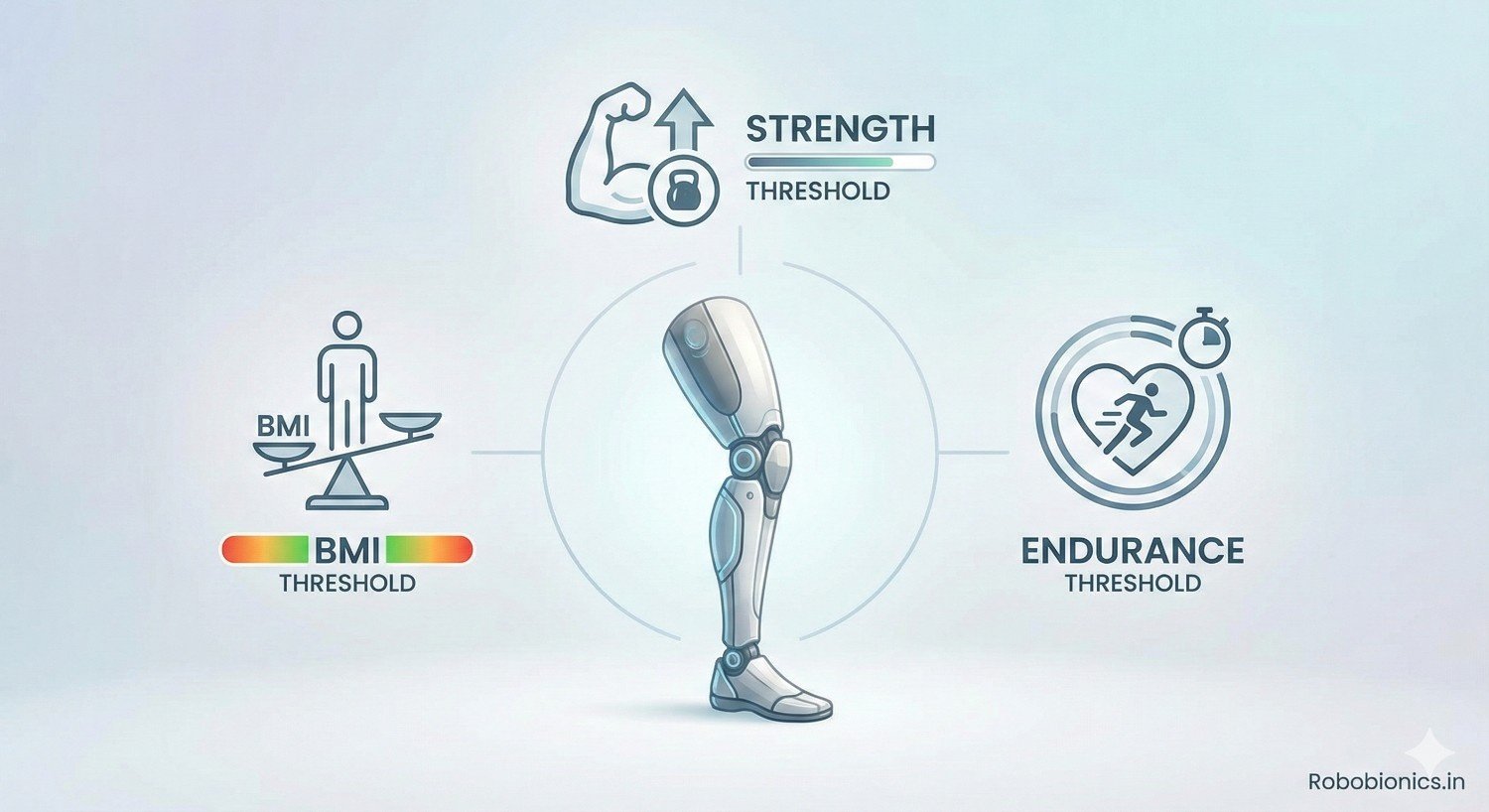
Prosthetic success does not depend on technology alone. It depends on whether the body can safely carry, control, and sustain the effort that a prosthetic demands every day. For doctors and rehabilitation teams, this means looking closely at body weight, muscle strength, and endurance before prescribing a device. These physical factors shape safety, comfort, and long-term use more than many people realize.
At Robobionics, we work with patients across a wide range of body types and fitness levels. We have seen strong outcomes when physical readiness is assessed honestly, and poor outcomes when it is ignored. A prosthetic that is too demanding for the body often leads to pain, falls, and early abandonment. A prosthetic that matches the body’s capacity supports confidence and independence.
This article focuses on BMI, strength, and endurance thresholds for prosthetic candidates. It explains why these factors matter, how doctors can assess them in simple ways, and how thresholds guide safe decision-making. The goal is not to exclude patients, but to prepare them properly and choose solutions that work in real life.
If you are a clinician, therapist, or part of an amputee care team, this guide will help you make clearer, safer choices. When physical readiness is understood and respected, prosthetic care becomes more effective and more humane.
A prosthetic is not just worn, it is actively carried and controlled by the body throughout the day.
Every step, transfer, or reach places extra load on muscles, joints, and the heart.
If the body cannot tolerate this load, even the best prosthetic becomes unsafe.
Doctors often focus on healing and limb shape, but physical capacity determines daily success.
Thresholds help predict whether the body can handle repeated effort without breakdown.
Ignoring these limits increases pain, fatigue, and fall risk.
Patients who meet basic physical thresholds tend to use their prosthetic more consistently.
They recover faster after activity and feel more confident during movement.
This consistency is key for long-term acceptance.
When thresholds are not met, use becomes irregular.
The prosthetic may be worn only briefly or avoided altogether.
Matching capacity to demand protects outcomes.
Physical thresholds are not meant to deny care.
They help doctors plan preparation, timing, and device choice.
Many patients can improve their readiness with guided support.
Using thresholds early allows safer progression.
Patients understand what needs to improve and why.
This transparency builds trust and motivation.
BMI gives a general view of body weight relative to height.
In prosthetic care, it helps estimate load on joints and sockets.
Higher BMI increases mechanical stress during movement.
While BMI is not perfect, it is a useful starting point.
It helps doctors anticipate fitting challenges and endurance demands.
BMI should always be interpreted alongside other factors.
Very low BMI often means low muscle mass and poor cushioning.
These patients may experience pressure pain and skin breakdown.
Socket comfort becomes harder to achieve.
Low body reserve also affects endurance.
Fatigue appears quickly during training.
Strength building may be needed before fitting.
Doctors should assess nutritional status carefully.
Improving weight and muscle supports safer prosthetic use.
Timing matters more than speed.
High BMI increases force through the prosthetic and remaining limb.
This stresses joints, skin, and cardiovascular systems.
Energy cost of walking rises significantly.
Socket suspension may be less stable with higher weight.
Skin folds and sweating increase irritation risk.
Fit must be managed carefully.
High BMI does not exclude prosthetic use.
It requires stronger components and endurance planning.
Weight management improves outcomes over time.
There is no single BMI cutoff for prosthetic eligibility.
However, extremes at either end increase risk.
Context always matters.
Doctors should consider BMI trends, not just numbers.
Recent weight loss or gain affects readiness.
Stability is often more important than absolute value.
BMI should be discussed openly with patients.
Clear explanation reduces stigma.
Shared understanding improves cooperation.
Heavier patients require components rated for higher loads.
This affects durability and safety.
Using under-rated components increases failure risk.
For low BMI patients, softer interfaces may be needed.
Pressure distribution becomes critical.
Component choice must match body composition.
BMI helps guide these technical decisions.
It protects both patient and device.
Thoughtful selection improves longevity.
Certain BMI-related issues suggest waiting before fitting.
Poor wound healing, skin fragility, or extreme fatigue are signs.
These indicate limited tolerance.
Delaying fitting allows targeted preparation.
Nutrition, conditioning, and medical optimization help.
This improves later success.
Explaining the reason for delay is essential.
Patients accept waiting when benefits are clear.
Honesty prevents frustration.
Strength controls balance, posture, and movement efficiency.
A prosthetic amplifies weakness if muscles cannot stabilize it.
Falls often result from strength deficits, not device failure.
Key muscle groups differ by amputation level.
Hips, core, and shoulders often compensate.
Weakness here limits safety.
Doctors should assess functional strength.
Simple movements reveal real capacity.
This guides safe planning.
Lower limb prosthetic use demands strong hips and core.
These muscles control weight shift and stance.
Knee stability depends on them.
Patients must stand, turn, and recover balance.
Without adequate strength, effort skyrockets.
Fatigue leads to unsafe movement.
Strength testing should focus on functional tasks.
Chair rises and step control are informative.
These predict walking safety.
Upper limb prosthetics rely on shoulder and trunk strength.
Lifting, positioning, and control require endurance.
Weak shoulders limit functional reach.
Many patients compensate with the opposite limb.
Overuse injuries may develop.
Balanced strength reduces strain.
Doctors should assess bilateral capacity.
This supports realistic expectations.
Strength guides device complexity.
Rather than isolated muscle grades, doctors should use functional benchmarks.
Tasks like repeated sit-to-stand or supported balance tell more.
These reflect real-life demands.
Patients who struggle with basic tasks may not tolerate prosthetic load.
This signals need for conditioning first.
Preparation reduces risk.
Benchmarks should be explained clearly.
Patients appreciate concrete goals.
This improves engagement.
After amputation, strength often becomes uneven.
One side works harder than the other.
This imbalance affects prosthetic control.
Compensation may hide weakness initially.
Over time, pain and fatigue appear.
Early detection prevents injury.
Doctors should assess both sides carefully.
Symmetry improves efficiency.
Balanced strength supports long-term use.
Sometimes healing is complete but strength is not.
This is a common reason for early failure.
Strength deficits should not be ignored.
Delaying fitting to build strength is protective.
It avoids negative learning and fear.
Patients progress faster later.
Clear explanation is essential.
Patients must understand the benefit.
This builds trust in the process.
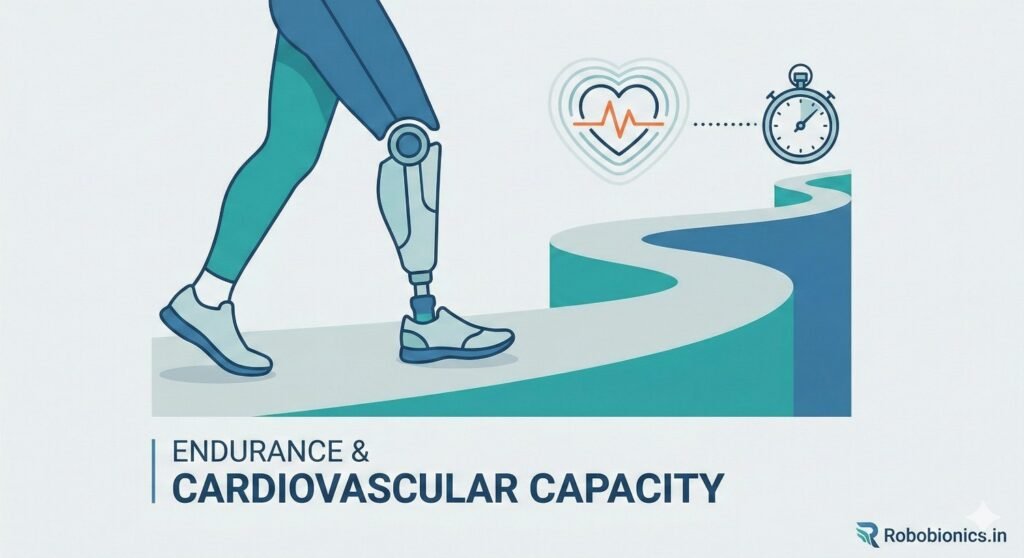
Prosthetic use requires sustained effort, not short bursts.
Walking with a prosthetic increases energy use.
Endurance determines how long activity can be maintained.
Patients with poor endurance tire quickly.
Fatigue affects balance and judgment.
This increases fall risk.
Endurance is often underestimated.
Doctors should assess it intentionally.
It predicts real-world use.
Prosthetic walking demands more from the heart and lungs.
Energy cost rises with amputation level and BMI.
Patients with heart or lung disease are affected more.
Short clinic walks may appear fine.
Longer daily use tells a different story.
Assessment should reflect daily life.
Doctors should consider medical history carefully.
Cardiac clearance may be needed.
Safety must guide decisions.
Many patients start strong and fade quickly.
This reveals limited endurance reserve.
Training must respect this pattern.
Ignoring fatigue leads to setbacks.
Rest becomes part of progress.
Gradual build-up improves tolerance.
Endurance thresholds guide pacing.
They protect long-term success.
Overload harms confidence.
Doctors do not need complex equipment.
Timed walking or standing tasks provide insight.
Recovery time is equally important.
Patients who recover slowly may struggle daily.
This indicates limited reserve.
Endurance building may be needed first.
Assessments should be repeated.
Consistency matters more than peak effort.
Patterns guide planning.
Dizziness, breathlessness, or confusion signal overload.
These should not be ignored.
They indicate unsafe demand.
Doctors must stop training when signs appear.
Pushing through fatigue is dangerous.
Safety outweighs speed.
Clear communication helps patients understand limits.
This prevents guilt or frustration.
Education supports cooperation.
Endurance can often be improved.
Pre-prosthetic conditioning is valuable.
It prepares the body gradually.
Simple activities build tolerance.
Consistency matters more than intensity.
Progress should be monitored.
Improved endurance shortens later rehab.
Patients feel more capable.
Preparation pays off.
BMI, strength, and endurance interact constantly.
A patient may be strong but lack endurance.
Another may have endurance but poor strength.
Decisions must consider all three together.
Focusing on one creates blind spots.
Integrated assessment improves accuracy.
Doctors should view thresholds as a system.
Balance matters more than extremes.
Holistic planning improves safety.
High BMI with low endurance is common.
Low BMI with poor strength also appears often.
Each pattern needs a different approach.
Recognizing these patterns helps tailor preparation.
Generic plans fail.
Specific strategies succeed.
Patients benefit from personalized explanations.
They understand their own profile.
Engagement improves.
Goals must match what the body can sustain.
This may mean limited walking or part-time use.
Realistic goals prevent disappointment.
As capacity improves, goals can expand.
Progress should feel earned.
This builds confidence.
Doctors should revisit goals regularly.
Capacity changes over time.
Flexibility is key.
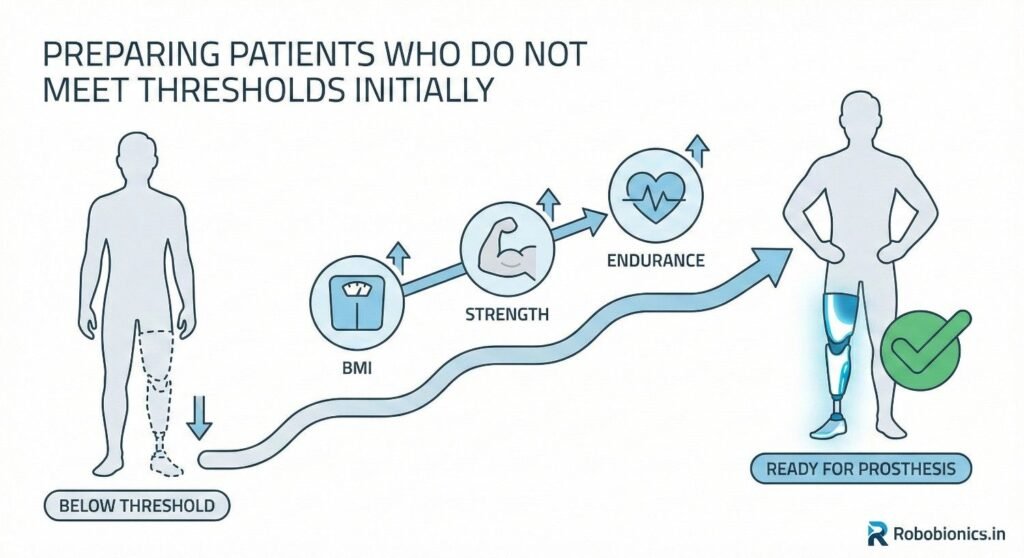
Many patients do not meet BMI, strength, or endurance thresholds at the first assessment, and this should never be framed as failure.
Physical readiness is a process that unfolds over time, especially after illness, injury, or long periods of inactivity.
When doctors present readiness as something that can be built, patients feel encouraged rather than rejected.
This mindset shift is critical for motivation.
Patients are more willing to engage in conditioning when they understand it leads directly to safer prosthetic use.
Clear explanation transforms delay into purposeful preparation.
Targeted conditioning before prosthetic fitting improves outcomes significantly.
Exercises focus on core stability, remaining limb strength, and basic cardiovascular tolerance.
These areas directly support prosthetic control.
Programs should be simple and consistent.
Overly complex routines reduce adherence.
Progress should be gradual and closely monitored.
Doctors should work closely with therapists during this phase.
Regular feedback helps adjust intensity.
Small gains compound over time.
BMI-related challenges often reflect nutritional or medical issues.
Poor nutrition limits muscle gain and endurance.
Addressing this early improves physical readiness.
Medical optimization may include managing anemia, pain, or breathing issues.
These factors quietly reduce capacity.
Treating them improves training response.
Doctors should coordinate with nutritionists and physicians.
Integrated care accelerates readiness.
The body performs better when supported holistically.
Prosthetic weight directly affects endurance and joint stress.
Heavier devices increase energy use during walking and standing.
Patients with limited endurance feel this quickly.
For borderline candidates, lighter designs improve tolerance.
Reduced weight lowers fatigue and improves confidence.
This can be the difference between use and abandonment.
Doctors should consider total system weight, not just components.
Every gram matters for some patients.
Design choices should reflect physical reserve.
Socket design must match body composition and strength.
Low BMI patients need careful pressure spread to avoid pain.
High BMI patients need secure suspension to control movement.
Poor socket match increases effort and discomfort.
This drains endurance and reduces wear time.
Thresholds guide safer socket strategies.
Doctors should expect more adjustments in borderline cases.
Frequent review prevents injury.
Comfort supports consistency.
Components are rated for specific weight and activity levels.
Using components near their limits increases wear and failure risk.
This is especially important in high BMI patients.
Doctors must ensure ratings exceed patient demands.
Safety margins protect both user and device.
Under-rating is a common but avoidable mistake.
Strength and endurance also guide component choice.
Higher demand requires more robust systems.
Matching ratings prevents breakdown.
Early prosthetic training should respect endurance limits.
Long sessions may appear productive but cause delayed fatigue.
This leads to soreness and reduced confidence.
Short, frequent sessions are often safer.
They allow recovery between efforts.
Learning improves when fatigue is controlled.
Doctors should guide therapists on pacing.
Endurance thresholds inform session length.
Structure prevents overload.
Recovery time is a key endurance indicator.
Patients who need excessive rest after training may be overloaded.
This signals need for adjustment.
Doctors should ask about next-day fatigue.
Lingering exhaustion suggests poor tolerance.
Plans should be revised promptly.
Good recovery predicts sustainable use.
It shows the body is adapting.
This is a positive sign.
Daily wear time should increase slowly.
Jumping to full-day use too soon overwhelms the body.
This often leads to setbacks.
Incremental increases allow tissues to adapt.
Muscles and joints need time.
Patience improves durability.
Doctors should set clear milestones.
Patients appreciate structured progression.
This builds trust and confidence.
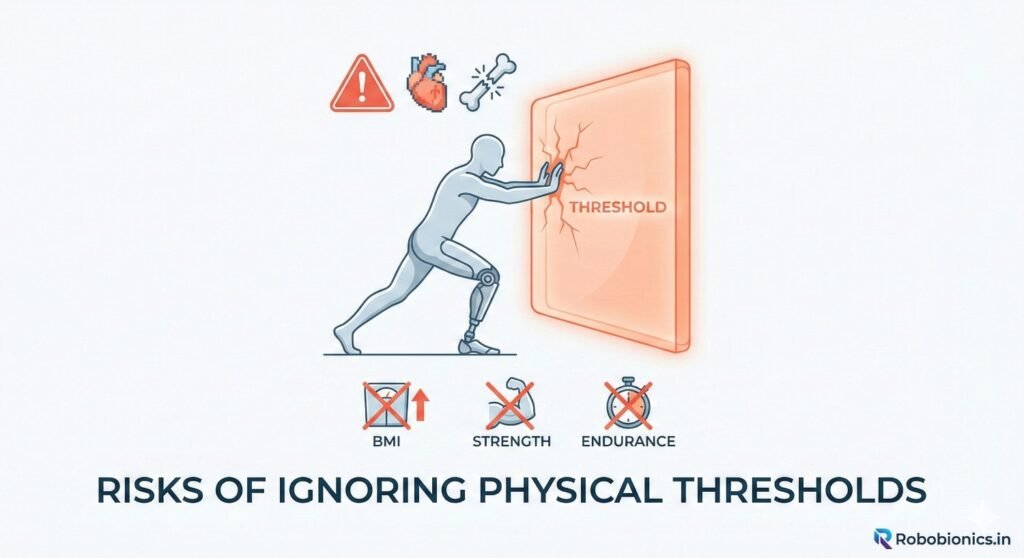
When strength or endurance is inadequate, balance suffers.
Falls become more likely, especially in lower limb users.
Injuries delay recovery significantly.
Falls also damage confidence.
Fear reduces willingness to continue training.
Prevention is far easier than recovery.
Thresholds exist to reduce this risk.
Ignoring them undermines safety.
Doctors must advocate for caution.
Compensating for weakness or poor endurance stresses other joints.
Back pain, knee pain, and shoulder strain are common results.
These issues often appear weeks later.
Chronic pain reduces prosthetic use.
Patients begin avoiding activity.
This leads to deconditioning.
Early threshold-based planning prevents these cycles.
Balanced load protects the body.
Comfort supports consistency.
One of the most common outcomes of ignoring thresholds is abandonment.
Patients stop using the prosthetic because it feels exhausting or painful.
This is often misinterpreted as lack of motivation.
In reality, the body is signaling overload.
Listening to these signals matters.
Threshold-based planning prevents wasted effort.
Abandonment also affects emotional health.
Patients feel they have failed.
Proper planning avoids this harm.
Discussions about BMI, strength, and endurance must be handled carefully.
Patients may feel judged if language is poorly chosen.
Doctors should focus on safety and success.
Explaining thresholds as protective tools helps.
Patients understand that readiness prevents injury.
Respect builds cooperation.
Avoid medical jargon during discussion.
Simple explanations work best.
Clarity reduces anxiety.
Goals should be specific and achievable.
For example, improving standing time or reducing fatigue.
Concrete targets feel manageable.
Shared goals create partnership.
Patients feel involved in decisions.
This increases adherence.
Doctors should celebrate small improvements.
Progress motivates continued effort.
Positive reinforcement matters.
Physical readiness takes time.
Doctors must be honest about this.
Unrealistic timelines lead to frustration.
Explaining why time is needed builds patience.
Patients accept delays when reasons are clear.
Trust strengthens the therapeutic relationship.
Timelines should remain flexible.
Bodies respond differently.
Adaptation improves outcomes.
Older adults often have lower strength and endurance reserves.
BMI may not reflect muscle quality accurately.
Functional testing becomes more important.
Thresholds may be lower, but safety margins higher.
Simple designs and shorter use periods work better.
Goals should reflect daily needs.
Doctors should reassess more frequently.
Capacity can change quickly.
Close monitoring protects safety.
Heart, lung, and metabolic diseases reduce endurance.
These conditions limit prosthetic tolerance.
Thresholds must reflect medical reality.
Collaboration with physicians is essential.
Medical optimization improves readiness.
Ignoring illness increases risk.
Prosthetic goals may need adjustment.
Part-time use may be appropriate.
Quality of life guides decisions.
Bilateral amputees face higher physical demand.
Strength and endurance thresholds must be higher.
Training is more intensive.
Preparation time is often longer.
Patience is essential.
Rushing leads to failure.
Doctors should plan staged fitting.
One step at a time improves success.
Thresholds guide progression.
BMI, strength, and endurance are not fixed.
They change with age, illness, and activity level.
Regular reassessment is necessary.
Weight gain or loss affects socket fit.
Strength changes affect balance.
Endurance shifts affect daily use.
Doctors should schedule periodic reviews.
This prevents surprises.
Proactive adjustment supports longevity.
When capacity declines, goals must adapt.
Reducing wear time or simplifying components may help.
This is not failure but adaptation.
When capacity improves, progression is possible.
Upgrading components may be appropriate.
Flexibility keeps care relevant.
Doctors should normalize these changes.
Patients feel less discouraged.
Adaptation supports long-term use.
Ongoing activity maintains capacity.
Strength and endurance need regular input.
Sedentary habits lead to decline.
Doctors should encourage sustainable activity.
Simple routines work best.
Consistency matters more than intensity.
Education supports independence.
Patients learn to manage their bodies.
This empowers long-term success.
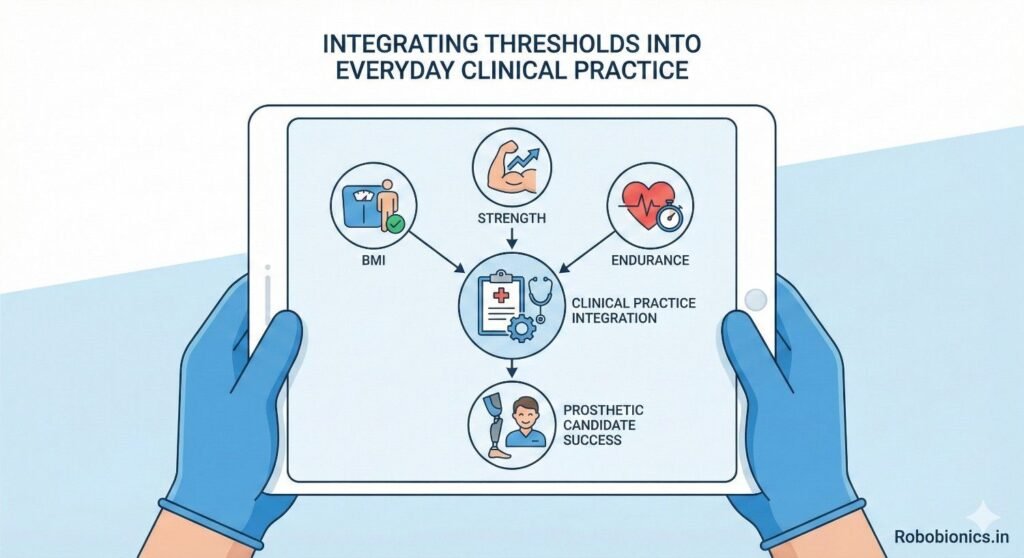
BMI, strength, and endurance should be assessed as routinely as wound healing and limb shape.
When these checks become standard, patients are not singled out or surprised.
Routine assessment normalizes physical readiness as part of safe prosthetic care.
Doctors can use simple tools and observations during regular visits.
This avoids the need for complex testing.
Consistency improves decision quality and documentation.
Embedding thresholds into routine care also improves team alignment.
Therapists, prosthetists, and doctors work from the same baseline.
This reduces mixed messages and confusion.
Threshold-based planning works best when the entire care team shares information.
Strength and endurance findings should inform prosthetic design and training plans.
Clear communication prevents mismatched expectations.
Doctors play a key role in coordinating this process.
By sharing threshold insights early, they guide safer decisions.
Collaboration improves efficiency and outcomes.
Regular case reviews help adjust plans as capacity changes.
This keeps care responsive.
Team alignment protects patient safety.
Clear documentation of BMI, strength, and endurance supports continuity of care.
It allows future providers to understand decision reasoning.
This is especially important in long rehabilitation journeys.
Progress notes should track trends rather than isolated values.
Improvement or decline matters more than single measurements.
Trends guide timely intervention.
Good documentation also supports patient communication.
Patients can see their own progress.
This reinforces motivation and trust.
Physical thresholds should guide, not dictate, decisions.
Rigid cutoffs ignore individual context and potential.
Ethical care requires flexibility.
Doctors must avoid bias based on body size or fitness level.
Every patient deserves individualized assessment.
Thresholds must be applied with judgment.
Context includes age, goals, and support systems.
Numbers alone never tell the full story.
Human insight remains essential.
The purpose of thresholds is safety, not denial.
They help prevent harm and wasted effort.
This must be communicated clearly.
When thresholds are not met, the response should be support.
Preparation and conditioning are the next steps.
Exclusion is rarely the answer.
Patients feel respected when doctors explain this approach.
Trust improves cooperation.
Ethical framing strengthens outcomes.
Ethical care includes reassessment.
What is unsafe today may be safe later.
Capacity can improve with time and effort.
Doctors should plan reassessment points.
This keeps options open.
Hope remains realistic and grounded.
Revisiting decisions also prevents stagnation.
Care evolves with the patient.
Flexibility is a sign of quality care.
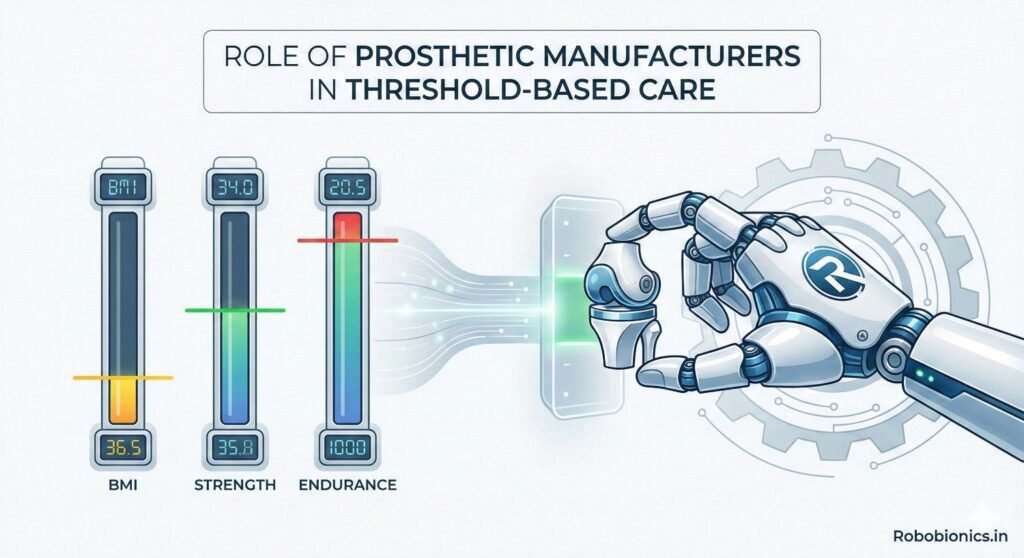
Manufacturers influence how demanding a prosthetic is.
Design choices affect weight, energy cost, and control effort.
These directly impact threshold tolerance.
At Robobionics, we focus on creating designs that respect physical limits.
Lightweight structures and efficient mechanics reduce strain.
Design must serve the body, not challenge it.
Listening to clinical feedback helps refine designs.
Real-world use reveals true demand.
Collaboration improves products.
Manufacturers should provide clear information about component limits.
Weight ratings, activity levels, and intended use must be transparent.
This supports safe prescription.
Clinicians rely on accurate data.
Ambiguity increases risk.
Clear guidance protects patients.
Educational support also matters.
Training clinicians on proper matching improves outcomes.
Knowledge strengthens partnerships.
Prosthetic needs change as physical capacity changes.
Manufacturers must support adjustments and upgrades.
Long-term service matters.
Accessible maintenance reduces downtime.
Reliable support encourages continued use.
Consistency builds trust.
A long-term view aligns with patient journeys.
Care does not end at fitting.
Support must continue.
Physical readiness is the foundation of safe prosthetic use.
BMI, strength, and endurance shape how the body responds to daily demand.
When these factors are assessed honestly, outcomes improve.
At Robobionics, we have seen that respecting physical thresholds prevents injury, frustration, and abandonment.
Patients who are prepared physically adapt faster and use their prosthetics more consistently.
Preparation protects both body and confidence.
Thresholds are not barriers.
They are guides that help patients succeed.
When used with care, clarity, and compassion, they turn prosthetic technology into a true tool for independence rather than a source of strain.
For many clinicians, the surgery is only the first step. What happens after the operation

For trauma amputees, the journey does not begin at the prosthetic clinic. It begins much

Amputation after cancer is not just a surgical event. It is the end of one

When a child loses a limb, the challenge is never only physical. A child’s body