
Post-Op Follow-Up Schedule That Prevents Prosthetic Delays (For Clinicians)
For many clinicians, the surgery is only the first step. What happens after the operation




Every doctor who treats severe limb injury faces one of the hardest choices in medicine. Should the limb be saved at all costs, or should amputation followed by a prosthesis be considered early? This is not just a medical question. It is a life question. It affects pain, function, money, time, dignity, and the future of the patient and their family.
In India, this decision carries even more weight. Patients often pay from their own pocket. Follow-ups may be irregular. Rehab access may be limited. A choice that looks right in the operation theatre can feel very different five years later. This article is written for doctors who want clarity, not theory. We will look at limb salvage versus amputation with prosthesis through a cost–utility lens, using simple language and real clinical thinking. The goal is not to push one option, but to help you choose better, case by case.
The choice between limb salvage and amputation is rarely clear-cut, even for experienced doctors who have managed hundreds of trauma or infection cases.
On one side is the emotional pull to save the limb, which often feels like saving identity, wholeness, and hope.
On the other side is the reality of prolonged treatment, repeated surgeries, ongoing pain, and uncertain function.
Doctors carry not only medical responsibility here, but also moral weight, because this choice reshapes a person’s life path.
In India, clinical decisions do not exist in a controlled system with guaranteed follow-up and insurance coverage.
Many patients travel long distances, miss appointments, or stop treatment due to cost or family pressure.
A limb salvage plan that depends on multiple surgeries and strict rehab may fail simply because the system cannot support it.
Understanding this context is essential before discussing cost–utility in any meaningful way.
Doctors are trained to save life and limb, and this instinct is deeply rooted in medical culture.
However, saving a limb does not always mean saving function, comfort, or independence.
Cost–utility analysis helps step back from emotion and look at outcomes over time.
It does not remove compassion, but it adds structure to a very human decision.
Cost–utility analysis is often misunderstood as a way to cut costs or deny care.
In truth, it is a method to understand how much real life benefit a treatment delivers over time.
It asks whether the pain, time, effort, and money invested actually improve the patient’s daily life.
For doctors, this aligns closely with the idea of meaningful recovery, not just survival.
Utility refers to how useful a life feels to the person living it.
Can they walk without fear, work without pain, and live without constant medical dependence?
A limb that is present but painful and weak may have low utility.
A prosthetic limb that restores stable function may offer higher utility, even after amputation.
Doctors see patients long after surgery, when complications, frustration, and regret appear.
Utility focuses attention on these later stages, not just the immediate surgical outcome.
By thinking in utility terms, doctors can better prepare patients for what lies ahead.
This leads to more honest counseling and better long-term trust.

Limb salvage aims to preserve the patient’s own limb through reconstruction, fixation, grafting, and soft tissue coverage.
When successful, it can maintain sensation, body image, and a sense of completeness.
In ideal settings, salvage can lead to acceptable function and satisfaction.
This potential makes salvage an attractive option at first glance.
Salvage rarely involves a single surgery, especially in trauma or infection cases.
Patients may undergo multiple procedures over months or even years.
Each surgery brings risk of infection, non-union, stiffness, and chronic pain.
The physical and emotional toll accumulates quietly over time.
Even after technically successful salvage, function may remain limited.
Joint stiffness, muscle weakness, nerve damage, and deformity are common.
Patients may walk, but with pain, limp, or heavy dependence on support devices.
This functional uncertainty plays a major role in long-term utility.
Initial surgery costs are only the beginning of limb salvage expenses.
Implants, repeat surgeries, hospital stays, antibiotics, and imaging add up quickly.
In India, many of these costs are paid out of pocket.
Families may sell assets or take loans to continue treatment.
Time away from work is one of the biggest hidden costs.
Patients may be unable to earn for months or years.
Caregivers also lose workdays while supporting hospital visits and recovery.
These losses deeply affect household stability and mental health.
Not all salvage attempts succeed.
Some end in delayed amputation after years of treatment.
In such cases, patients bear the full cost of salvage and still require a prosthesis later.
From a cost–utility view, this is the worst outcome.
Chronic pain is common after complex salvage procedures.
Pain reduces mobility, sleep quality, and emotional well-being.
Even if the limb is preserved, constant pain lowers daily life satisfaction.
Utility drops when pain becomes a central feature of life.
Salvaged limbs often require braces, walking aids, or frequent medical care.
This ongoing dependency can feel restrictive and frustrating for patients.
Loss of independence affects self-esteem and social participation.
Utility is shaped as much by autonomy as by anatomy.
Repeated hospital visits and uncertain outcomes create emotional fatigue.
Patients may feel stuck in a cycle of treatment without closure.
Anxiety and depression are not uncommon in long salvage journeys.
These psychological effects strongly influence perceived quality of life.
Amputation is often seen as a failure, but modern medicine tells a different story.
In many cases, it is a planned step toward stable recovery and function.
When done thoughtfully, amputation can shorten suffering and speed rehabilitation.
This reframing is crucial for honest doctor–patient discussions.
Amputation outcomes are often more predictable than salvage outcomes.
Healing timelines, complication risks, and rehab pathways are clearer.
This predictability allows better planning for patients and families.
From a utility perspective, certainty has real value.
Despite its benefits, amputation carries strong emotional impact.
Patients may grieve the loss of a body part deeply.
Doctors must recognize and respect this grief.
Utility improves only when emotional support is part of care.
Amputation usually involves fewer surgeries than salvage.
Hospital stays are often shorter and more defined.
This reduces prolonged medical expenses.
Costs become more predictable early in the process.
Prosthetic costs vary widely based on function and technology.
However, Indian-made solutions have improved affordability significantly.
When planned early, prosthetic fitting can be integrated smoothly into rehab.
This integration improves both cost control and outcomes.
Prostheses require maintenance and periodic replacement.
These costs should be discussed clearly with patients from the start.
However, they are often spaced out and easier to plan for.
Predictable costs support better financial coping.
Many patients regain stable mobility and hand function with prosthetics.
They can return to work, travel, and manage daily tasks independently.
This independence strongly boosts perceived quality of life.
Utility rises when patients feel capable again.
Compared to failed or painful salvage, amputation may reduce chronic pain.
Medical visits become less frequent once rehab stabilizes.
Patients often describe relief from ending prolonged treatment cycles.
This relief plays a major role in long-term satisfaction.
Initial emotional distress after amputation is common.
However, many patients adapt well with proper counseling and support.
Seeing functional progress helps rebuild confidence.
Utility improves as identity reshapes around ability rather than loss.
Short-term results can be misleading in both limb salvage and amputation cases.
In the first few months, limb salvage may look promising because the limb is still present, while amputation may appear harsh and final.
However, doctors know that real outcomes reveal themselves over years, not during discharge summaries.
Cost–utility analysis forces us to stretch the timeline and ask how life actually unfolds.
At five years, many salvaged limbs show signs of wear that were not visible early on.
Arthritis, implant fatigue, chronic infection, and nerve pain may slowly emerge.
Patients often adjust expectations downward and accept limitations they once hoped to overcome.
Utility at this stage depends heavily on pain control and coping ability.
By five years, many amputees with good prosthetic support reach a stable rhythm of life.
They understand their device, know its limits, and plan work and travel accordingly.
Follow-ups become routine rather than urgent.
This stability often translates into consistent quality of life scores.
Salvaged limbs may allow walking, but endurance is often limited by pain or stiffness.
Patients may avoid long distances, uneven ground, or crowded spaces.
With a well-fitted prosthesis, gait may be more energy-efficient and predictable.
Endurance matters greatly for work and social participation.
In upper limb salvage, fine motor control is often compromised by nerve or tendon damage.
Even after reconstruction, grip strength and coordination may remain poor.
Modern prosthetic hands can restore functional grip patterns reliably.
For many patients, this reliability outweighs the loss of biological tissue.
Return to work is one of the strongest indicators of utility.
Salvage patients may return late or with restricted duties.
Amputees with appropriate prosthetics often resume work sooner and more consistently.
This difference has deep economic and emotional impact.

Young patients often have higher expectations and physical demands.
They may struggle more with partial function and chronic pain.
In such cases, early amputation with prosthesis may offer higher long-term utility.
Doctors should weigh future decades, not just immediate outcomes.
Older patients may tolerate prolonged salvage poorly.
Diabetes, vascular disease, and poor healing increase complication risk.
A clear, well-planned amputation may reduce medical stress.
Utility improves when treatment aligns with physical resilience.
Patients with unstable income or limited family support face unique challenges.
Long salvage timelines may be impossible to sustain financially.
Predictable pathways often serve these patients better.
Doctors must factor social reality into medical decisions.
Not every limb is salvageable in a meaningful way.
Doctors should distinguish between technical possibility and functional likelihood.
If function is unlikely, salvage may not serve the patient well.
Honesty at this stage prevents future regret.
Ask whether the patient can realistically complete prolonged treatment.
Consider travel distance, financial buffer, and rehab access.
A good plan in a weak system often fails.
Utility suffers when systems collapse mid-treatment.
Patients deserve to understand both options from the start.
Present amputation as a treatment option, not a last punishment.
Clear explanations reduce shock and resistance later.
Shared decisions improve acceptance and outcomes.
Doctors sometimes frame amputation as “giving up,” which adds emotional burden.
This language can trap patients in prolonged suffering.
Neutral, respectful language supports clearer thinking.
Words shape choices more than we realize.
Abstract explanations are rarely enough.
Patients benefit from understanding daily life scenarios.
Explain how walking, working, and resting may feel after each path.
Visualization improves informed consent.
Family members often influence decisions strongly.
They may prioritize limb preservation due to emotion or stigma.
Doctors should gently bring utility and burden into family discussions.
Aligned families support better long-term outcomes.

Long medical journeys strain household finances.
Repeated expenses erode savings and increase debt.
Amputation pathways often limit this erosion.
Utility includes financial peace, not just physical function.
When a working adult is disabled long-term, children and spouses are affected.
Education, nutrition, and mental health can suffer.
Doctors rarely see these downstream effects, but they are real.
Cost–utility analysis brings them into view.
From a broader view, prolonged disability reduces workforce participation.
Stable rehabilitation restores productivity.
While doctors focus on individuals, systems feel these effects.
Utility has social dimensions too.
Some injuries have high salvage success with good function.
When soft tissue and nerves are intact, outcomes can be excellent.
In such cases, salvage may deliver high utility.
Doctors should recognize and pursue these opportunities.
Patients with insurance, rehab access, and family support tolerate salvage better.
They can complete long treatment plans more reliably.
Utility improves when care continuity is strong.
Context can turn salvage into a good choice.
Some patients deeply value limb preservation despite limitations.
When fully informed, this preference should be respected.
Utility is personal and subjective.
Doctors guide, but patients choose.
In cases with massive tissue damage or uncontrolled infection, salvage risks are high.
Delays may worsen outcomes and increase suffering.
Early amputation can shorten recovery and stabilize life sooner.
Utility often favors decisiveness here.
Repeated failure drains hope, money, and resilience.
At some point, continuation causes more harm than benefit.
Doctors must recognize this turning point.
Timely change of course can restore dignity.
When follow-up is uncertain, complex salvage plans are risky.
Predictable pathways perform better in weak systems.
Utility depends on completion, not intention.
Realism protects patients.
Doctors may struggle with feelings of failure after recommending amputation.
Medical training reinforces limb preservation as success.
But success should be defined by life quality.
This shift requires emotional maturity.
Doctors who follow patients long-term often change perspectives.
Seeing chronic pain and regret teaches powerful lessons.
Experience refines judgment beyond textbooks.
Cost–utility thinking grows with exposure.
These decisions are heavy and isolating.
Peer discussion and case reviews help.
Shared learning reduces individual burden.
Better decisions emerge from collective wisdom.
For many years, decisions around limb salvage were made when prosthetic options were heavy, uncomfortable, and limited in function.
Doctors were trained at a time when prostheses often caused more frustration than freedom, which naturally pushed thinking toward saving the biological limb at almost any cost.
Today, this assumption is outdated, especially in the Indian context where locally made prosthetics have improved in comfort, control, and affordability.
Modern prosthetic care changes long-term outcomes in ways that were not possible a decade ago.
One of the strongest advantages of amputation with prosthesis is predictability, which is often undervalued in clinical decision-making.
While limb salvage outcomes vary widely depending on healing, infection control, and patient adherence, prosthetic pathways offer clearer timelines and milestones.
Patients and families find psychological comfort in knowing what the next six months or one year is likely to look like.
This sense of control contributes meaningfully to overall quality of life and utility.
Modern prostheses are designed to perform the same way every day, which supports routine and confidence.
Patients learn movement patterns and build habits that do not change unpredictably due to pain flare-ups or mechanical failure of salvaged joints.
This consistency allows people to plan work, travel, and social activities with less fear.
From a cost–utility view, consistency often matters more than peak performance.
Imported prosthetic systems were once the only option for advanced function, but their high cost limited access and long-term sustainability.
Indian manufacturers have narrowed this gap by focusing on essential function, durability, and service support rather than unnecessary complexity.
This shift has made advanced prosthetic care realistic for a much larger patient population.
As a result, the utility of amputation pathways has increased significantly in recent years.
When doctors evaluate prosthetic costs, it is important to look beyond the initial fitting.
Maintenance, servicing, and replacement cycles all influence long-term affordability.
Indian-made prosthetics often perform better in this regard because service is local and downtime is shorter.
Lower disruption translates directly into better functional outcomes and higher utility.
Prosthetic success depends heavily on access to timely adjustments and repairs.
When patients can reach service centers easily, minor issues do not become major setbacks.
This accessibility reduces frustration and abandonment.
From a cost–utility perspective, good service support amplifies the value of the prosthesis itself.
Upper limb salvage can preserve appearance, but functional outcomes are often limited by nerve damage and stiffness.
Patients may retain a limb that looks intact but cannot perform useful tasks independently.
This mismatch between appearance and function can be emotionally challenging.
Modern prosthetic hands now offer reliable grip patterns that restore meaningful daily use.
From a utility standpoint, being able to eat, dress, and work independently often outweighs the value of preserving biological tissue.
Patients frequently report that functional independence matters more than how the limb looks.
When prosthetic function meets daily needs reliably, quality of life improves substantially.
Doctors should weigh function more heavily than anatomy in these cases.
Upper limb decisions require especially careful counseling because expectations are often high.
Doctors should explain likely functional limits of salvage and realistic capabilities of prosthetics.
Clear discussions prevent disappointment and improve acceptance.
Utility improves when expectations match outcomes.

Walking on a salvaged limb with pain or deformity can require high energy expenditure.
Patients may tire easily and avoid activity, which reduces participation and fitness.
A well-fitted prosthetic limb often allows more efficient movement.
Better endurance supports work and social life, increasing utility.
Unstable salvaged limbs increase fall risk, especially on uneven surfaces common in Indian environments.
Fear of falling limits confidence and independence.
Prosthetic limbs with good alignment and support can offer greater stability.
Safety is a key but often overlooked component of quality of life.
Lower limb amputees often show steady improvement as skills develop.
In contrast, salvaged limbs may deteriorate due to joint wear or chronic infection.
This divergence becomes more apparent over time.
Long-term trajectories matter greatly in cost–utility analysis.
Whether a limb is salvaged or replaced with a prosthesis, rehabilitation determines final function.
Surgery sets the stage, but rehab writes the story.
Inadequate rehab can erase the benefits of even the best surgical work.
Utility depends on follow-through, not just technique.
Salvage often requires prolonged, painful rehabilitation with uncertain payoff.
Patients may lose motivation over time, especially when progress is slow.
Amputation rehab, while challenging, often follows clearer goals and timelines.
This clarity supports adherence and better outcomes.
Rehab access varies widely across India.
Travel distance, cost, and work obligations limit participation.
Simpler rehab pathways often perform better in real-world conditions.
Utility improves when rehab demands match patient capacity.
Advanced prosthetic technology delivers value only when patients are trained well.
Without proper guidance, even good devices remain underused.
Doctors should consider training support when recommending prosthetic options.
Utility depends on skill, not just hardware.
Educated patients manage expectations and devices better.
They report problems early and engage actively in rehab.
This proactive behavior reduces complications and abandonment.
Education is one of the most cost-effective interventions available.
Close collaboration between doctors and prosthetists improves outcomes.
Aligned goals and shared information reduce errors and delays.
This teamwork strengthens the entire care pathway.
Cost–utility improves when silos break down.
Doctors are trained to measure success by surgical metrics.
However, patients measure success by how life feels afterward.
Cost–utility analysis bridges this gap.
It encourages doctors to define success more broadly.
When doctors stay involved beyond surgery, decisions improve.
Follow-up reveals the real impact of choices.
This feedback loop sharpens judgment over time.
Utility thinking grows with responsibility.
Young doctors learn from what seniors emphasize.
If value, function, and quality of life are prioritized, future care improves.
Cost–utility concepts should be part of clinical teaching.
This prepares doctors for modern practice.

The most useful question is not whether a limb can be saved, but whether saving it will allow the patient to live a stable, independent, and dignified life.
This shift in questioning changes the entire decision process and moves the focus from surgical possibility to long-term utility.
When doctors frame discussions this way, patients also begin to think beyond the operation and toward life after recovery.
This alignment reduces confusion and regret later.
Doctors can mentally map limb salvage and amputation as two parallel life paths rather than sequential steps.
Each path has its own timeline, risks, costs, and expected daily experience.
By laying these out clearly, doctors help patients understand that amputation is not a failure, but an alternative strategy.
Clarity at this stage improves shared decision-making.
Certain signs suggest that limb salvage may deliver poor utility despite technical success.
Severe nerve damage, extensive soft tissue loss, repeated infections, and unstable social support all reduce the chances of good long-term outcomes.
When these red flags are present, doctors should pause and reconsider the default push toward salvage.
Early honesty prevents prolonged suffering.
Doctors should begin with biological and functional realities rather than cost alone.
Expected pain levels, likely range of motion, and risk of repeated interventions shape long-term quality of life.
When functional outcomes are likely to be limited, utility drops regardless of limb preservation.
Clinical realism is the foundation of value-based care.
Cost–utility analysis must include the patient’s ability to sustain treatment.
Income stability, family support, and access to follow-up care strongly influence outcomes.
A plan that collapses financially or socially delivers poor utility.
Doctors should feel responsible for considering these realities.
Availability of rehabilitation services and prosthetic support varies widely.
Doctors should choose pathways that the local system can support well.
Strong systems amplify outcomes, while weak systems undermine even good plans.
Utility depends on system fit.
Patients handle difficult news better when it is shared early and honestly.
Introducing amputation as a valid option from the beginning reduces shock if salvage fails.
This approach builds trust and preserves the therapeutic relationship.
Patients appreciate clarity more than false hope.
Cost–utility concepts should be translated into daily life examples.
Doctors can explain how each option affects work, rest, travel, and family roles.
When patients understand how life may look, decisions feel more real and less abstract.
This clarity supports informed consent.
Doctors should allow space for grief, fear, and uncertainty.
Rushing decisions without emotional support leads to resistance and regret.
Involving counselors or peer support can help patients adapt.
Utility improves when emotional needs are respected.
Families often fear social stigma and long-term dependence.
They may push for limb salvage even when outcomes are uncertain.
Doctors should acknowledge these fears without reinforcing them.
Respectful dialogue opens the door to rational discussion.
Doctors can gently guide families back to the patient’s daily experience.
Asking how the patient will live, work, and cope over years shifts focus.
This reframing often clarifies why certain options make more sense.
Utility becomes easier to understand when grounded in life stories.
Hidden doubts and half-truths create conflict later.
Clear documentation and open discussion reduce blame and mistrust.
Families cope better when they feel included and informed.
Transparency protects everyone involved.

Doctors who follow patients long-term gain invaluable insight.
They see which decisions lead to satisfaction and which lead to regret.
This experience refines future judgment.
Cost–utility thinking deepens with follow-up.
Not every outcome will be good, even with careful planning.
Doctors should reflect without harsh self-judgment.
Learning, not guilt, improves care quality.
Utility improves when clinicians grow from experience.
Discussing cases with colleagues builds shared wisdom.
Patterns emerge that no single doctor can see alone.
These insights strengthen collective decision-making.
Collaboration improves value for patients.
Healthcare systems are slowly moving from procedure counts to outcome measures.
Doctors who think in cost–utility terms are better prepared for this shift.
Patient-centered outcomes will increasingly guide policy and funding.
Clinical leadership is needed in this transition.
Affordable, functional prosthetics are changing what is possible after amputation.
This progress makes early, planned amputation a more viable option in many cases.
Doctors should stay informed about these advances.
Knowledge expands treatment choices.
Doctors have a unique role in protecting patients from unnecessary suffering.
Balanced, value-based decisions serve both individuals and society.
Cost–utility analysis supports this ethical responsibility.
Thoughtful care leaves lasting impact.
Every limb decision carries weight that extends far beyond the operation theatre.
It shapes years of pain or comfort, dependence or independence, struggle or stability.
Cost–utility analysis does not replace clinical judgment; it sharpens it.
By looking honestly at long-term outcomes, doctors honor both science and humanity.
At RoboBionics, we work closely with clinicians across India and see how thoughtful decisions change lives.
When amputation is chosen with clarity and followed by the right prosthetic support, patients often rebuild life faster and with greater confidence.
The goal is never to choose amputation or salvage by default, but to choose wisely, case by case, with courage and compassion.
For many clinicians, the surgery is only the first step. What happens after the operation
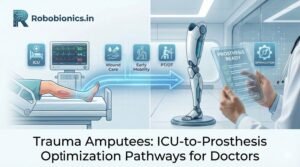
For trauma amputees, the journey does not begin at the prosthetic clinic. It begins much

Amputation after cancer is not just a surgical event. It is the end of one

When a child loses a limb, the challenge is never only physical. A child’s body