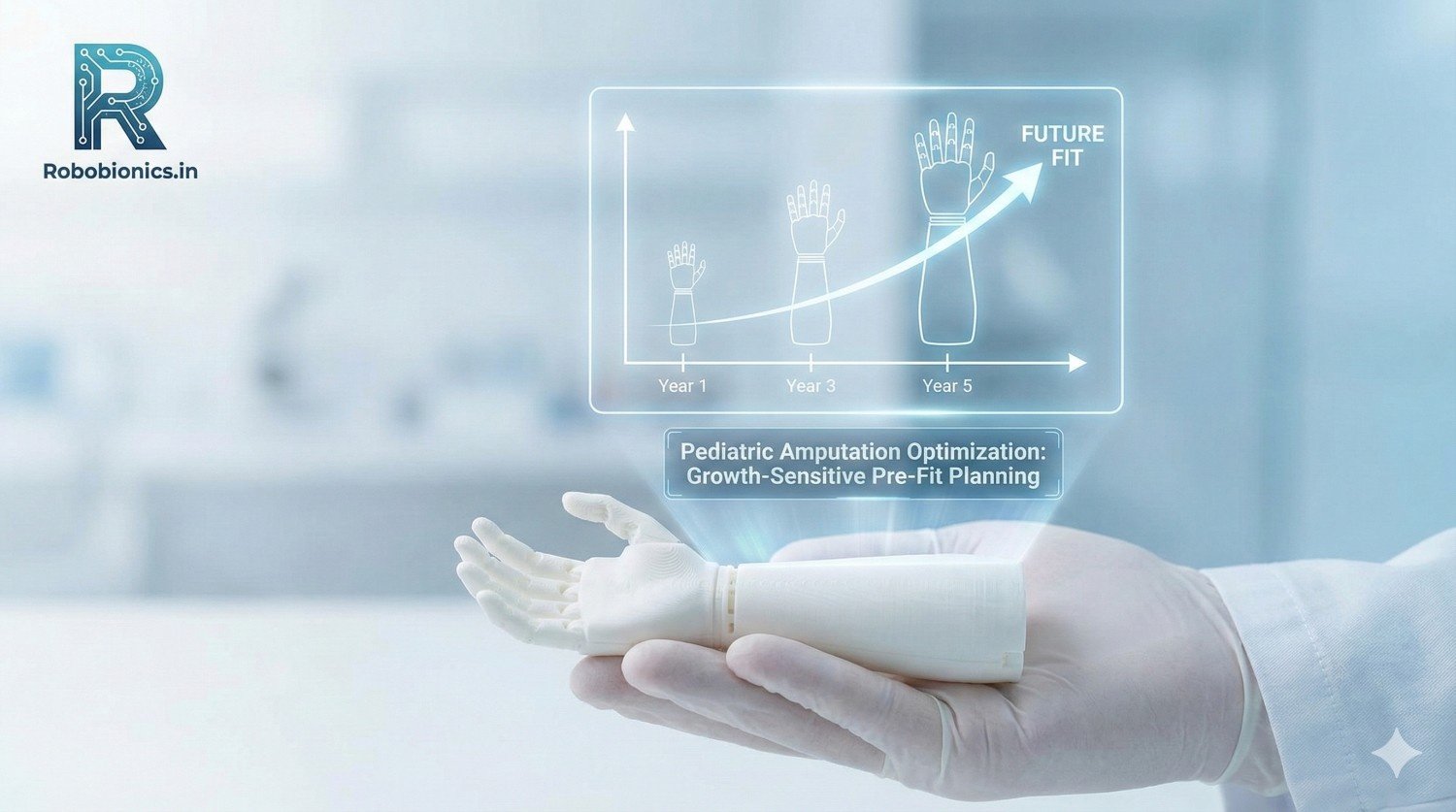
Pediatric Amputation Optimization: Growth-Sensitive Pre-Fit Planning

When a child loses a limb, the challenge is never only physical. A child’s body is still growing, learning, and changing every day. Decisions made early do not just affect healing. They shape movement, confidence, and development for years to come. This makes pediatric amputation care very different from adult care, even when the surgery looks similar.

At Robobionics, working with children, parents, and doctors across India, we have learned that early prosthetic planning must respect growth above all else. A child is not a smaller adult. Bones grow, muscles adapt, and the brain rewires itself continuously. Pre-fit planning that ignores growth often leads to repeated discomfort, delayed learning, and emotional stress.

This article is written for medical doctors who guide children through amputation recovery and prosthetic preparation. It focuses on growth-sensitive pre-fit planning that supports healthy development, safe prosthetic use, and long-term success. These insights come from real pediatric journeys, not ideal timelines.

Why Pediatric Amputation Planning Is Different From Adult Care

Growth Never Pauses for Healing

In children, bone growth, muscle development, and nervous system learning continue even during recovery. Healing and growth happen together, not one after the other.

Medical planning must support both at the same time.

Small Decisions Have Long-Term Impact

Minor alignment issues or delayed movement in a child can influence posture and gait for years.

Early planning protects future development.

Children Adapt Fast but Forget Slowly

Children learn movement quickly, but they also remember fear and discomfort strongly.

Early experiences shape long-term acceptance of prosthetics.
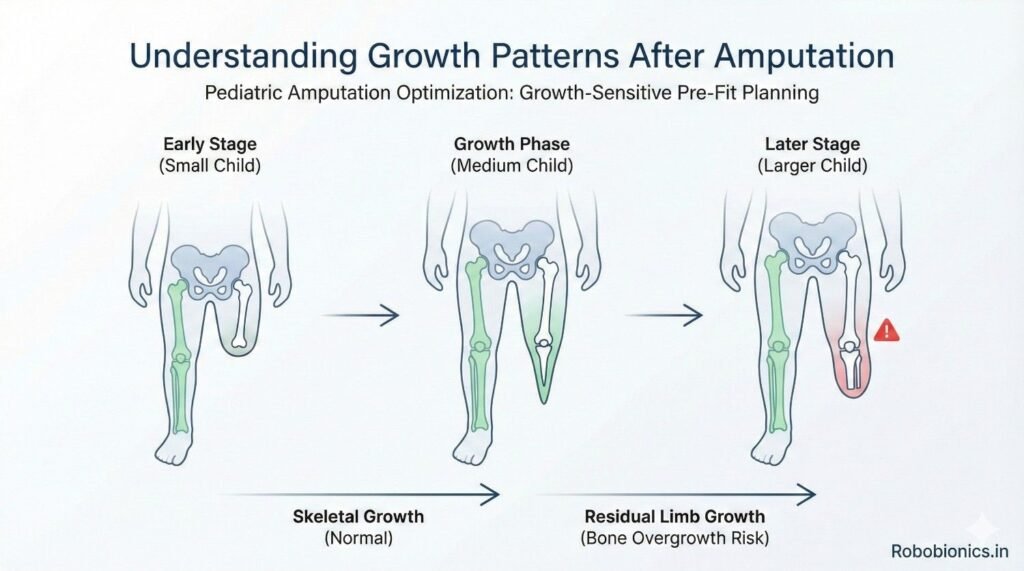
Understanding Growth Patterns After Amputation

Bone Growth and Limb Length Changes

Bones grow from specific growth plates. Amputation changes load patterns and growth direction.

Doctors must anticipate how remaining bones will grow over time.

Muscle Development and Imbalance

Muscles strengthen where they are used and weaken where they are avoided.

Poor early movement guidance creates imbalance quickly.

Skin and Soft Tissue Adaptation

Children’s skin adapts fast but is sensitive to pressure.

Early protection prevents long-term sensitivity.

Timing Prosthetic Exposure in Growing Children

Early Exposure Versus Early Overload

Early prosthetic exposure supports learning, but excessive demand harms growing tissue.

Doctors must balance opportunity with protection.

Age-Appropriate Readiness

Readiness depends on developmental stage, not just wound healing.

Cognitive and motor readiness matter equally.

Using Temporary Prosthetic Solutions

Interim devices allow exposure without long-term commitment.

They support learning while growth continues.

Growth-Sensitive Pre-Fit Medical Assessment

Looking Beyond the Surgical Site

Assessment must include posture, spine alignment, and limb symmetry.

Growth compensation happens quickly in children.

Tracking Baseline Movement Patterns

Knowing how a child moves before fitting helps detect problems early.

Baseline observation is essential.

Involving Multiple Disciplines Early

Pediatric care benefits from shared planning between surgeons, pediatricians, therapists, and prosthetists.

Early collaboration prevents fragmented care.

Range of Motion Preservation in Children

Children Lose Motion Differently

Children often avoid movement quietly rather than complain.

Stiffness can develop without visible distress.

Play-Based Movement Encouragement

Structured exercises feel restrictive to children.

Play-based movement preserves motion naturally.

Preventing Growth-Related Contractures

As bones grow, tight muscles create contractures faster.

Early motion guidance protects joint alignment.

Pain and Sensory Considerations in Pediatric Patients

Children Express Pain Indirectly

Behavioral changes often signal discomfort before words do.

Doctors should watch behavior closely.

Preventing Fear-Based Avoidance

Pain experiences early on shape long-term movement habits.

Gentle progression builds trust.

Sensory Re-Education Over Suppression

Teaching children to tolerate sensation works better than numbing it.

This supports long-term prosthetic comfort.
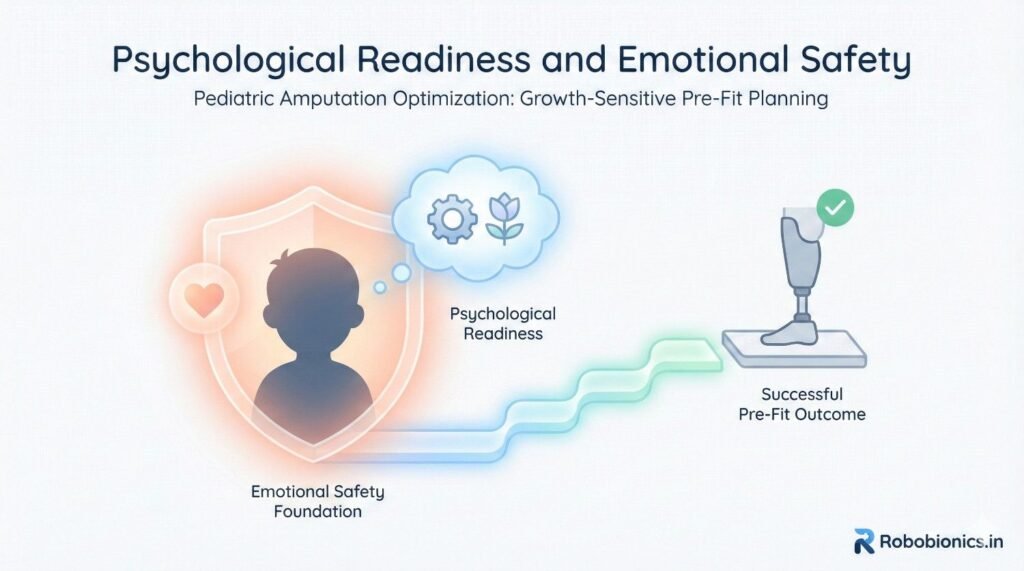
Psychological Readiness and Emotional Safety

Fear Looks Different in Children

Children may show fear through withdrawal or refusal, not words.

Understanding this prevents mislabeling behavior.

Building Trust Through Predictability

Clear routines and familiar faces reduce anxiety.

Predictability improves cooperation.

Protecting Self-Image Early

How children see themselves develops early.

Positive framing prevents stigma and shame.

Family Dynamics in Pediatric Prosthetic Planning

Parents Carry Hidden Anxiety

Parental fear often transfers to the child.

Doctors should address parents directly.

Balancing Protection and Independence

Overprotection limits learning.

Guided independence supports growth.

Educating the Entire Care Circle

Grandparents, teachers, and caregivers influence daily habits.

Consistent guidance prevents confusion.

Growth Monitoring and Follow-Up Planning

Growth Requires Regular Review

Children outgrow devices faster than adults.

Regular reviews prevent discomfort and frustration.

Watching for Asymmetry

Asymmetry often appears before pain.

Early detection allows correction.

Planning for Adjustments, Not Surprises

Setting expectations about frequent changes reduces stress.

Preparation builds resilience.

Prosthetic Design Considerations for Growing Children

Designing for Change, Not Permanence

Pediatric prosthetics must allow adjustments.

Rigid designs fail children.

Weight and Energy Considerations

Heavy devices fatigue children quickly.

Lightweight designs support play and learning.

Allowing Exploration and Play

Play is therapy for children.

Designs must support safe exploration.

School Integration and Daily Environment Planning

School Is a Major Part of a Child’s Life

For a child, school is not just a place to study. It is where movement, play, social learning, and self-image develop every day.

Prosthetic planning that ignores school life creates gaps in adaptation.

Managing Classroom Movement Needs

Sitting, standing, writing, and carrying school bags place repeated demands on a growing body.

Doctors should consider these daily movements when advising pre-fit planning.

Preparing Teachers and Staff

Teachers often feel unsure how to support a child with limb loss.

Simple guidance from doctors helps schools respond with confidence rather than fear.

Supporting Motor Learning and Brain Development

The Developing Brain Learns Differently

Children’s brains are highly adaptable, especially in early years. They learn movement patterns quickly through repetition and play.

Early prosthetic exposure supports healthy brain mapping.

Preventing Compensatory Movement Patterns

Without guidance, children create shortcuts that strain joints and posture.

Early correction protects long-term alignment.

Repetition Without Pressure

Children need repetition, but not force.

Doctors should encourage frequent, gentle practice rather than intense sessions.
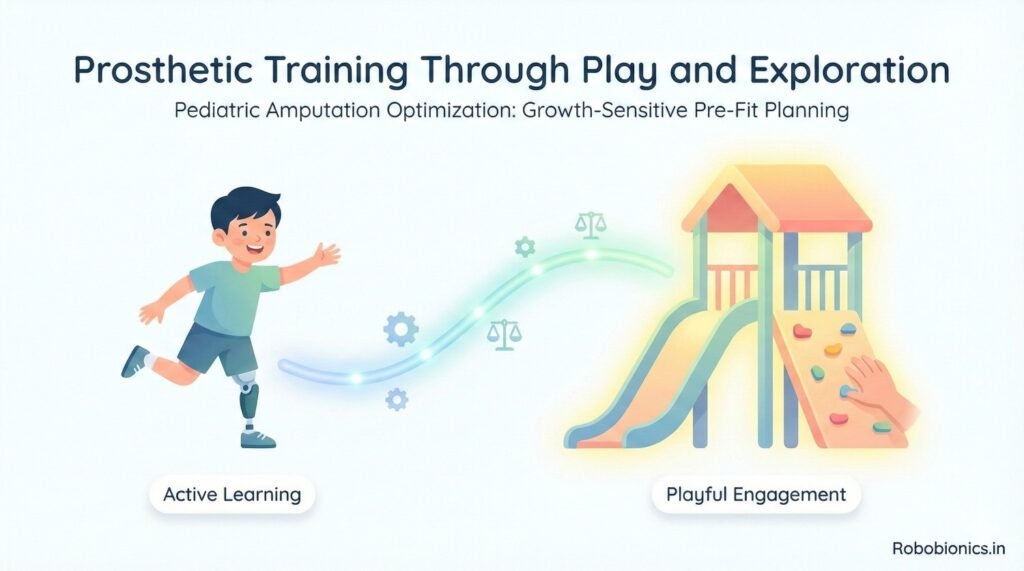
Prosthetic Training Through Play and Exploration

Play Is the Best Therapy

Children learn best when they are engaged and curious.

Play-based training builds skills without fear.

Allowing Safe Mistakes

Falling, dropping objects, and trying again are part of learning.

Over-restricting movement slows confidence.

Encouraging Curiosity

When children explore freely, prosthetics become tools rather than burdens.

This mindset supports long-term use.

Growth Spurts and Prosthetic Planning

Growth Happens in Bursts

Children do not grow evenly. Sudden growth spurts change limb length, alignment, and balance.

Doctors should anticipate these changes.

Adjusting Before Discomfort Appears

Waiting for pain means waiting too long.

Proactive adjustment prevents setbacks.

Monitoring During Puberty

Puberty brings rapid physical and emotional change.

Closer follow-up during this phase protects continuity.

Managing Limb Length Discrepancy Over Time

Growth Plate Behavior After Amputation

Remaining growth plates may grow faster or slower due to altered load.

Doctors should track this carefully.

Early Detection of Imbalance

Small differences increase over time if ignored.

Regular measurement prevents major correction later.

Coordinating With Orthopedic Care

Some cases need orthopedic input.

Early coordination avoids crisis-driven decisions.

Emotional Changes as Children Grow Older

Feelings Change With Age

A young child may accept a prosthetic easily, while an adolescent may struggle more.

Doctors should expect these shifts.

Body Image and Peer Awareness

Teenagers become more aware of differences.

Support during this phase is critical.

Normalizing Emotional Ups and Downs

Emotional fluctuation is part of growth.

Doctors should reassure families that this is normal.

Preventing Prosthetic Abandonment During Adolescence

Adolescence Is a High-Risk Phase

Many children stop using prosthetics during teenage years.

This often reflects emotional strain, not device failure.

Respecting Autonomy While Staying Supportive

Adolescents need choice and voice.

Forcing use often backfires.

Reconnecting Prosthetics to Personal Goals

Sports, hobbies, or independence can renew motivation.

Doctors should help reframe purpose.
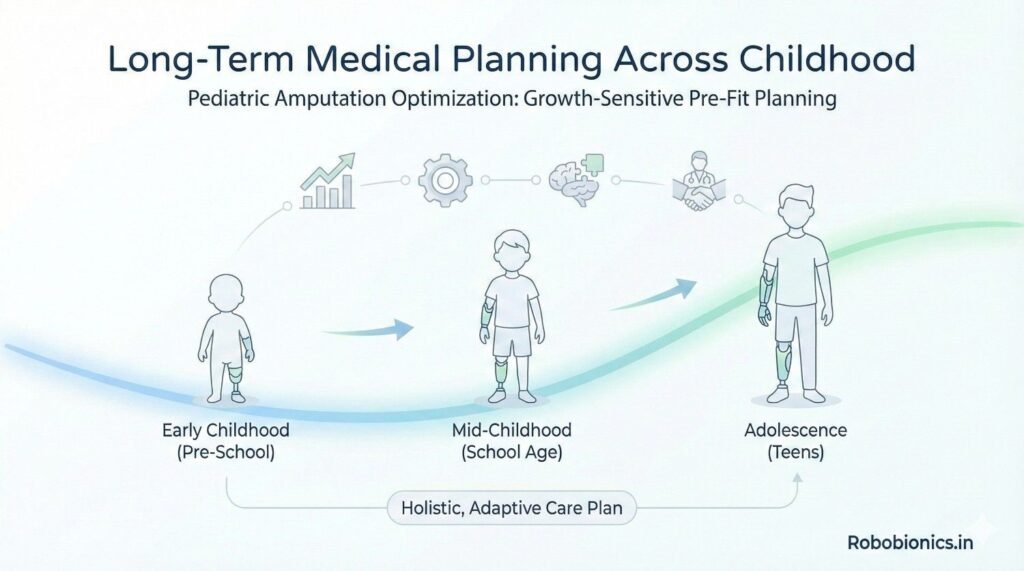
Long-Term Medical Planning Across Childhood

Thinking in Years, Not Months

Pediatric prosthetic care spans many years.

Early decisions echo into adulthood.

Planning for Transitions

Transitions between care teams and life stages need preparation.

Continuity matters.

Documenting Growth and Decisions

Clear records help future teams understand past choices.

This protects long-term outcomes.

Role of the Doctor as a Consistent Anchor

Stability Builds Trust

Children and families meet many professionals over time.

Doctors provide continuity and reassurance.

Adjusting Guidance as the Child Matures

Advice that works at age five may not work at fifteen.

Doctors must adapt communication.

Being Available for Questions

Knowing support exists reduces anxiety.

Availability builds confidence.

Nutrition and Growth Support in Pediatric Amputation Care

Growth Increases Nutritional Demand

Children need more nutrients than adults because they are growing every day. After amputation, this demand rises further due to healing and adaptation.

Poor nutrition quietly slows growth and learning.

Protein and Bone Health

Protein supports muscle and tissue growth, while calcium and vitamin D support bone strength.

Doctors should ensure nutrition supports both healing and growth.

Monitoring Weight and Height Trends

Sudden weight loss or stalled height gain signals concern.

Regular tracking helps detect problems early.

Protecting Joints and Spine During Growth

Compensatory Movement Risks

Children often compensate for limb loss by overusing other joints.

Over time, this stresses hips, knees, shoulders, and the spine.

Early Posture Guidance

Posture habits form early and persist.

Simple guidance protects long-term alignment.

Preventing Secondary Pain

Joint and back pain can appear years later if early protection is missed.

Prevention is far easier than correction.

Managing Fatigue and Energy in Children

Fatigue Looks Different in Children

Children may become irritable, withdrawn, or inattentive when tired.

Doctors should look beyond verbal reports.

Balancing Activity and Rest

Children need activity for learning, but also rest for recovery.

Guidance should support balance, not extremes.

Avoiding Burnout

Over-scheduling therapy can reduce joy and motivation.

Preserving play protects engagement.

Supporting Parents and Preventing Caregiver Burnout

Parents Carry Long-Term Responsibility

Caring for a child with limb loss is emotionally demanding.

Burnout affects decision-making and patience.

Normalizing Parental Struggle

Parents often feel guilt or fear.

Acknowledging this reduces isolation.

Encouraging Shared Responsibility

Involving schools and extended family reduces pressure.

Support networks improve sustainability.

Cultural and Social Considerations in Pediatric Care

Social Acceptance Matters Early

Children sense difference quickly.

Early positive framing prevents stigma.

Addressing Community Reactions

Families often worry about how others will react.

Doctor reassurance helps families respond confidently.

Encouraging Normal Participation

Participation builds resilience.

Doctors should encourage inclusion, not avoidance.
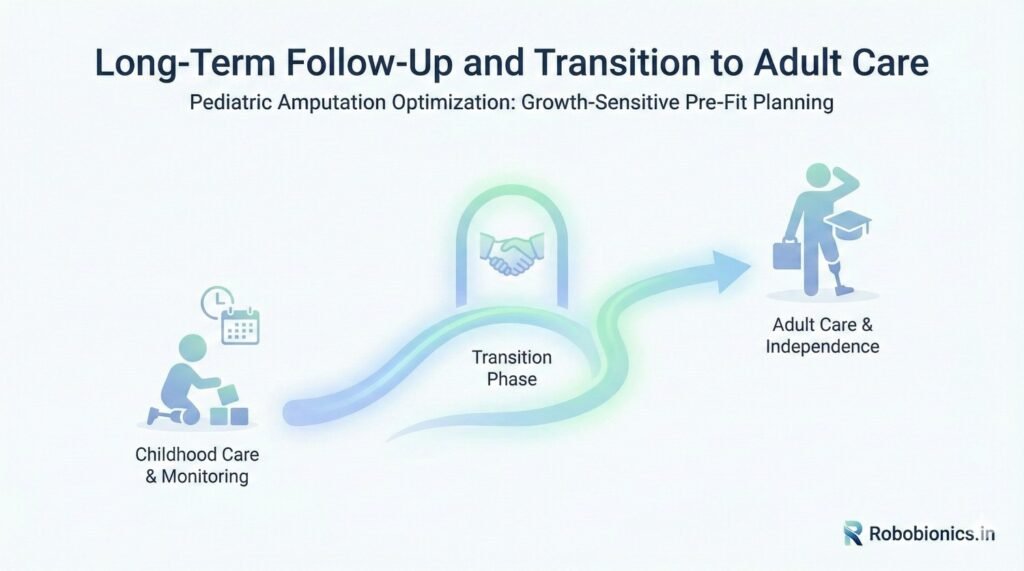
Long-Term Follow-Up and Transition to Adult Care

Preparing for Adult Prosthetic Systems

Children eventually move into adult care.

Preparation should begin early.

Teaching Self-Advocacy Skills

As children mature, they should learn to express needs.

Self-advocacy supports independence.

Maintaining Continuity of Care

Smooth transitions prevent gaps.

Documentation and communication matter.

Conclusion: Planning for Growth Is Planning for Life

Pediatric amputation care is never just about replacing a limb. It is about supporting a growing human being whose body, mind, and identity are still forming. Every medical decision made early has long-term consequences, not because it is dramatic, but because growth amplifies its effects over time.

Children grow in ways adults do not. Bones lengthen, muscles strengthen, coordination improves, and the brain rewires itself continuously. When amputation occurs during these years, the body adapts quickly, but it also compensates easily in ways that can become problematic later. Growth-sensitive planning exists to guide this adaptation safely.

Pre-fit planning in pediatric care must always look ahead. A well-healed limb today may not tolerate the same prosthetic design next year. A movement pattern that seems harmless at age six may strain the spine at sixteen. Doctors who think in years rather than weeks protect future mobility.

Early prosthetic exposure plays a powerful role in motor learning. When introduced thoughtfully, it helps the developing brain map new movement patterns naturally. When introduced too aggressively or without emotional safety, it creates fear that lingers. The goal is not early performance, but early familiarity and trust.

Family dynamics are central to pediatric outcomes. Parents want to protect their children, but overprotection limits exploration and confidence. Doctors who guide families gently toward balanced independence help children grow stronger both physically and emotionally. Addressing parental anxiety openly prevents it from shaping the child’s experience.

School and social environments shape self-image. Children who feel included and supported adapt better than those who feel singled out or restricted. Medical guidance that considers school life, play, and peer interaction supports whole-child development, not just limb function.

Adolescence is a turning point. Growth accelerates, emotions intensify, and identity becomes more important. Prosthetic abandonment during this phase is common, not because devices fail, but because emotional needs change. Doctors who respect autonomy and reconnect prosthetics to personal goals help adolescents stay engaged.

Nutrition, sleep, fatigue management, and joint protection often receive less attention, yet they quietly shape outcomes. A growing body under stress needs support. When these needs are met, children have the energy and resilience to adapt.

At Robobionics, our experience with pediatric patients across India has taught us that the best prosthetic outcomes come from early, growth-sensitive planning. Devices matter, but preparation matters more. When doctors, families, and prosthetic teams align around growth, children gain more than mobility. They gain confidence, independence, and the freedom to explore their world.

Pediatric amputation optimization is not about predicting every future challenge. It is about creating flexible, supportive pathways that evolve with the child. When planning respects growth, prosthetics become tools that grow alongside the child, supporting a life that continues to unfold with possibility and strength.

Share:

More Posts

Partner With Us

REFUNDS AND CANCELLATIONS

Last updated: November 10, 2022

Thank you for shopping at Robo Bionics.

If, for any reason, You are not completely satisfied with a purchase We invite You to review our policy on refunds and returns.

The following terms are applicable for any products that You purchased with Us.

Interpretation And Definitions

Interpretation

The words of which the initial letter is capitalized have meanings defined under the following conditions. The following definitions shall have the same meaning regardless of whether they appear in singular or in plural.

Definitions

For the purposes of this Return and Refund Policy:

  • Company (referred to as either “the Company”, “Robo Bionics”, “We”, “Us” or “Our” in this Agreement) refers to Bionic Hope Private Limited, Pearl Haven, 1st Floor Kumbharwada, Manickpur Near St. Michael’s Church Vasai Road West, Palghar Maharashtra 401202.

  • Goods refer to the items offered for sale on the Website.

  • Orders mean a request by You to purchase Goods from Us.

  • Service refers to the Services Provided like Online Demo and Live Demo.

  • Website refers to Robo Bionics, accessible from https://robobionics.in

  • You means the individual accessing or using the Service, or the company, or other legal entity on behalf of which such individual is accessing or using the Service, as applicable.

Your Order Cancellation Rights

You are entitled to cancel Your Service Bookings within 7 days without giving any reason for doing so, before completion of Delivery.

The deadline for cancelling a Service Booking is 7 days from the date on which You received the Confirmation of Service.

In order to exercise Your right of cancellation, You must inform Us of your decision by means of a clear statement. You can inform us of your decision by:

  • By email: contact@robobionics.in

We will reimburse You no later than 7 days from the day on which We receive your request for cancellation, if above criteria is met. We will use the same means of payment as You used for the Service Booking, and You will not incur any fees for such reimbursement.

Please note in case you miss a Service Booking or Re-schedule the same we shall only entertain the request once.

Conditions For Returns

In order for the Goods to be eligible for a return, please make sure that:

  • The Goods were purchased in the last 14 days
  • The Goods are in the original packaging

The following Goods cannot be returned:

  • The supply of Goods made to Your specifications or clearly personalized.
  • The supply of Goods which according to their nature are not suitable to be returned, deteriorate rapidly or where the date of expiry is over.
  • The supply of Goods which are not suitable for return due to health protection or hygiene reasons and were unsealed after delivery.
  • The supply of Goods which are, after delivery, according to their nature, inseparably mixed with other items.

We reserve the right to refuse returns of any merchandise that does not meet the above return conditions in our sole discretion.

Only regular priced Goods may be refunded by 50%. Unfortunately, Goods on sale cannot be refunded. This exclusion may not apply to You if it is not permitted by applicable law.

Returning Goods

You are responsible for the cost and risk of returning the Goods to Us. You should send the Goods at the following:

  • the Prosthetic Limb Fitting Centre that they purchased the product from
  • email us at contact@robobionics.in with all the information and we shall provide you a mailing address in 3 days.

We cannot be held responsible for Goods damaged or lost in return shipment. Therefore, We recommend an insured and trackable courier service. We are unable to issue a refund without actual receipt of the Goods or proof of received return delivery.

Contact Us

If you have any questions about our Returns and Refunds Policy, please contact us:

  • By email: contact@robobionics.in

TERMS & CONDITIONS

Last Updated on: 1st Jan 2021

These Terms and Conditions (“Terms”) govern Your access to and use of the website, platforms, applications, products and services (ively, the “Services”) offered by Robo Bionics® (a registered trademark of Bionic Hope Private Limited, also used as a trade name), a company incorporated under the Companies Act, 2013, having its Corporate office at Pearl Heaven Bungalow, 1st Floor, Manickpur, Kumbharwada, Vasai Road (West), Palghar – 401202, Maharashtra, India (“Company”, “We”, “Us” or “Our”). By accessing or using the Services, You (each a “User”) agree to be bound by these Terms and all applicable laws and regulations. If You do not agree with any part of these Terms, You must immediately discontinue use of the Services.

1. DEFINITIONS

1.1 “Individual Consumer” means a natural person aged eighteen (18) years or above who registers to use Our products or Services following evaluation and prescription by a Rehabilitation Council of India (“RCI”)–registered Prosthetist.

1.2 “Entity Consumer” means a corporate organisation, nonprofit entity, CSR sponsor or other registered organisation that sponsors one or more Individual Consumers to use Our products or Services.

1.3 “Clinic” means an RCI-registered Prosthetics and Orthotics centre or Prosthetist that purchases products and Services from Us for fitment to Individual Consumers.

1.4 “Platform” means RehabConnect, Our online marketplace by which Individual or Entity Consumers connect with Clinics in their chosen locations.

1.5 “Products” means Grippy® Bionic Hand, Grippy® Mech, BrawnBand, WeightBand, consumables, accessories and related hardware.

1.6 “Apps” means Our clinician-facing and end-user software applications supporting Product use and data collection.

1.7 “Impact Dashboard™” means the analytics interface provided to CSR, NGO, corporate and hospital sponsors.

1.8 “Services” includes all Products, Apps, the Platform and the Impact Dashboard.

2. USER CATEGORIES AND ELIGIBILITY

2.1 Individual Consumers must be at least eighteen (18) years old and undergo evaluation and prescription by an RCI-registered Prosthetist prior to purchase or use of any Products or Services.

2.2 Entity Consumers must be duly registered under the laws of India and may sponsor one or more Individual Consumers.

2.3 Clinics must maintain valid RCI registration and comply with all applicable clinical and professional standards.

3. INTERMEDIARY LIABILITY

3.1 Robo Bionics acts solely as an intermediary connecting Users with Clinics via the Platform. We do not endorse or guarantee the quality, legality or outcomes of services rendered by any Clinic. Each Clinic is solely responsible for its professional services and compliance with applicable laws and regulations.

4. LICENSE AND INTELLECTUAL PROPERTY

4.1 All content, trademarks, logos, designs and software on Our website, Apps and Platform are the exclusive property of Bionic Hope Private Limited or its licensors.

4.2 Subject to these Terms, We grant You a limited, non-exclusive, non-transferable, revocable license to use the Services for personal, non-commercial purposes.

4.3 You may not reproduce, modify, distribute, decompile, reverse engineer or create derivative works of any portion of the Services without Our prior written consent.

5. WARRANTIES AND LIMITATIONS

5.1 Limited Warranty. We warrant that Products will be free from workmanship defects under normal use as follows:
 (a) Grippy™ Bionic Hand, BrawnBand® and WeightBand®: one (1) year from date of purchase, covering manufacturing defects only.
 (b) Chargers and batteries: six (6) months from date of purchase.
 (c) Grippy Mech™: three (3) months from date of purchase.
 (d) Consumables (e.g., gloves, carry bags): no warranty.

5.2 Custom Sockets. Sockets fabricated by Clinics are covered only by the Clinic’s optional warranty and subject to physiological changes (e.g., stump volume, muscle sensitivity).

5.3 Exclusions. Warranty does not apply to damage caused by misuse, user negligence, unauthorised repairs, Acts of God, or failure to follow the Instruction Manual.

5.4 Claims. To claim warranty, You must register the Product online, provide proof of purchase, and follow the procedures set out in the Warranty Card.

5.5 Disclaimer. To the maximum extent permitted by law, all other warranties, express or implied, including merchantability and fitness for a particular purpose, are disclaimed.

6. DATA PROTECTION AND PRIVACY

6.1 We collect personal contact details, physiological evaluation data, body measurements, sensor calibration values, device usage statistics and warranty information (“User Data”).

6.2 User Data is stored on secure servers of our third-party service providers and transmitted via encrypted APIs.

6.3 By using the Services, You consent to collection, storage, processing and transfer of User Data within Our internal ecosystem and to third-party service providers for analytics, R&D and support.

6.4 We implement reasonable security measures and comply with the Information Technology Act, 2000, and Information Technology (Reasonable Security Practices and Procedures and Sensitive Personal Data or Information) Rules, 2011.

6.5 A separate Privacy Policy sets out detailed information on data processing, user rights, grievance redressal and cross-border transfers, which forms part of these Terms.

7. GRIEVANCE REDRESSAL

7.1 Pursuant to the Information Technology Rules, 2021, We have given the Charge of Grievance Officer to our QC Head:
 - Address: Grievance Officer
 - Email: support@robobionics.in
 - Phone: +91-8668372127

7.2 All support tickets and grievances must be submitted exclusively via the Robo Bionics Customer Support portal at https://robobionics.freshdesk.com/.

7.3 We will acknowledge receipt of your ticket within twenty-four (24) working hours and endeavour to resolve or provide a substantive response within seventy-two (72) working hours, excluding weekends and public holidays.

8. PAYMENT, PRICING AND REFUND POLICY

8.1 Pricing. Product and Service pricing is as per quotations or purchase orders agreed in writing.

8.2 Payment. We offer (a) 100% advance payment with possible incentives or (b) stage-wise payment plans without incentives.

8.3 Refunds. No refunds, except pro-rata adjustment where an Individual Consumer is medically unfit to proceed or elects to withdraw mid-stage, in which case unused stage fees apply.

9. USAGE REQUIREMENTS AND INDEMNITY

9.1 Users must follow instructions provided by RCI-registered professionals and the User Manual.

9.2 Users and Entity Consumers shall indemnify and hold Us harmless from all liabilities, claims, damages and expenses arising from misuse of the Products, failure to follow professional guidance, or violation of these Terms.

10. LIABILITY

10.1 To the extent permitted by law, Our total liability for any claim arising out of or in connection with these Terms or the Services shall not exceed the aggregate amount paid by You to Us in the twelve (12) months preceding the claim.

10.2 We shall not be liable for any indirect, incidental, consequential or punitive damages, including loss of profit, data or goodwill.

11. MEDICAL DEVICE COMPLIANCE

11.1 Our Products are classified as “Rehabilitation Aids,” not medical devices for diagnostic purposes.

11.2 Manufactured under ISO 13485:2016 quality management and tested for electrical safety under IEC 60601-1 and IEC 60601-1-2.

11.3 Products shall only be used under prescription and supervision of RCI-registered Prosthetists, Physiotherapists or Occupational Therapists.

12. THIRD-PARTY CONTENT

We do not host third-party content or hardware. Any third-party services integrated with Our Apps are subject to their own terms and privacy policies.

13. INTELLECTUAL PROPERTY

13.1 All intellectual property rights in the Services and User Data remain with Us or our licensors.

13.2 Users grant Us a perpetual, irrevocable, royalty-free licence to use anonymised usage data for analytics, product improvement and marketing.

14. MODIFICATIONS TO TERMS

14.1 We may amend these Terms at any time. Material changes shall be notified to registered Users at least thirty (30) days prior to the effective date, via email and website notice.

14.2 Continued use of the Services after the effective date constitutes acceptance of the revised Terms.

15. FORCE MAJEURE

Neither party shall be liable for delay or failure to perform any obligation under these Terms due to causes beyond its reasonable control, including Acts of God, pandemics, strikes, war, terrorism or government regulations.

16. DISPUTE RESOLUTION AND GOVERNING LAW

16.1 All disputes shall be referred to and finally resolved by arbitration under the Arbitration and Conciliation Act, 1996.

16.2 A sole arbitrator shall be appointed by Bionic Hope Private Limited or, failing agreement within thirty (30) days, by the Mumbai Centre for International Arbitration.

16.3 Seat of arbitration: Mumbai, India.

16.4 Governing law: Laws of India.

16.5 Courts at Mumbai have exclusive jurisdiction over any proceedings to enforce an arbitral award.

17. GENERAL PROVISIONS

17.1 Severability. If any provision is held invalid or unenforceable, the remainder shall remain in full force.

17.2 Waiver. No waiver of any breach shall constitute a waiver of any subsequent breach of the same or any other provision.

17.3 Assignment. You may not assign your rights or obligations without Our prior written consent.

By accessing or using the Products and/or Services of Bionic Hope Private Limited, You acknowledge that You have read, understood and agree to be bound by these Terms and Conditions.