
Post-Op Follow-Up Schedule That Prevents Prosthetic Delays (For Clinicians)
For many clinicians, the surgery is only the first step. What happens after the operation



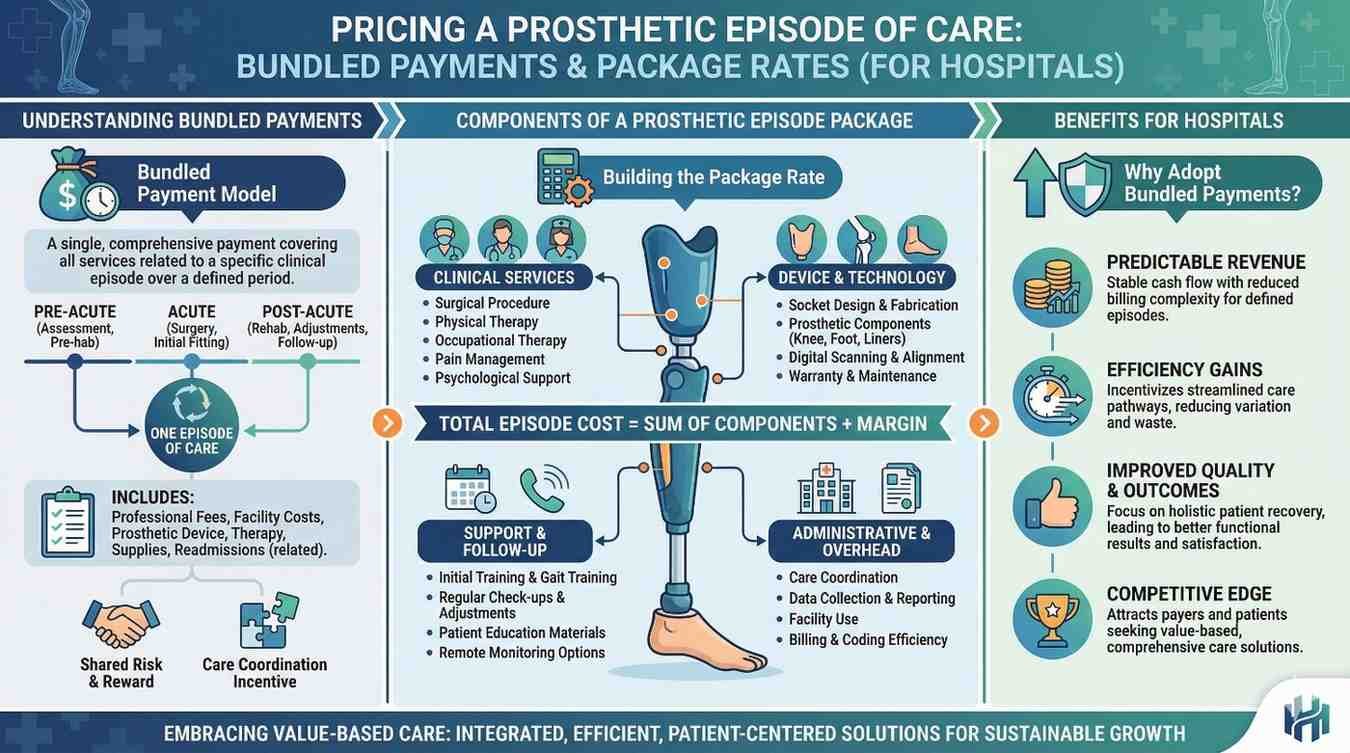
Hospitals today are being asked to deliver better outcomes at a fixed cost. Prosthetic care sits right at the center of this pressure. It touches surgery, rehabilitation, devices, follow-ups, and long-term outcomes, yet it is often priced in pieces instead of as one complete journey. This creates confusion for hospitals and uncertainty for patients.
This article explores how hospitals can price a full prosthetic episode of care using bundled payments and package rates. We will break down what an episode truly includes, where costs usually leak, and how smart bundling can protect margins while improving patient trust. The focus is practical and grounded, written for hospital leaders who want clarity, control, and consistency in prosthetic pricing.
Many hospitals still think of prosthetics as a product purchase. A limb is ordered, fitted, billed, and the case is closed. In reality, this view misses most of the work, cost, and risk that come before and after the device is delivered. A prosthetic episode of care is not about a limb alone. It is about restoring safe movement over time.
When hospitals price only the device, everything else becomes fragmented. Therapy is billed separately. Follow-ups become add-ons. Complications turn into losses. Bundled thinking starts by accepting that prosthetic care is a continuous journey, not a single transaction.
A true prosthetic episode begins much earlier than most price sheets suggest. It often starts at surgical planning, where the amputation level and wound closure directly affect prosthetic success. Post-surgical healing, stump shaping, and early mobility training are part of the same journey, even if they sit under different departments.
Once the prosthetic is fitted, the episode continues through gait training, repeated alignment, comfort adjustments, and patient education. The episode only stabilizes when the patient can use the device safely in daily life without frequent clinical intervention. Pricing that ignores this full arc almost always leads to cost overruns.
Rehabilitation is not a side service in prosthetic care. It is the engine that determines success or failure. Patients need time to learn balance, confidence, and control. Poor rehab leads to falls, device rejection, and readmissions, all of which are expensive.
In a bundled model, rehab must be priced as a core component, not an optional extra. Hospitals that underprice rehab often pay for it later through complications that could have been avoided.
Fee-for-service pricing treats every step as a separate bill. Surgery, device, therapy, reviews, and repairs all live in different cost buckets. This makes it hard for hospital leaders to see the true cost of one prosthetic patient.
Because no one owns the full episode, no one is accountable for outcomes. Costs rise quietly across departments, while margins shrink without a clear reason. Bundled pricing fixes this by forcing visibility across the entire care path.
Under fee-for-service, more visits mean more billing. More adjustments mean more revenue. This structure rewards volume, not stability. In prosthetic care, this is dangerous.
The goal should be fewer complications, fewer visits, and faster independence. Bundled payments flip the incentive. Hospitals are rewarded when the patient stabilizes sooner and stays stable longer.
Patients often experience fee-for-service chaos directly. They receive multiple bills from different departments. They are unsure what is included and what is not. Trust erodes quickly when costs feel unpredictable.
Package rates create clarity. One price. One journey. One accountable system. This clarity improves patient satisfaction and reduces disputes.

Hospitals must clearly define when the episode begins. Some start at surgery. Others start at prosthetic prescription. The right choice depends on how integrated the hospital’s care model is.
What matters most is consistency. Once defined, all internal teams must align to that start point. This prevents cost shifting and internal friction.
The episode should not end at device delivery. That is where many failures begin. A better end point is functional stability, such as independent walking with minimal support and no major skin issues.
By tying the end of the bundle to function rather than time, hospitals protect both outcomes and finances.
Not every patient progresses at the same speed. Some need more therapy. Some need extra fittings. Bundles should allow for reasonable variation without triggering losses.
This is achieved by pricing based on averages, not ideal cases. Hospitals that plan only for best-case scenarios struggle with bundled models.
To price a prosthetic bundle well, hospitals must understand their cost base deeply. Fixed costs include staff salaries, infrastructure, and standard equipment. Variable costs include devices, consumables, and session-based therapy.
When these are mixed together without clarity, pricing becomes guesswork. Clear separation allows smarter risk management.
The prosthetic device itself is a major cost driver, but it should not dominate the pricing conversation. Advanced devices may cost more upfront but reduce rehab time, complications, and readmissions.
Hospitals should model device cost alongside downstream impact, not in isolation. This is where many pricing models fail.
Follow-up visits and small adjustments are inevitable. Ignoring them in pricing leads to leakage. Bundles should include a defined number of follow-ups and minor fixes.
This encourages proactive care instead of reactive billing.
Bundled payments often sound risky to hospitals. The fear is simple. If something goes wrong, the hospital pays. But this risk already exists under fee-for-service, just in a less visible form.
Bundling does not create risk. It reveals it. Once visible, it can be managed.
Hospitals that succeed with bundles rely heavily on historical data. Past complication rates, therapy usage, and device failures provide a realistic baseline.
Pricing without data is gambling. Pricing with data is strategy.
Manufacturers play a key role in bundle success. Reliable devices, fast service, and local support reduce variability.
Hospitals that treat manufacturers as partners, not vendors, manage risk far better over time.
Package rates are especially powerful for cash-pay patients and corporate contracts. They offer certainty in a market where medical bills often feel open-ended.
Hospitals that offer clear prosthetic packages often see faster decision-making and higher patient trust.
A package does not mean one-size-fits-all. Hospitals can offer tiered packages based on device type, activity level, or rehab intensity.
The key is transparent structure, not rigid uniformity.
Clear packages are easier to communicate. They support marketing, referral discussions, and patient education.
When patients understand what they are paying for, conversion improves.
Doctors and therapists often fear that bundles limit care. This fear must be addressed openly. Bundles should support good care, not restrict it.
When clinicians help design the bundle, acceptance increases dramatically.
Finance teams focus on margins. Operations teams focus on flow. Bundles sit at the intersection of both.
Regular reviews and shared dashboards help keep everyone aligned.
Patients often ask detailed questions about cost. Frontline staff must be trained to explain packages clearly and confidently.
Confusion at the front desk can undo the value of even the best pricing model.
Across healthcare, payment models are moving toward value and outcomes. Prosthetic care will not be an exception.
Hospitals that build bundle capability early will adapt faster as policies evolve.
When hospitals price the full episode, they naturally start improving the episode itself. Waste becomes visible. Gaps are addressed.
Pricing becomes a tool for care improvement, not just billing.
Patients sense when care is well planned. Bundled prosthetic pricing signals that the hospital has thought through the entire journey.
That trust is hard to earn and easy to lose.
We are approaching the next major section, where we will go deeper into designing bundle tiers, managing complications within packages, and protecting margins without cutting care quality.
Prosthetic patients are not a single group. Their needs vary based on age, cause of amputation, health status, and daily activity. A single flat bundle often fails because it assumes everyone follows the same path.
Tiered bundles solve this problem. They allow hospitals to price care based on expected complexity while still keeping the model simple and transparent.
One of the most useful ways to design tiers is by expected activity level. A low-activity patient who mainly walks indoors has very different needs from a working adult who navigates public spaces daily.
When bundles reflect real-world use, outcomes improve and cost surprises reduce. This also helps clinicians recommend the right option without feeling restricted.
Device selection should be aligned with the bundle tier, not treated as an afterthought. Basic devices may suit lower tiers, while advanced knees or feet fit naturally into higher tiers.
This alignment avoids last-minute cost escalation and keeps expectations clear for both teams and patients.

No care model eliminates complications completely. Skin issues, alignment problems, and delayed healing are part of prosthetic care.
The mistake hospitals make is pretending these will not occur when pricing bundles. A good bundle assumes some level of complication and plans for it.
Bundles should be built around what usually happens, not best-case scenarios. If ten out of a hundred patients need extra visits, the cost of those visits should be spread across the bundle price.
This approach stabilizes margins and avoids constant renegotiation.
Hospitals must define which complications are covered within the bundle and which are not. Minor skin issues, routine adjustments, and early gait problems are often best included.
Major unrelated medical events may sit outside the bundle. Clarity here prevents conflict later.
When margins feel tight, the instinct is often to cut therapy sessions or follow-ups. This usually backfires.
A better approach is to remove waste. Duplicate visits, poor coordination, and late device decisions add cost without adding value.
Bundled pricing exposes these inefficiencies and creates pressure to fix them.
Addressing small problems early prevents expensive complications later. A quick alignment tweak today can prevent a fall next month.
Bundles encourage early action because the hospital benefits when the patient stabilizes faster.
Cheaper devices often lead to higher long-term cost through breakdowns and patient dissatisfaction. Reliability matters more in a bundled model because the hospital owns the outcome.
Choosing partners who deliver consistent quality protects margins over time.
In bundled care, manufacturers are not just suppliers. Their performance directly affects hospital risk.
Hospitals should evaluate partners based on long-term reliability, not just unit price.
Local service support reduces downtime and emergency visits. Quick repairs prevent care disruption.
These factors should be considered part of the economic equation when choosing a prosthetic partner.
The best partnerships share responsibility for success. Data sharing, joint reviews, and aligned incentives strengthen bundle performance.
When all parties focus on patient stability, everyone benefits.

Patients are often anxious about prosthetic costs. A bundled price reduces fear and confusion.
When patients know what is included, they are more likely to commit to care and follow through with rehab.
Multiple bills from different departments frustrate patients. Bundles simplify the financial experience.
This reduces disputes, delays, and administrative burden for hospitals.
Bundles create a natural moment for education. Patients learn what the journey will look like and what support they will receive.
Clear expectations improve engagement and outcomes.
Bundled care requires smooth handoffs between surgery, rehab, prosthetics, and follow-up teams.
Poor coordination increases cost and risk. Dedicated care coordinators or clear ownership models help prevent this.
Standard care pathways do not eliminate clinical judgment. They reduce unnecessary variation that drives cost.
When teams follow agreed pathways, bundles become easier to manage and predict.
Bundles should not be static. Regular review of outcomes and costs helps refine pricing and care design.
Small adjustments over time prevent major failures later.
Payers are increasingly interested in predictable cost and measurable outcomes. Bundled prosthetic care fits this direction well.
Hospitals with established bundles are better positioned to negotiate favorable contracts.
Bundled models generate valuable data on outcomes and cost drivers. This data strengthens payer discussions and internal planning.
Hospitals that invest in tracking early gain long-term advantage.
Policies evolve. Bundles designed with flexibility adapt more easily than rigid fee structures.
This adaptability protects hospitals from sudden reimbursement shifts.

Bundled pricing shows that the hospital understands care as a journey, not a transaction.
This mindset influences culture, quality, and patient trust.
Bundles cut across departments. Without leadership backing, they fail.
CMOs and CFOs play a key role in aligning teams and sustaining momentum.
Prosthetic bundles can become a template for other episodes of care.
Success here builds confidence for broader transformation.
We are now approaching the final major section, where we will focus on implementation steps, common mistakes hospitals make when launching bundles, and a strong closing that ties pricing strategy to long-term growth and patient trust.
The biggest mistake hospitals make is trying to bundle everything at once. Prosthetic care is complex, and sudden system-wide change creates resistance.
A better approach is to start with one clearly defined prosthetic package. One limb level. One patient profile. One care pathway. This allows teams to test assumptions, track outcomes, and fix gaps without pressure.
Early success builds trust. Trust makes scaling easier.
Bundled pricing fails when no one owns the full journey. Surgery teams own part of it. Rehab owns another. Prosthetics sits somewhere in between.
Hospitals need one accountable owner for the episode of care. This may be a clinical lead, a program head, or a multidisciplinary committee with real authority.
Clear ownership prevents finger-pointing and keeps the patient at the center.
Operational friction often comes from poor alignment between clinical documentation and billing systems. Bundles require clean, consistent records to work smoothly.
Hospitals should invest time upfront to align codes, internal billing logic, and package definitions. This reduces errors and avoids confusion for both staff and patients.
Some hospitals intentionally price bundles too low to make them attractive. This often leads to losses that erode internal support.
Bundles should be fair, not aggressive. Sustainability matters more than short-term wins.
A bundle that fails financially will not survive long enough to improve care.
Many complications happen after discharge. Skin breakdown, poor gait habits, and device misuse often appear weeks later.
Bundles that end too early shift these costs back to the hospital through readmissions or reputational damage.
Including structured follow-up protects both outcomes and margins.
Care evolves. Devices improve. Patient profiles change.
Bundles must evolve too. Hospitals that never revisit pricing or structure eventually fall behind reality.
Regular review keeps bundles relevant and effective.

Not all data is useful. Hospitals should focus on outcomes that reflect stability and independence.
Readmissions, falls, therapy duration, and patient-reported confidence are more valuable than raw visit counts.
These measures tell the real story of bundle performance.
Over time, bundled care generates rich insight. Hospitals learn which patients need more support and which pathways work best.
This knowledge improves future pricing, care design, and partner selection.
Data becomes a strategic asset, not just a reporting requirement.
Strong data supports conversations with payers, corporate clients, and referral partners.
Hospitals that can show predictable outcomes and costs gain credibility in negotiations.
This strengthens long-term positioning in competitive markets.
Healthcare margins are under constant pressure. Bundled pricing creates predictability.
When hospitals know the cost and outcome of an episode, planning becomes easier.
Predictability supports sustainable growth.
Many hospitals offer prosthetic services. Few offer clear, well-designed prosthetic packages.
Bundles differentiate by signaling maturity, transparency, and patient-first thinking.
This attracts both patients and partners.
Referring doctors value clarity. When they know what their patients will receive and what it will cost, referrals increase.
Bundles simplify these conversations and build trust.
For patients, prosthetic care is often unfamiliar and intimidating. Unclear pricing adds fear to an already emotional journey.
Bundles reduce this fear by offering certainty.
When patients feel safe financially, they engage better clinically.
Patients who understand the full journey are more likely to follow therapy plans and attend follow-ups.
Clear structure supports better behavior and better results.
This directly improves bundle performance.
Patients remember how they were treated during life-changing moments.
Hospitals that provide clear, supportive prosthetic care earn long-term goodwill.
This reputation spreads through families and communities.

In markets like India, affordability is critical. Fee-for-service pricing often creates unpredictable bills that patients cannot manage.
Bundled prosthetic pricing allows hospitals to design care that is both high quality and financially accessible.
This expands access without compromising outcomes.
As insurance coverage and employer health programs grow, predictable packages become essential.
Bundles fit well into these structures and simplify contracting.
Hospitals that adapt early gain advantage.
Advanced prosthetic technology must be paired with thoughtful pricing.
Bundles ensure innovation is delivered responsibly, with outcomes and access in mind.
Pricing a prosthetic episode of care is not just a finance exercise. It is a statement about how a hospital views responsibility, trust, and long-term care.
Bundled payments and package rates bring clarity where confusion once existed. They align teams, protect margins, and improve patient experience.
Most importantly, they treat prosthetic care as a complete journey, not a collection of bills.
Hospitals that embrace this approach are not just pricing better. They are caring better.
For many clinicians, the surgery is only the first step. What happens after the operation

For trauma amputees, the journey does not begin at the prosthetic clinic. It begins much

Amputation after cancer is not just a surgical event. It is the end of one

When a child loses a limb, the challenge is never only physical. A child’s body