
Post-Op Follow-Up Schedule That Prevents Prosthetic Delays (For Clinicians)
For many clinicians, the surgery is only the first step. What happens after the operation



Early mobilization after amputation is not about rushing a patient out of bed. It is about guiding safe, meaningful movement at the right time so the body heals in the right way. When patients move early, swelling reduces faster, muscles stay active, joints remain flexible, and confidence grows. These changes directly affect how well a prosthetic limb fits and functions later.
This article is written for clinicians who manage amputees from surgery to prosthetic fitting. It explains how early mobilization improves limb shape, skin tolerance, balance, and readiness for a socket. The focus is practical and realistic, shaped by real clinical settings across India. When doctors use clear mobilization pathways instead of waiting for problems to appear, patients recover faster and prosthetic outcomes improve.
The human body responds to movement as a signal to heal. When muscles contract and joints move, blood flow improves and swelling reduces. This creates a healthier environment for the surgical site and surrounding tissues.
Without movement, fluids collect, tissues stiffen, and healing slows. Early mobilization gently reminds the body how to recover in a functional way.
Doctors who encourage early movement support natural healing processes.
The shape of the residual limb is influenced by how it is used. Muscles that stay active maintain tone, while inactive muscles soften and allow tissue to sag.
Early movement supports even shaping and better volume control. This leads to a limb that fits more comfortably inside a prosthetic socket.
Mobilization is an indirect but powerful shaping tool.
Early mobilization restores a sense of control. Patients feel less dependent and more confident when they can sit, stand, or move with support.
This confidence reduces fear and anxiety, which otherwise slow recovery. A calm patient participates better in care.
Mental readiness supports physical progress.
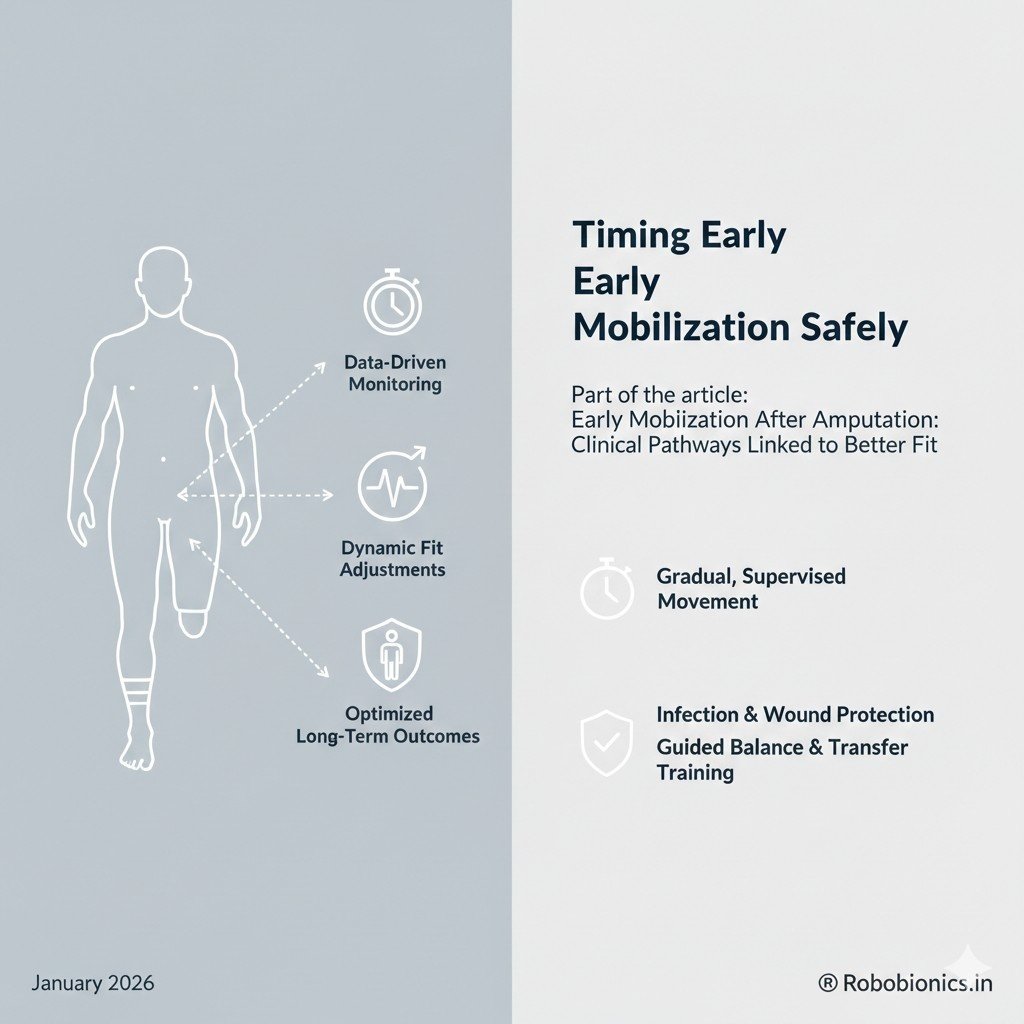
Mobilization does not mean walking immediately. It starts with safe actions like sitting up, changing positions, and gentle transfers.
Doctors should assess wound stability, pain control, and overall medical status before starting. Early does not mean careless.
The goal is safe progression, not speed.
No two patients recover at the same pace. Age, cause of amputation, and medical conditions affect readiness.
Doctors should adjust timelines based on healing signs rather than fixed days.
Flexible planning improves safety.
Delaying mobilization out of fear often causes more harm than benefit. Prolonged bed rest increases stiffness, weakness, and swelling.
Doctors should challenge unnecessary restrictions and reassess daily.
Timely movement prevents avoidable setbacks.
Muscle activity acts like a pump, pushing fluid back toward the heart. Even small movements improve lymphatic drainage.
Patients who mobilize early often show faster reduction in limb swelling.
Less swelling leads to easier shaping and earlier fitting.
Mobilization works best when paired with proper compression. Movement inside compression encourages even pressure distribution.
Doctors should coordinate both strategies rather than treating them separately.
Integration improves outcomes.
Some increase in warmth or mild redness is normal with activity. Persistent swelling or pain signals overload.
Doctors should adjust intensity rather than stop movement completely.
Balanced progression protects healing.
Movement places stress on healing tissue, but controlled stress supports strength. The key is keeping stress within safe limits.
Doctors should guide therapists on movement ranges and weight limits.
Clear boundaries prevent injury.
Pain should guide intensity, not stop all activity. Sharp or worsening pain needs evaluation, but mild discomfort is expected.
Doctors should help patients understand this difference.
Education reduces fear-driven immobility.
Regular wound checks ensure mobilization is not causing harm. Changes in drainage, redness, or tension need prompt attention.
Early detection allows quick correction.
Vigilance keeps movement safe.
Early mobilization naturally moves joints through range. This prevents muscles from shortening and joints from stiffening.
Patients who move early have fewer contractures and need less corrective therapy later.
Movement is the best contracture prevention.
Mobilization should include movements that reach near full joint range, as tolerated. Partial movement alone is not enough.
Doctors should encourage therapists to aim for quality movement.
Full range preserves flexibility.
Rest is important, but prolonged rest encourages stiffness. Alternating activity with rest supports recovery.
Doctors should guide patients toward balanced routines.
Balance sustains progress.
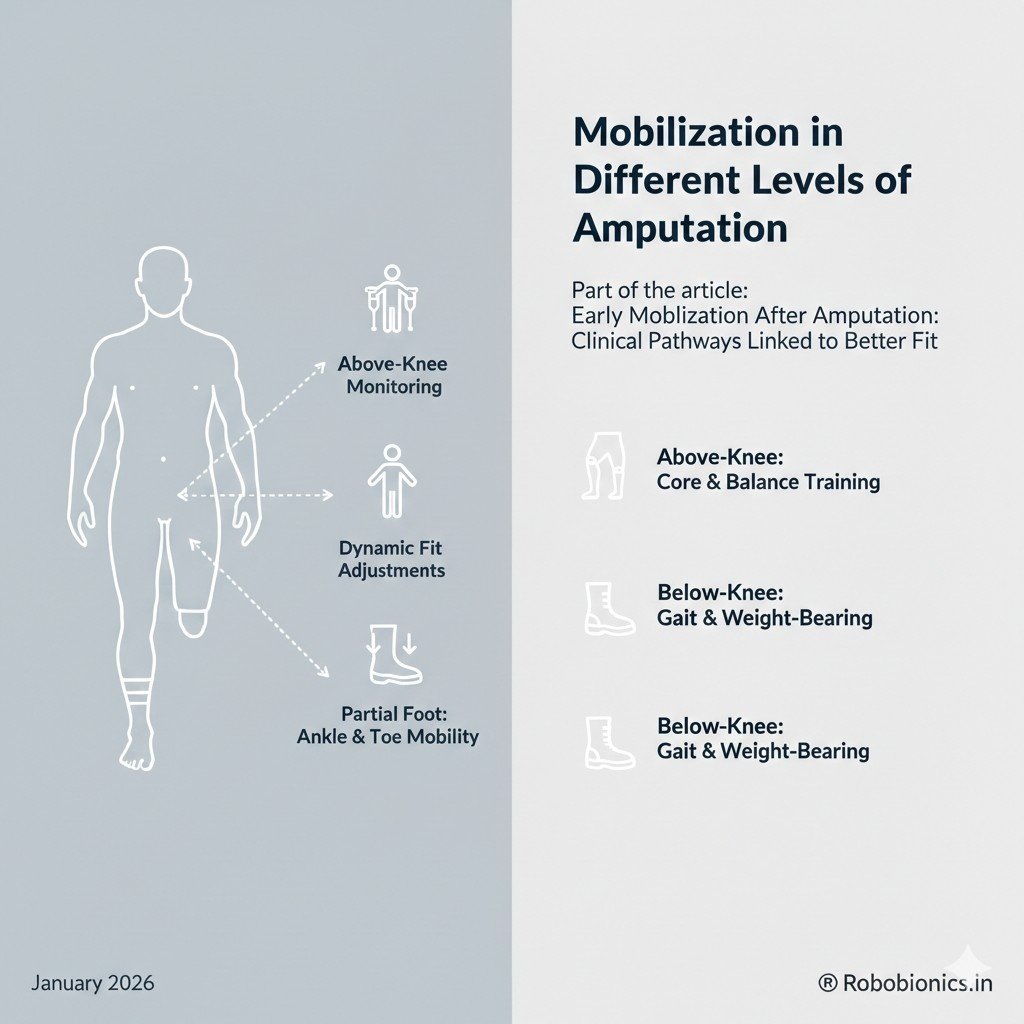
Below-knee amputees benefit from early sitting, transfers, and standing balance activities. Knee extension during activity prevents flexion stiffness.
Early weight shifts build confidence and strength.
These steps prepare the limb for socket tolerance.
Above-knee amputees need careful hip control during mobilization. Early prone positioning and supported standing prevent hip flexion contractures.
Balance training is crucial due to higher energy demands.
Doctors should ensure gradual progression.
Upper limb amputees should mobilize the shoulder early. Gentle reaching and posture training prevent stiffness.
Hand and arm movement support circulation and reduce swelling.
Early use supports future prosthetic control.
Doctors set the tone for mobilization. When doctors prioritize movement, teams follow.
Clear orders and encouragement remove hesitation.
Leadership drives action.
Therapists guide safe techniques and progression. Doctors should share surgical details and precautions.
Open communication avoids mixed messages.
Teamwork improves confidence.
Nurses assist with transfers and positioning. Their involvement ensures movement happens outside therapy sessions.
Doctors should include nursing staff in mobilization plans.
Shared responsibility ensures consistency.
Most movement habits are formed in the ward. Patients copy what they see and repeat what feels allowed. If movement is delayed here, fear and stiffness grow quietly.
Clear ward pathways turn movement into routine care. When sitting up, transfers, and short stands are expected, patients adapt quickly.
Doctors who standardize ward movement protect future function.
Mobilization should be planned daily, not left to chance. Simple goals like sitting out of bed, standing with support, or short walks build momentum.
When goals are written and reviewed, they happen more often. Verbal encouragement alone is not enough.
Structure removes hesitation.
Different shifts often follow different rules. One shift encourages movement, another restricts it. This confuses patients.
Doctors should ensure consistent instructions across teams. What is allowed should be clear to everyone.
Consistency builds confidence.
Patients move better when they know why movement matters. Explaining that early movement improves prosthetic fit gives purpose.
Purpose reduces fear and resistance. Patients stop seeing movement as a test and start seeing it as preparation.
Understanding drives effort.
Patients do not need technical detail. They need to know what is safe, what to avoid, and when to ask for help.
Demonstrations work better than instructions alone. Simple cues are remembered longer.
Clarity improves participation.
Family members often help patients sit, stand, and walk. Without guidance, they may overprotect.
Doctors should reassure families that guided movement is safe. When families support movement, activity increases.
Support multiplies effort.
Balance is the base of all movement. After amputation, balance changes suddenly.
Early balance training retrains the body to feel safe upright. This reduces falls and fear later.
Balance prepares patients for prosthetic use.
Balance training starts with sitting balance, then standing with support. Progression is gradual.
Doctors should ensure patients feel supported, not rushed.
Confidence grows with success.
Patients who balance well tolerate early socket trials better. They shift weight smoothly and avoid sudden pressure spikes.
Balance protects skin and comfort.
This link is often overlooked.
Muscles weaken quickly with bed rest. Weak muscles struggle to support a prosthesis later.
Early mobilization preserves strength, especially in the core and remaining limb muscles.
Strength supports alignment and control.
Functional movements like transfers and standing build useful strength. These movements mirror daily life.
Doctors should prioritize functional activity over isolated exercises early on.
Function builds confidence.
While preserving strength, doctors should watch for overuse. Fatigue can change movement quality.
Rest and progression should be planned.
Balance prevents injury.
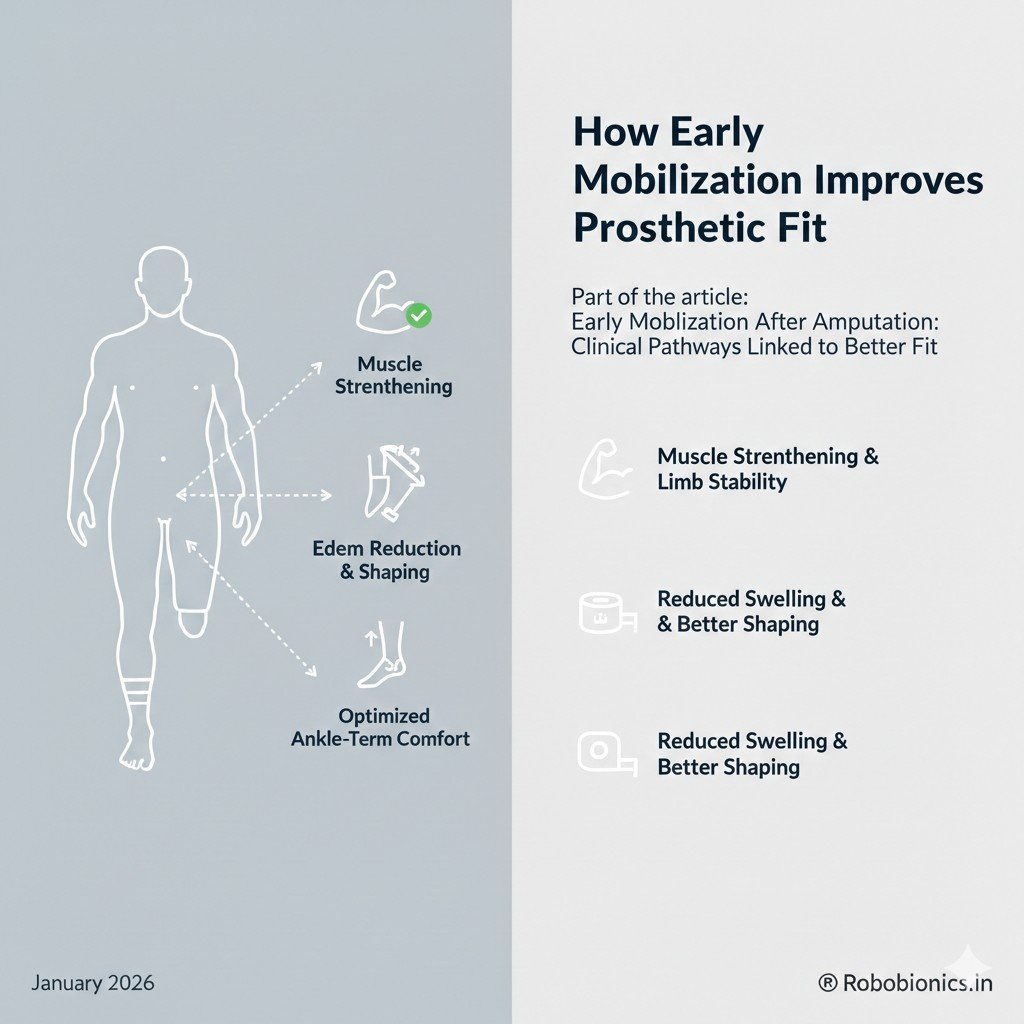
Movement applies gentle, repeated pressure to tissues. This supports even limb shaping.
Inactive limbs often develop uneven soft tissue. Active limbs shape more predictably.
Better shape means better fit.
Early movement exposes skin to mild stress. Over time, skin adapts and becomes more tolerant.
This conditioning reduces redness during socket trials.
Prepared skin lasts longer.
Mobilized limbs tend to stabilize in volume earlier. Swelling resolves faster and fluctuates less.
Stable volume simplifies socket design.
Predictability saves time.
Rest is important, but too much rest slows recovery. Patients often believe staying still protects healing.
Doctors should correct this belief gently.
Movement is part of recovery.
There is rarely a perfect moment. Waiting for all pain to disappear delays progress.
Doctors should focus on safe readiness, not perfection.
Timely action matters.
Fear limits movement more than pain. Ignoring fear leads to avoidance.
Doctors should address fear directly and reassure patients.
Calm guidance unlocks movement.
Elderly patients lose strength and balance quickly. Early mobilization prevents rapid decline.
Progression may be slower, but movement is still essential.
Gentle consistency works best.
Patients with heart, lung, or metabolic issues still benefit from early movement, with modification.
Doctors should coordinate with medical teams to set safe limits.
Adaptation is better than avoidance.
Trauma patients may have multiple injuries. Mobilization plans must respect all injuries.
Even small movements within limits make a difference.
Partial movement is better than none.
Progress should be measured by what patients can do, not just by time. Sitting tolerance, standing time, and transfer ability are useful markers.
These markers guide safe progression.
Function tells the real story.
Setbacks happen due to pain, infection, or fatigue. Early response prevents loss of momentum.
Doctors should adjust intensity, not abandon mobilization.
Continuity matters.
Celebrating small gains motivates patients. Standing longer or walking farther builds confidence.
Doctors should acknowledge progress openly.
Recognition fuels effort.
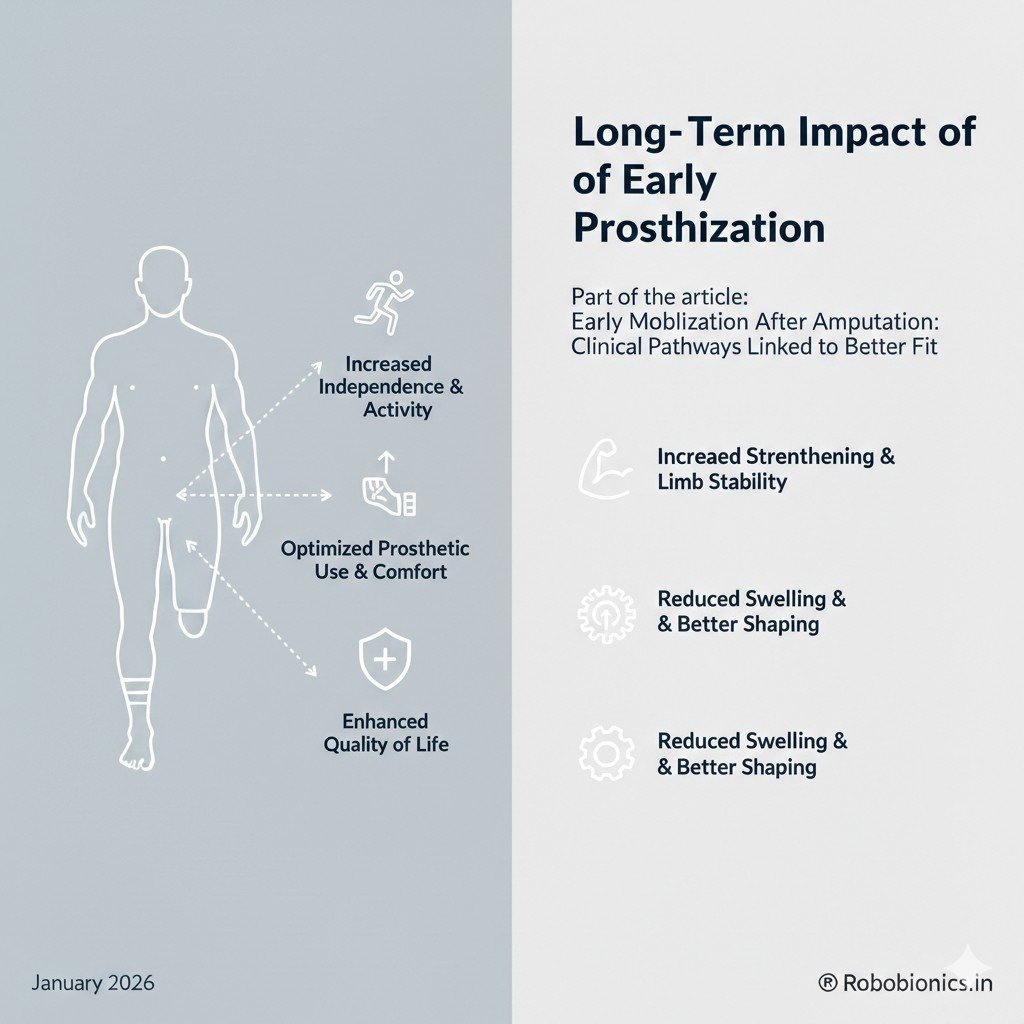
Patients who mobilize early are ready for prosthetics sooner. Their limbs shape better and tolerate pressure earlier.
This shortens the overall rehabilitation timeline.
Early effort pays off.
Good early habits lead to smoother gait and better control. Comfort improves and fatigue reduces.
Patients use their prosthesis longer each day.
Comfort sustains independence.
Early mobilization reduces complications like contractures, skin breakdown, and prolonged rehab.
This saves time and resources for patients and clinics.
Efficiency improves care quality.
Early mobilization should be seen as essential care, not optional therapy. Doctors set this priority.
When movement is valued, outcomes improve.
Priority shapes practice.
Patients move more when they understand how movement affects their future prosthesis.
Meaning transforms effort into commitment.
Doctors should make this link clear.
A good prosthetic fit begins long before the socket is made. It begins with early, guided movement.
Clinical pathways that encourage early mobilization create better fits and better lives.
This is how mobility is restored with care.
A middle-aged patient underwent a planned below-knee amputation due to infection. Pain was controlled early, and sitting at the edge of the bed began on day two. By day three, the patient was standing with support.
Swelling reduced steadily, and the limb responded well to compression. When referred for prosthetics, the residual limb showed stable volume and good skin tolerance.
Early mobilization shortened the overall rehab timeline and reduced fitting adjustments.
An above-knee amputee remained mostly in bed for the first week due to fear of pain and falls. Hip flexion positioning became habitual.
When mobilization finally began, stiffness limited upright posture and balance. Prosthetic fitting was delayed to address contracture risk.
This case shows how delay increases downstream complexity.
An upper-limb amputee started gentle shoulder and trunk movements within days of surgery. Posture training and supported reach were emphasized.
Swelling reduced, and shoulder range remained full. When myoelectric fitting began, control and comfort were excellent.
Early movement protected both motion and confidence.
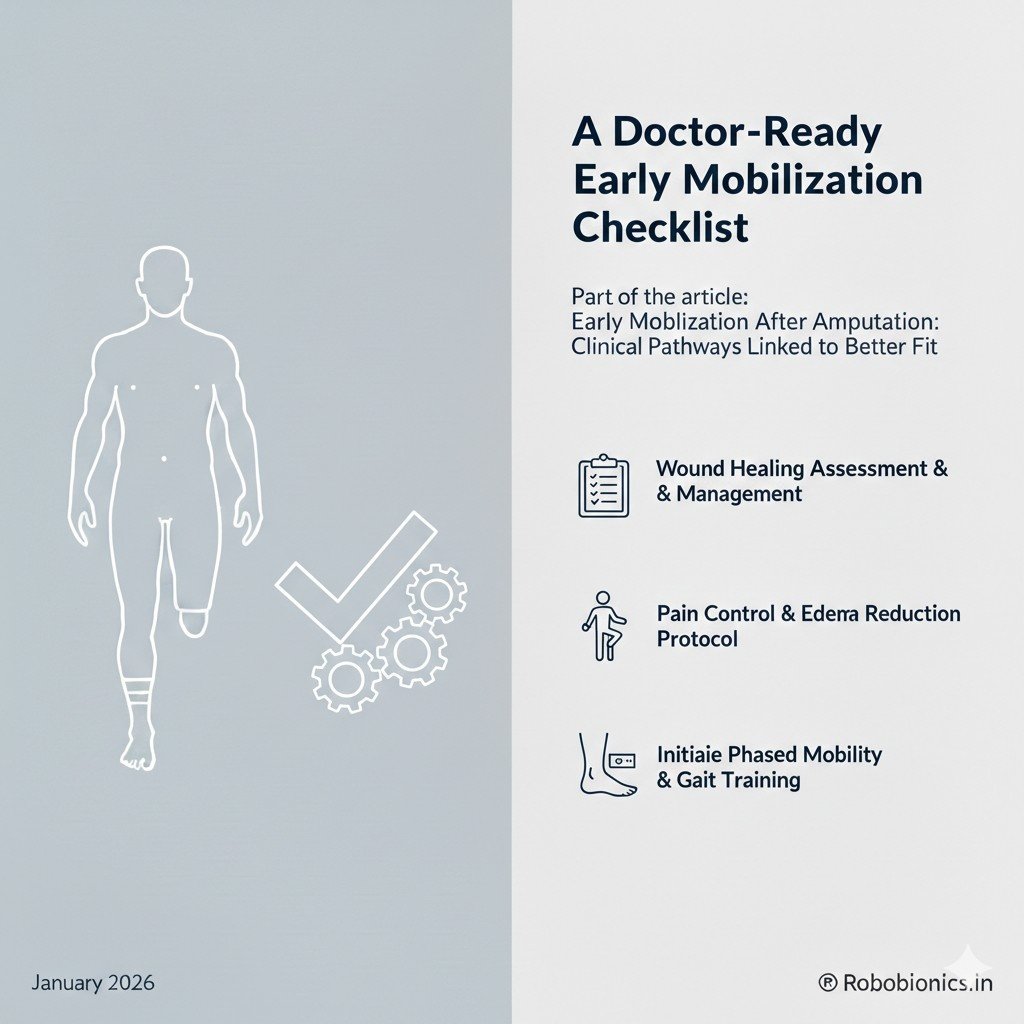
Doctors should confirm wound stability, pain control, and basic medical safety. Vital signs, hemoglobin levels, and overall alertness guide readiness.
Clear documentation of precautions helps the team move confidently.
Safety enables progress.
Mobilization orders should specify allowed positions, weight-bearing limits, and daily goals. Vague orders lead to inactivity.
Written goals turn intent into action.
Clarity removes hesitation.
Doctors should observe limb position, ask about movement done, and note barriers. These quick checks reinforce importance.
What is checked gets done.
Attention drives adherence.
Mobilized limbs develop firmer, evenly distributed tissue. This supports uniform socket contact.
Patients report fewer pressure points during trials.
Comfort begins early.
When limb shape is predictable, prosthetic design is simpler. Fewer adjustments are needed.
This saves time and reduces patient frustration.
Preparation reduces trial and error.
Early movement preserves joint range and muscle balance. This supports better alignment once the prosthesis is worn.
Better alignment means less energy use and pain.
Movement protects mechanics.
Controlled movement does not harm a stable wound. In fact, improved circulation supports healing.
Fear-based restriction often causes more harm.
Education replaces fear with confidence.
Waiting delays strength, balance, and shaping. Prosthetic rehab then becomes corrective instead of progressive.
Early mobilization prepares the body.
Preparation reduces struggle.
Older patients benefit the most from early movement. Delay leads to rapid decline.
Gentle progression works at any age.
Age is not a reason to wait.
Hospitals benefit from standard early mobilization pathways for amputees. These reduce variation and missed opportunities.
Pathways guide new staff and maintain quality.
Standard care protects outcomes.
Staff training builds confidence in assisting mobilization. Fear of causing harm often limits activity.
Training replaces uncertainty with skill.
Skill enables safe movement.
Tracking time to first sit, stand, and walk helps teams improve. These metrics highlight delays.
Measurement drives improvement.
Data supports change.
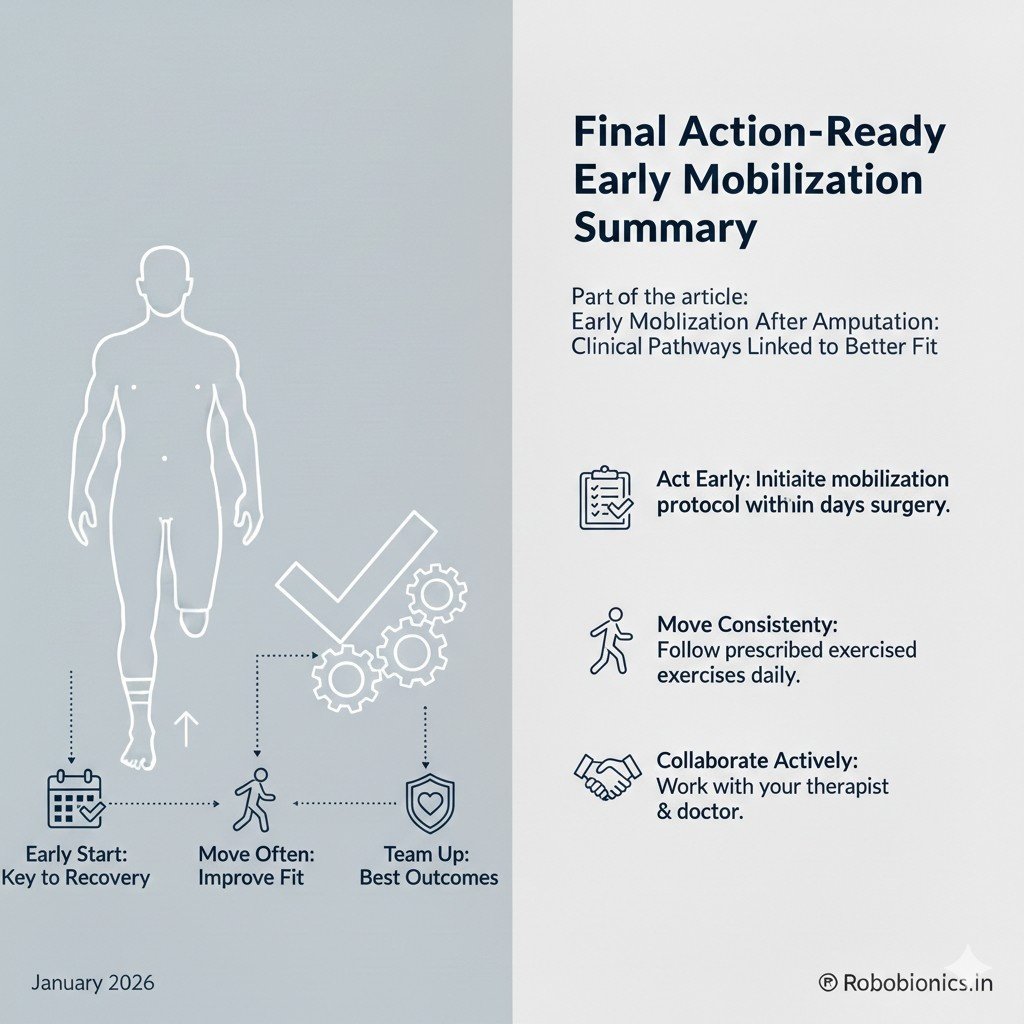
Early mobilization is not optional. It shapes healing, limb form, and prosthetic success.
Delays create problems that are hard to undo.
Early action saves time later.
Prescribe movement early, review it daily, and explain its purpose clearly.
Small actions create large gains.
Consistency matters.
Patients who move early heal better, fit faster, and live more independently.
Early mobilization links directly to better prosthetic fit and better lives.
This is thoughtful, effective care.
For many clinicians, the surgery is only the first step. What happens after the operation

For trauma amputees, the journey does not begin at the prosthetic clinic. It begins much

Amputation after cancer is not just a surgical event. It is the end of one

When a child loses a limb, the challenge is never only physical. A child’s body