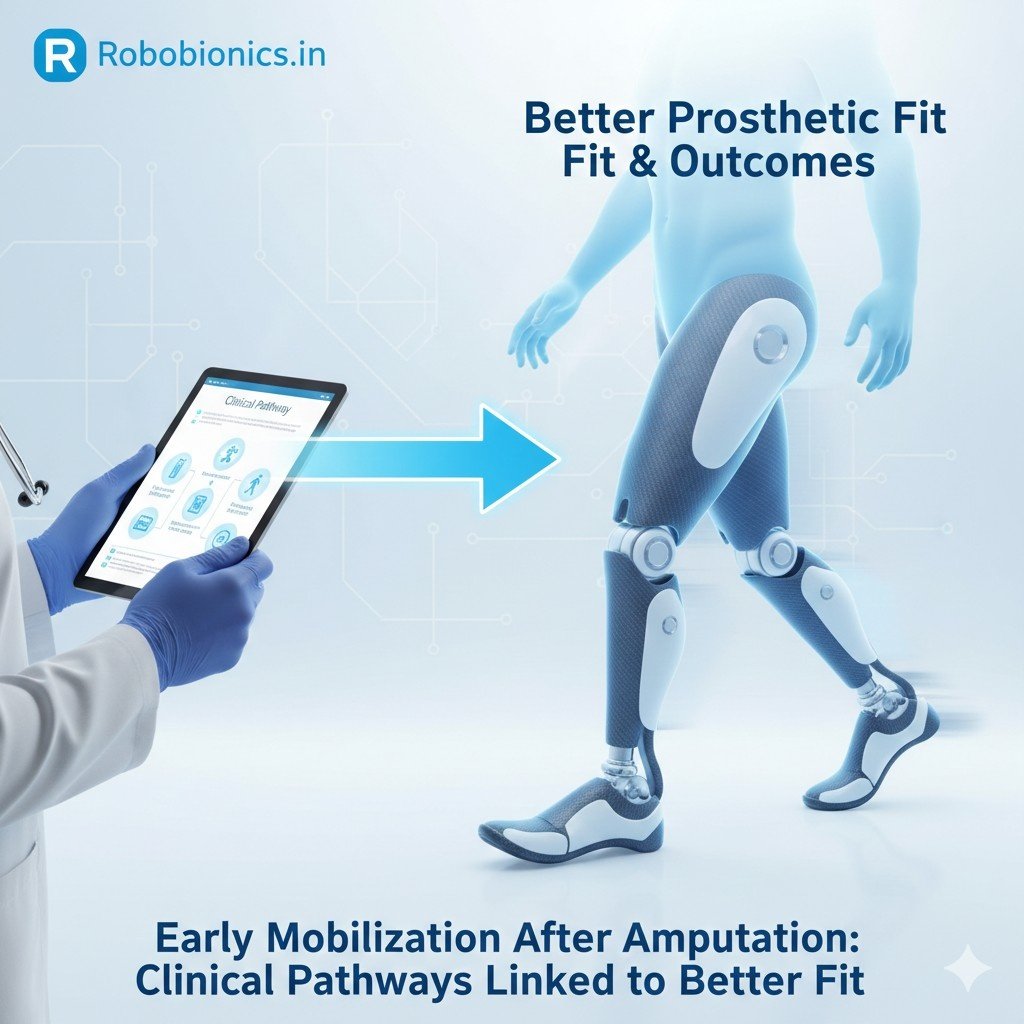
Early Mobilization After Amputation: Clinical Pathways Linked to Better Fit

Early mobilization after amputation is not about rushing a patient out of bed. It is about guiding safe, meaningful movement at the right time so the body heals in the right way. When patients move early, swelling reduces faster, muscles stay active, joints remain flexible, and confidence grows. These changes directly affect how well a prosthetic limb fits and functions later.

This article is written for clinicians who manage amputees from surgery to prosthetic fitting. It explains how early mobilization improves limb shape, skin tolerance, balance, and readiness for a socket. The focus is practical and realistic, shaped by real clinical settings across India. When doctors use clear mobilization pathways instead of waiting for problems to appear, patients recover faster and prosthetic outcomes improve.

Why Early Mobilization Matters After Amputation

Movement as a healing signal

The human body responds to movement as a signal to heal. When muscles contract and joints move, blood flow improves and swelling reduces. This creates a healthier environment for the surgical site and surrounding tissues.

Without movement, fluids collect, tissues stiffen, and healing slows. Early mobilization gently reminds the body how to recover in a functional way.

Doctors who encourage early movement support natural healing processes.

Link between movement and residual limb shape

The shape of the residual limb is influenced by how it is used. Muscles that stay active maintain tone, while inactive muscles soften and allow tissue to sag.

Early movement supports even shaping and better volume control. This leads to a limb that fits more comfortably inside a prosthetic socket.

Mobilization is an indirect but powerful shaping tool.

Psychological impact of early movement

Early mobilization restores a sense of control. Patients feel less dependent and more confident when they can sit, stand, or move with support.

This confidence reduces fear and anxiety, which otherwise slow recovery. A calm patient participates better in care.

Mental readiness supports physical progress.
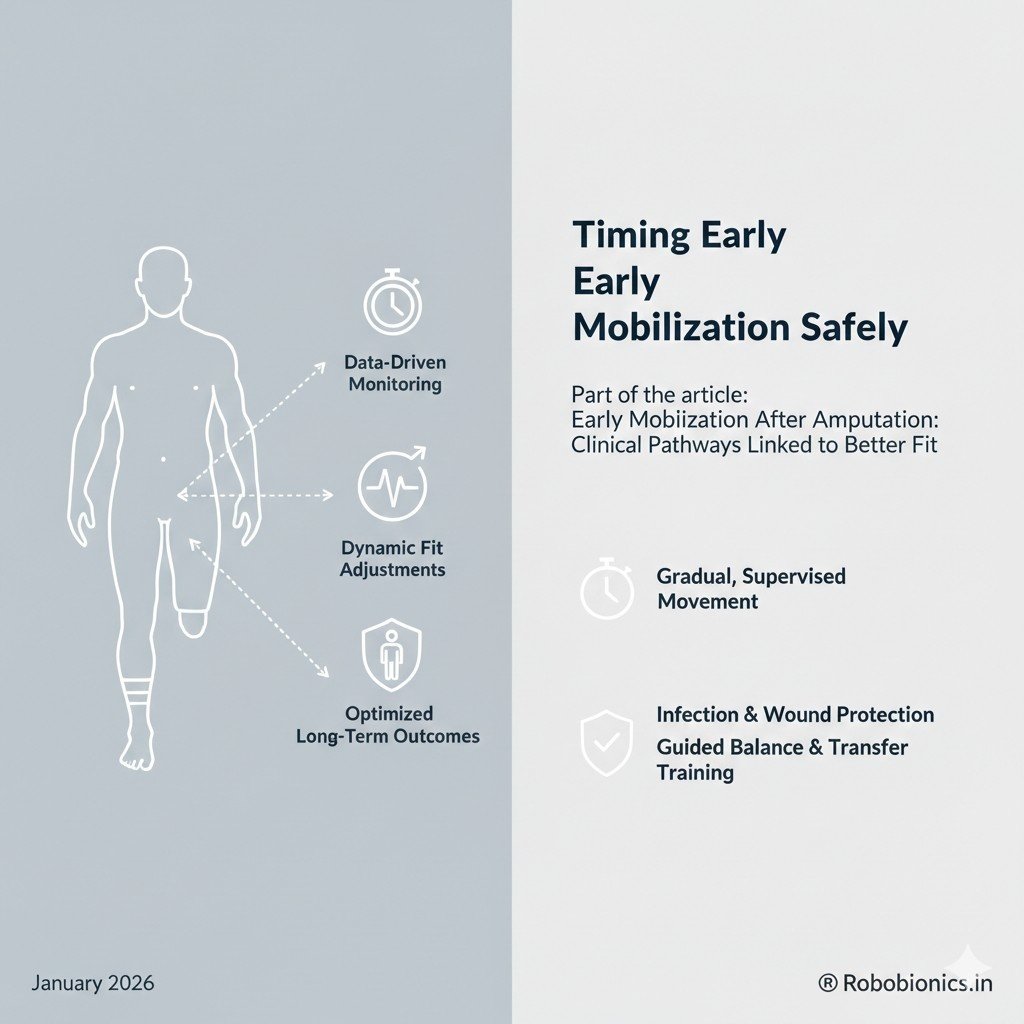
Timing Early Mobilization Safely

When movement can begin

Mobilization does not mean walking immediately. It starts with safe actions like sitting up, changing positions, and gentle transfers.

Doctors should assess wound stability, pain control, and overall medical status before starting. Early does not mean careless.

The goal is safe progression, not speed.

Individualizing timing for each patient

No two patients recover at the same pace. Age, cause of amputation, and medical conditions affect readiness.

Doctors should adjust timelines based on healing signs rather than fixed days.

Flexible planning improves safety.

Avoiding unnecessary delays

Delaying mobilization out of fear often causes more harm than benefit. Prolonged bed rest increases stiffness, weakness, and swelling.

Doctors should challenge unnecessary restrictions and reassess daily.

Timely movement prevents avoidable setbacks.

Early Mobilization and Edema Control

How movement reduces swelling

Muscle activity acts like a pump, pushing fluid back toward the heart. Even small movements improve lymphatic drainage.

Patients who mobilize early often show faster reduction in limb swelling.

Less swelling leads to easier shaping and earlier fitting.

Combining mobilization with compression

Mobilization works best when paired with proper compression. Movement inside compression encourages even pressure distribution.

Doctors should coordinate both strategies rather than treating them separately.

Integration improves outcomes.

Monitoring limb response to activity

Some increase in warmth or mild redness is normal with activity. Persistent swelling or pain signals overload.

Doctors should adjust intensity rather than stop movement completely.

Balanced progression protects healing.

Protecting the Surgical Site During Mobilization

Understanding safe stress versus harmful stress

Movement places stress on healing tissue, but controlled stress supports strength. The key is keeping stress within safe limits.

Doctors should guide therapists on movement ranges and weight limits.

Clear boundaries prevent injury.

Pain as a guide, not an enemy

Pain should guide intensity, not stop all activity. Sharp or worsening pain needs evaluation, but mild discomfort is expected.

Doctors should help patients understand this difference.

Education reduces fear-driven immobility.

Wound observation during early movement

Regular wound checks ensure mobilization is not causing harm. Changes in drainage, redness, or tension need prompt attention.

Early detection allows quick correction.

Vigilance keeps movement safe.

Early Mobilization and Joint Protection

Preventing contractures through movement

Early mobilization naturally moves joints through range. This prevents muscles from shortening and joints from stiffening.

Patients who move early have fewer contractures and need less corrective therapy later.

Movement is the best contracture prevention.

Importance of full-range positioning

Mobilization should include movements that reach near full joint range, as tolerated. Partial movement alone is not enough.

Doctors should encourage therapists to aim for quality movement.

Full range preserves flexibility.

Balancing rest and activity

Rest is important, but prolonged rest encourages stiffness. Alternating activity with rest supports recovery.

Doctors should guide patients toward balanced routines.

Balance sustains progress.
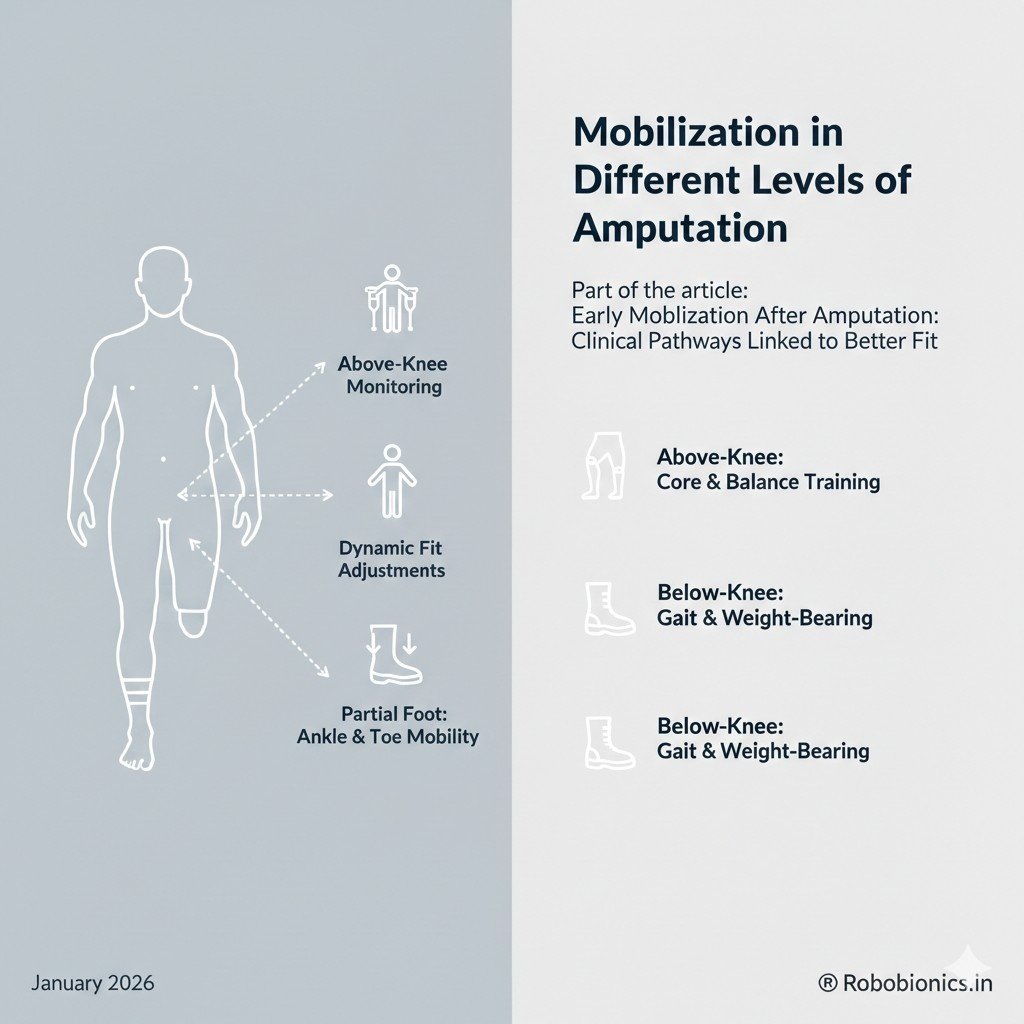
Mobilization in Different Levels of Amputation

Below-knee amputees

Below-knee amputees benefit from early sitting, transfers, and standing balance activities. Knee extension during activity prevents flexion stiffness.

Early weight shifts build confidence and strength.

These steps prepare the limb for socket tolerance.

Above-knee amputees

Above-knee amputees need careful hip control during mobilization. Early prone positioning and supported standing prevent hip flexion contractures.

Balance training is crucial due to higher energy demands.

Doctors should ensure gradual progression.

Upper limb amputees

Upper limb amputees should mobilize the shoulder early. Gentle reaching and posture training prevent stiffness.

Hand and arm movement support circulation and reduce swelling.

Early use supports future prosthetic control.

Role of the Care Team in Early Mobilization

Doctor leadership in mobilization planning

Doctors set the tone for mobilization. When doctors prioritize movement, teams follow.

Clear orders and encouragement remove hesitation.

Leadership drives action.

Coordination with physiotherapists

Therapists guide safe techniques and progression. Doctors should share surgical details and precautions.

Open communication avoids mixed messages.

Teamwork improves confidence.

Nursing support for daily movement

Nurses assist with transfers and positioning. Their involvement ensures movement happens outside therapy sessions.

Doctors should include nursing staff in mobilization plans.

Shared responsibility ensures consistency.

Ward-Level Mobilization Pathways That Work

Why wards decide long-term outcomes

Most movement habits are formed in the ward. Patients copy what they see and repeat what feels allowed. If movement is delayed here, fear and stiffness grow quietly.

Clear ward pathways turn movement into routine care. When sitting up, transfers, and short stands are expected, patients adapt quickly.

Doctors who standardize ward movement protect future function.

Making mobilization a daily expectation

Mobilization should be planned daily, not left to chance. Simple goals like sitting out of bed, standing with support, or short walks build momentum.

When goals are written and reviewed, they happen more often. Verbal encouragement alone is not enough.

Structure removes hesitation.

Reducing variation across shifts

Different shifts often follow different rules. One shift encourages movement, another restricts it. This confuses patients.

Doctors should ensure consistent instructions across teams. What is allowed should be clear to everyone.

Consistency builds confidence.

Educating Patients and Caregivers Early

Why understanding changes behavior

Patients move better when they know why movement matters. Explaining that early movement improves prosthetic fit gives purpose.

Purpose reduces fear and resistance. Patients stop seeing movement as a test and start seeing it as preparation.

Understanding drives effort.

Teaching safe movement in simple terms

Patients do not need technical detail. They need to know what is safe, what to avoid, and when to ask for help.

Demonstrations work better than instructions alone. Simple cues are remembered longer.

Clarity improves participation.

Involving family as movement partners

Family members often help patients sit, stand, and walk. Without guidance, they may overprotect.

Doctors should reassure families that guided movement is safe. When families support movement, activity increases.

Support multiplies effort.

Early Mobilization and Balance Training

Why balance matters before prosthetics

Balance is the base of all movement. After amputation, balance changes suddenly.

Early balance training retrains the body to feel safe upright. This reduces falls and fear later.

Balance prepares patients for prosthetic use.

Starting balance work safely

Balance training starts with sitting balance, then standing with support. Progression is gradual.

Doctors should ensure patients feel supported, not rushed.

Confidence grows with success.

Linking balance to socket readiness

Patients who balance well tolerate early socket trials better. They shift weight smoothly and avoid sudden pressure spikes.

Balance protects skin and comfort.

This link is often overlooked.

Strength Preservation Through Early Activity

Muscle loss without movement

Muscles weaken quickly with bed rest. Weak muscles struggle to support a prosthesis later.

Early mobilization preserves strength, especially in the core and remaining limb muscles.

Strength supports alignment and control.

Functional strength over exercise

Functional movements like transfers and standing build useful strength. These movements mirror daily life.

Doctors should prioritize functional activity over isolated exercises early on.

Function builds confidence.

Preventing overuse injuries

While preserving strength, doctors should watch for overuse. Fatigue can change movement quality.

Rest and progression should be planned.

Balance prevents injury.
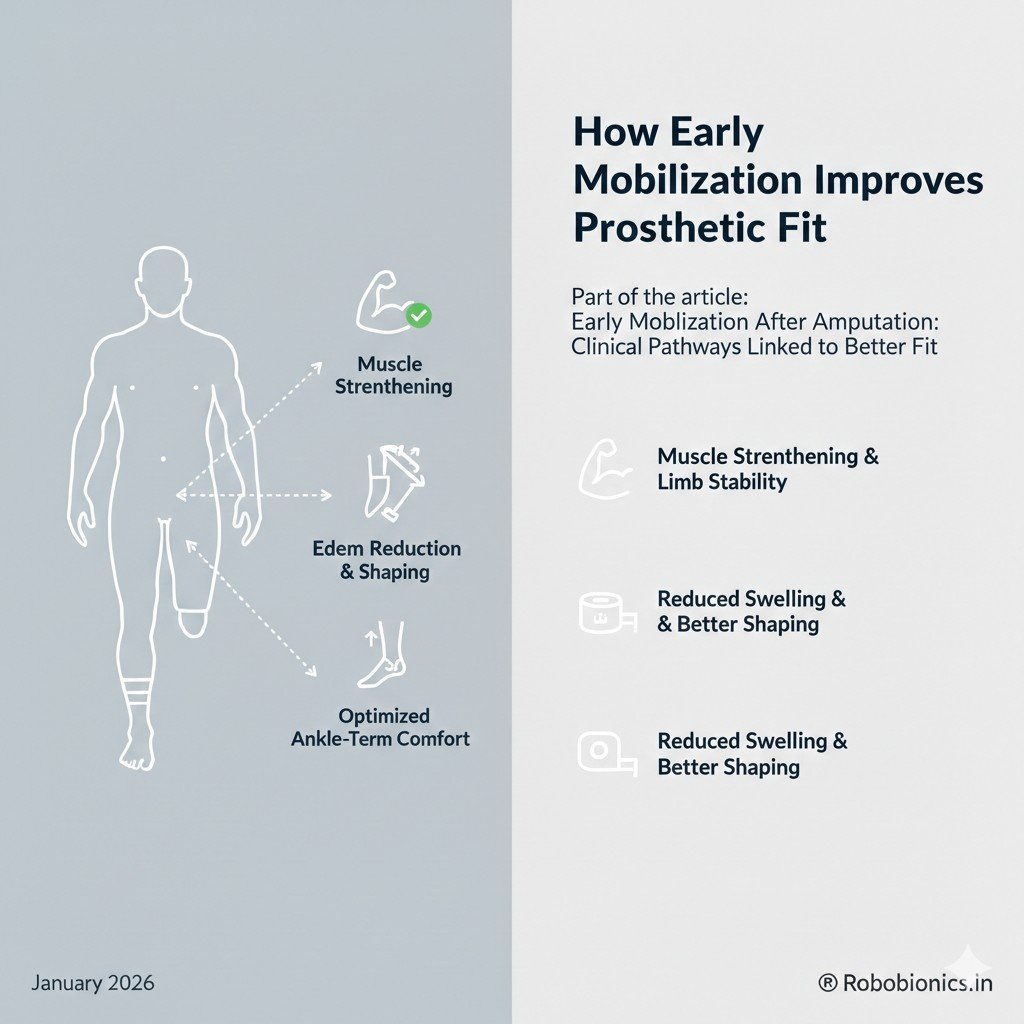
How Early Mobilization Improves Prosthetic Fit

Shaping through activity

Movement applies gentle, repeated pressure to tissues. This supports even limb shaping.

Inactive limbs often develop uneven soft tissue. Active limbs shape more predictably.

Better shape means better fit.

Skin conditioning and tolerance

Early movement exposes skin to mild stress. Over time, skin adapts and becomes more tolerant.

This conditioning reduces redness during socket trials.

Prepared skin lasts longer.

Volume stability and predictability

Mobilized limbs tend to stabilize in volume earlier. Swelling resolves faster and fluctuates less.

Stable volume simplifies socket design.

Predictability saves time.

Preventing Common Mobilization Errors

Confusing rest with recovery

Rest is important, but too much rest slows recovery. Patients often believe staying still protects healing.

Doctors should correct this belief gently.

Movement is part of recovery.

Waiting for the “right time”

There is rarely a perfect moment. Waiting for all pain to disappear delays progress.

Doctors should focus on safe readiness, not perfection.

Timely action matters.

Ignoring patient fear

Fear limits movement more than pain. Ignoring fear leads to avoidance.

Doctors should address fear directly and reassure patients.

Calm guidance unlocks movement.

Mobilization in Special Populations

Elderly patients

Elderly patients lose strength and balance quickly. Early mobilization prevents rapid decline.

Progression may be slower, but movement is still essential.

Gentle consistency works best.

Patients with medical complications

Patients with heart, lung, or metabolic issues still benefit from early movement, with modification.

Doctors should coordinate with medical teams to set safe limits.

Adaptation is better than avoidance.

Trauma and polytrauma patients

Trauma patients may have multiple injuries. Mobilization plans must respect all injuries.

Even small movements within limits make a difference.

Partial movement is better than none.

Measuring Progress and Adjusting Pathways

Using functional milestones

Progress should be measured by what patients can do, not just by time. Sitting tolerance, standing time, and transfer ability are useful markers.

These markers guide safe progression.

Function tells the real story.

Responding to setbacks quickly

Setbacks happen due to pain, infection, or fatigue. Early response prevents loss of momentum.

Doctors should adjust intensity, not abandon mobilization.

Continuity matters.

Reinforcing success to build momentum

Celebrating small gains motivates patients. Standing longer or walking farther builds confidence.

Doctors should acknowledge progress openly.

Recognition fuels effort.
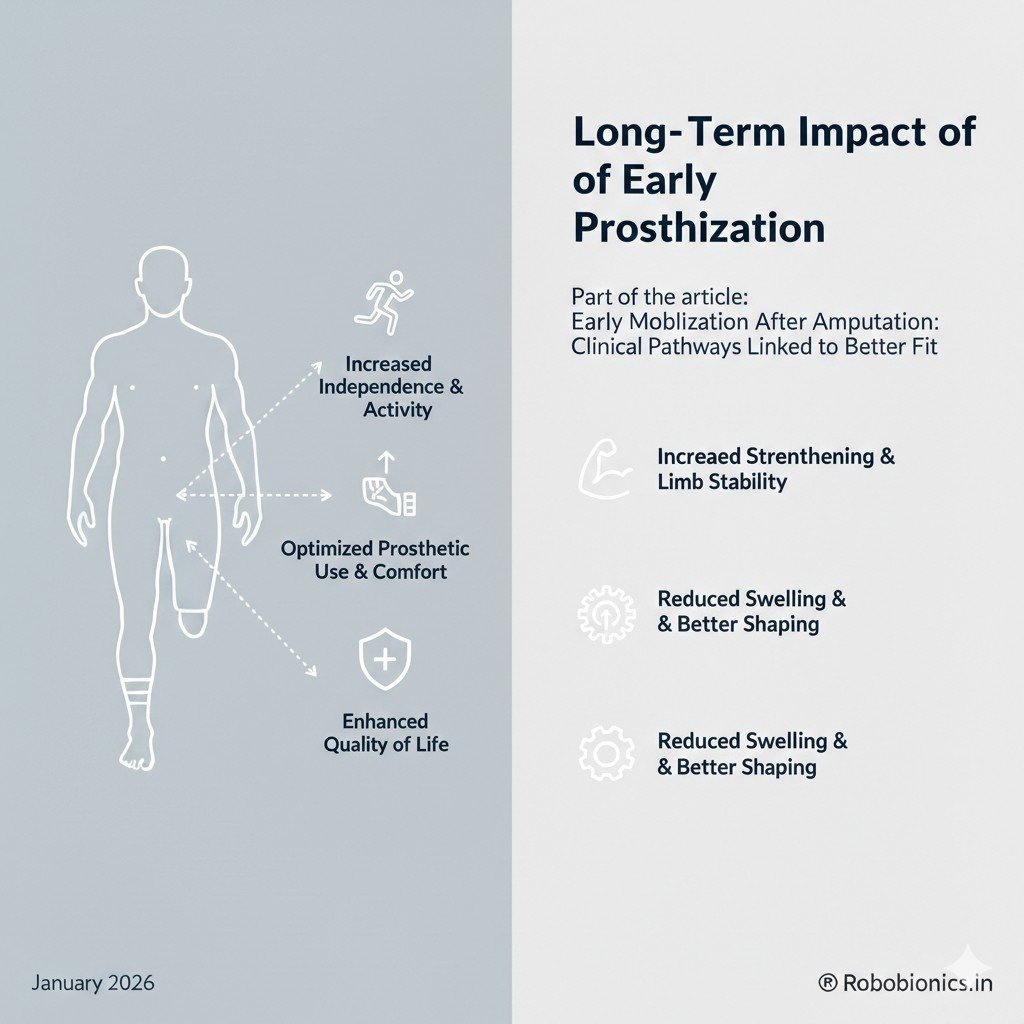
Long-Term Impact of Early Mobilization

Faster prosthetic readiness

Patients who mobilize early are ready for prosthetics sooner. Their limbs shape better and tolerate pressure earlier.

This shortens the overall rehabilitation timeline.

Early effort pays off.

Better prosthetic use and comfort

Good early habits lead to smoother gait and better control. Comfort improves and fatigue reduces.

Patients use their prosthesis longer each day.

Comfort sustains independence.

Reduced healthcare burden

Early mobilization reduces complications like contractures, skin breakdown, and prolonged rehab.

This saves time and resources for patients and clinics.

Efficiency improves care quality.

Final Clinical Perspective

Mobilization as a clinical priority

Early mobilization should be seen as essential care, not optional therapy. Doctors set this priority.

When movement is valued, outcomes improve.

Priority shapes practice.

Linking movement to meaning

Patients move more when they understand how movement affects their future prosthesis.

Meaning transforms effort into commitment.

Doctors should make this link clear.

Building better fits through better pathways

A good prosthetic fit begins long before the socket is made. It begins with early, guided movement.

Clinical pathways that encourage early mobilization create better fits and better lives.

This is how mobility is restored with care.

Case-Based Clinical Examples

A below-knee amputee mobilized on day two

A middle-aged patient underwent a planned below-knee amputation due to infection. Pain was controlled early, and sitting at the edge of the bed began on day two. By day three, the patient was standing with support.

Swelling reduced steadily, and the limb responded well to compression. When referred for prosthetics, the residual limb showed stable volume and good skin tolerance.

Early mobilization shortened the overall rehab timeline and reduced fitting adjustments.

An above-knee amputee with delayed mobilization

An above-knee amputee remained mostly in bed for the first week due to fear of pain and falls. Hip flexion positioning became habitual.

When mobilization finally began, stiffness limited upright posture and balance. Prosthetic fitting was delayed to address contracture risk.

This case shows how delay increases downstream complexity.

An upper-limb amputee with early shoulder movement

An upper-limb amputee started gentle shoulder and trunk movements within days of surgery. Posture training and supported reach were emphasized.

Swelling reduced, and shoulder range remained full. When myoelectric fitting began, control and comfort were excellent.

Early movement protected both motion and confidence.
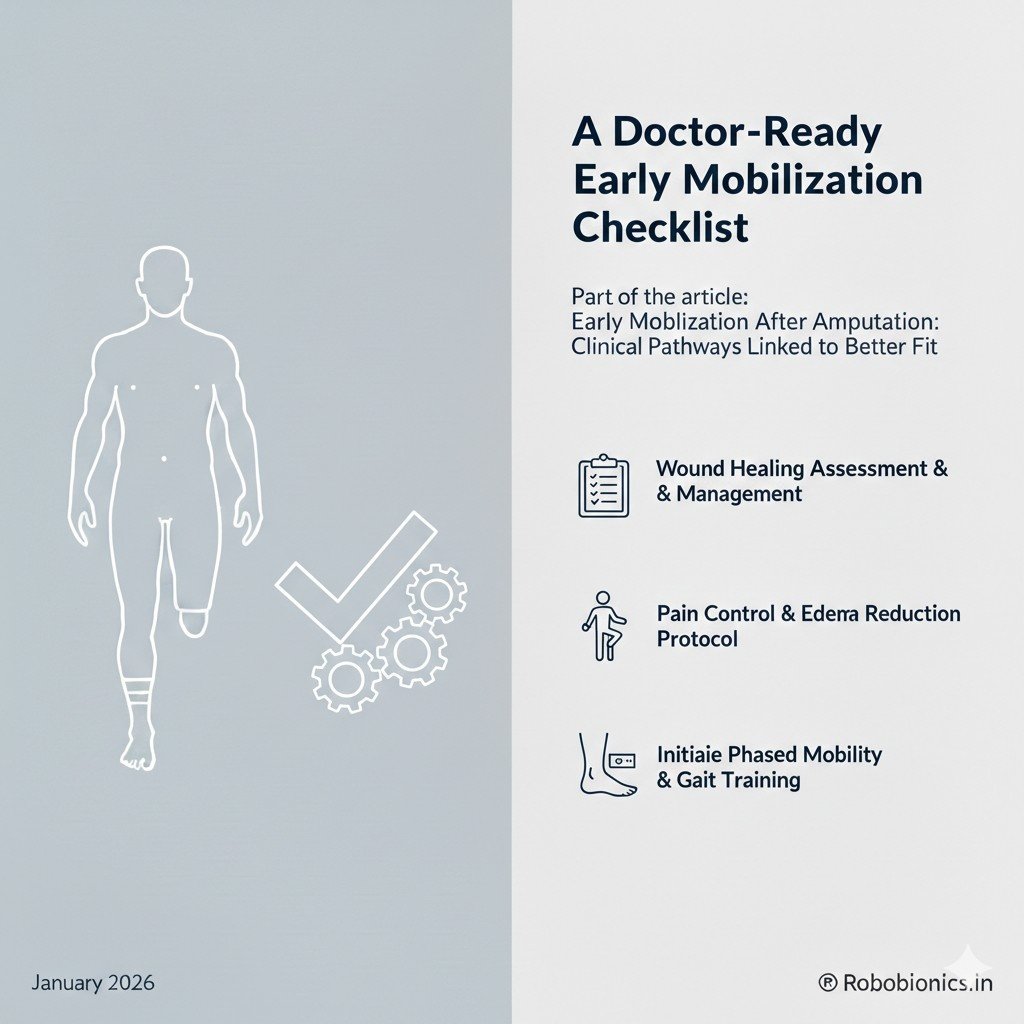
A Doctor-Ready Early Mobilization Checklist

What to assess before starting mobilization

Doctors should confirm wound stability, pain control, and basic medical safety. Vital signs, hemoglobin levels, and overall alertness guide readiness.

Clear documentation of precautions helps the team move confidently.

Safety enables progress.

What to prescribe clearly

Mobilization orders should specify allowed positions, weight-bearing limits, and daily goals. Vague orders lead to inactivity.

Written goals turn intent into action.

Clarity removes hesitation.

What to review daily on rounds

Doctors should observe limb position, ask about movement done, and note barriers. These quick checks reinforce importance.

What is checked gets done.

Attention drives adherence.

Linking Early Mobilization to Better Prosthetic Fit

How movement improves socket comfort

Mobilized limbs develop firmer, evenly distributed tissue. This supports uniform socket contact.

Patients report fewer pressure points during trials.

Comfort begins early.

Reducing socket modifications

When limb shape is predictable, prosthetic design is simpler. Fewer adjustments are needed.

This saves time and reduces patient frustration.

Preparation reduces trial and error.

Improving long-term alignment and gait

Early movement preserves joint range and muscle balance. This supports better alignment once the prosthesis is worn.

Better alignment means less energy use and pain.

Movement protects mechanics.

Common Myths That Delay Mobilization

“The wound will open if the patient moves”

Controlled movement does not harm a stable wound. In fact, improved circulation supports healing.

Fear-based restriction often causes more harm.

Education replaces fear with confidence.

“Mobilization can wait until prosthetic rehab”

Waiting delays strength, balance, and shaping. Prosthetic rehab then becomes corrective instead of progressive.

Early mobilization prepares the body.

Preparation reduces struggle.

“Older patients cannot mobilize early”

Older patients benefit the most from early movement. Delay leads to rapid decline.

Gentle progression works at any age.

Age is not a reason to wait.

Integrating Early Mobilization Into Hospital Systems

Creating standard pathways

Hospitals benefit from standard early mobilization pathways for amputees. These reduce variation and missed opportunities.

Pathways guide new staff and maintain quality.

Standard care protects outcomes.

Training staff to support movement

Staff training builds confidence in assisting mobilization. Fear of causing harm often limits activity.

Training replaces uncertainty with skill.

Skill enables safe movement.

Auditing outcomes to improve care

Tracking time to first sit, stand, and walk helps teams improve. These metrics highlight delays.

Measurement drives improvement.

Data supports change.
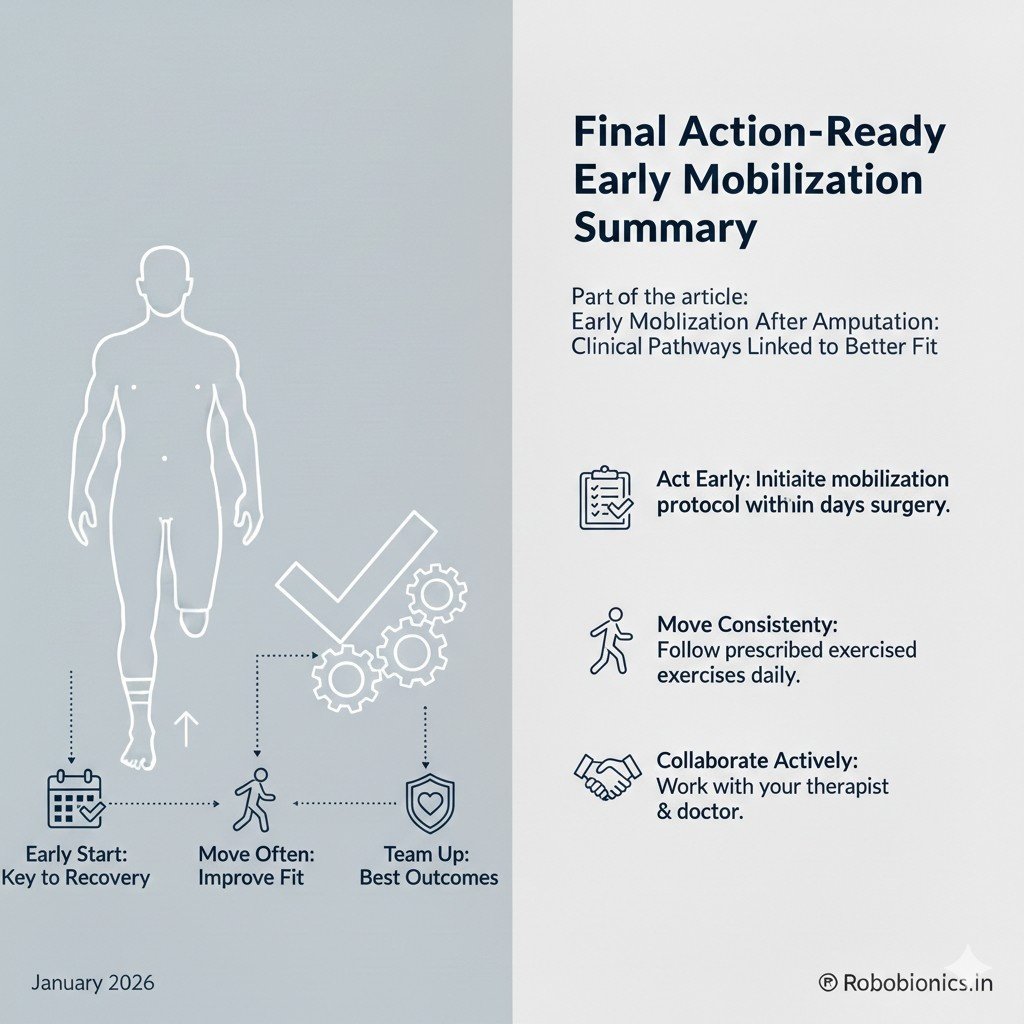
Final Action-Oriented Summary

What every doctor should remember

Early mobilization is not optional. It shapes healing, limb form, and prosthetic success.

Delays create problems that are hard to undo.

Early action saves time later.

What to change in daily practice

Prescribe movement early, review it daily, and explain its purpose clearly.

Small actions create large gains.

Consistency matters.

The lasting value of early mobilization

Patients who move early heal better, fit faster, and live more independently.

Early mobilization links directly to better prosthetic fit and better lives.

This is thoughtful, effective care.

Share:

More Posts

Partner With Us

REFUNDS AND CANCELLATIONS

Last updated: November 10, 2022

Thank you for shopping at Robo Bionics.

If, for any reason, You are not completely satisfied with a purchase We invite You to review our policy on refunds and returns.

The following terms are applicable for any products that You purchased with Us.

Interpretation And Definitions

Interpretation

The words of which the initial letter is capitalized have meanings defined under the following conditions. The following definitions shall have the same meaning regardless of whether they appear in singular or in plural.

Definitions

For the purposes of this Return and Refund Policy:

  • Company (referred to as either “the Company”, “Robo Bionics”, “We”, “Us” or “Our” in this Agreement) refers to Bionic Hope Private Limited, Pearl Haven, 1st Floor Kumbharwada, Manickpur Near St. Michael’s Church Vasai Road West, Palghar Maharashtra 401202.

  • Goods refer to the items offered for sale on the Website.

  • Orders mean a request by You to purchase Goods from Us.

  • Service refers to the Services Provided like Online Demo and Live Demo.

  • Website refers to Robo Bionics, accessible from https://robobionics.in

  • You means the individual accessing or using the Service, or the company, or other legal entity on behalf of which such individual is accessing or using the Service, as applicable.

Your Order Cancellation Rights

You are entitled to cancel Your Service Bookings within 7 days without giving any reason for doing so, before completion of Delivery.

The deadline for cancelling a Service Booking is 7 days from the date on which You received the Confirmation of Service.

In order to exercise Your right of cancellation, You must inform Us of your decision by means of a clear statement. You can inform us of your decision by:

  • By email: contact@robobionics.in

We will reimburse You no later than 7 days from the day on which We receive your request for cancellation, if above criteria is met. We will use the same means of payment as You used for the Service Booking, and You will not incur any fees for such reimbursement.

Please note in case you miss a Service Booking or Re-schedule the same we shall only entertain the request once.

Conditions For Returns

In order for the Goods to be eligible for a return, please make sure that:

  • The Goods were purchased in the last 14 days
  • The Goods are in the original packaging

The following Goods cannot be returned:

  • The supply of Goods made to Your specifications or clearly personalized.
  • The supply of Goods which according to their nature are not suitable to be returned, deteriorate rapidly or where the date of expiry is over.
  • The supply of Goods which are not suitable for return due to health protection or hygiene reasons and were unsealed after delivery.
  • The supply of Goods which are, after delivery, according to their nature, inseparably mixed with other items.

We reserve the right to refuse returns of any merchandise that does not meet the above return conditions in our sole discretion.

Only regular priced Goods may be refunded by 50%. Unfortunately, Goods on sale cannot be refunded. This exclusion may not apply to You if it is not permitted by applicable law.

Returning Goods

You are responsible for the cost and risk of returning the Goods to Us. You should send the Goods at the following:

  • the Prosthetic Limb Fitting Centre that they purchased the product from
  • email us at contact@robobionics.in with all the information and we shall provide you a mailing address in 3 days.

We cannot be held responsible for Goods damaged or lost in return shipment. Therefore, We recommend an insured and trackable courier service. We are unable to issue a refund without actual receipt of the Goods or proof of received return delivery.

Contact Us

If you have any questions about our Returns and Refunds Policy, please contact us:

  • By email: contact@robobionics.in

TERMS & CONDITIONS

Last Updated on: 1st Jan 2021

These Terms and Conditions (“Terms”) govern Your access to and use of the website, platforms, applications, products and services (ively, the “Services”) offered by Robo Bionics® (a registered trademark of Bionic Hope Private Limited, also used as a trade name), a company incorporated under the Companies Act, 2013, having its Corporate office at Pearl Heaven Bungalow, 1st Floor, Manickpur, Kumbharwada, Vasai Road (West), Palghar – 401202, Maharashtra, India (“Company”, “We”, “Us” or “Our”). By accessing or using the Services, You (each a “User”) agree to be bound by these Terms and all applicable laws and regulations. If You do not agree with any part of these Terms, You must immediately discontinue use of the Services.

1. DEFINITIONS

1.1 “Individual Consumer” means a natural person aged eighteen (18) years or above who registers to use Our products or Services following evaluation and prescription by a Rehabilitation Council of India (“RCI”)–registered Prosthetist.

1.2 “Entity Consumer” means a corporate organisation, nonprofit entity, CSR sponsor or other registered organisation that sponsors one or more Individual Consumers to use Our products or Services.

1.3 “Clinic” means an RCI-registered Prosthetics and Orthotics centre or Prosthetist that purchases products and Services from Us for fitment to Individual Consumers.

1.4 “Platform” means RehabConnect, Our online marketplace by which Individual or Entity Consumers connect with Clinics in their chosen locations.

1.5 “Products” means Grippy® Bionic Hand, Grippy® Mech, BrawnBand, WeightBand, consumables, accessories and related hardware.

1.6 “Apps” means Our clinician-facing and end-user software applications supporting Product use and data collection.

1.7 “Impact Dashboard™” means the analytics interface provided to CSR, NGO, corporate and hospital sponsors.

1.8 “Services” includes all Products, Apps, the Platform and the Impact Dashboard.

2. USER CATEGORIES AND ELIGIBILITY

2.1 Individual Consumers must be at least eighteen (18) years old and undergo evaluation and prescription by an RCI-registered Prosthetist prior to purchase or use of any Products or Services.

2.2 Entity Consumers must be duly registered under the laws of India and may sponsor one or more Individual Consumers.

2.3 Clinics must maintain valid RCI registration and comply with all applicable clinical and professional standards.

3. INTERMEDIARY LIABILITY

3.1 Robo Bionics acts solely as an intermediary connecting Users with Clinics via the Platform. We do not endorse or guarantee the quality, legality or outcomes of services rendered by any Clinic. Each Clinic is solely responsible for its professional services and compliance with applicable laws and regulations.

4. LICENSE AND INTELLECTUAL PROPERTY

4.1 All content, trademarks, logos, designs and software on Our website, Apps and Platform are the exclusive property of Bionic Hope Private Limited or its licensors.

4.2 Subject to these Terms, We grant You a limited, non-exclusive, non-transferable, revocable license to use the Services for personal, non-commercial purposes.

4.3 You may not reproduce, modify, distribute, decompile, reverse engineer or create derivative works of any portion of the Services without Our prior written consent.

5. WARRANTIES AND LIMITATIONS

5.1 Limited Warranty. We warrant that Products will be free from workmanship defects under normal use as follows:
 (a) Grippy™ Bionic Hand, BrawnBand® and WeightBand®: one (1) year from date of purchase, covering manufacturing defects only.
 (b) Chargers and batteries: six (6) months from date of purchase.
 (c) Grippy Mech™: three (3) months from date of purchase.
 (d) Consumables (e.g., gloves, carry bags): no warranty.

5.2 Custom Sockets. Sockets fabricated by Clinics are covered only by the Clinic’s optional warranty and subject to physiological changes (e.g., stump volume, muscle sensitivity).

5.3 Exclusions. Warranty does not apply to damage caused by misuse, user negligence, unauthorised repairs, Acts of God, or failure to follow the Instruction Manual.

5.4 Claims. To claim warranty, You must register the Product online, provide proof of purchase, and follow the procedures set out in the Warranty Card.

5.5 Disclaimer. To the maximum extent permitted by law, all other warranties, express or implied, including merchantability and fitness for a particular purpose, are disclaimed.

6. DATA PROTECTION AND PRIVACY

6.1 We collect personal contact details, physiological evaluation data, body measurements, sensor calibration values, device usage statistics and warranty information (“User Data”).

6.2 User Data is stored on secure servers of our third-party service providers and transmitted via encrypted APIs.

6.3 By using the Services, You consent to collection, storage, processing and transfer of User Data within Our internal ecosystem and to third-party service providers for analytics, R&D and support.

6.4 We implement reasonable security measures and comply with the Information Technology Act, 2000, and Information Technology (Reasonable Security Practices and Procedures and Sensitive Personal Data or Information) Rules, 2011.

6.5 A separate Privacy Policy sets out detailed information on data processing, user rights, grievance redressal and cross-border transfers, which forms part of these Terms.

7. GRIEVANCE REDRESSAL

7.1 Pursuant to the Information Technology Rules, 2021, We have given the Charge of Grievance Officer to our QC Head:
 - Address: Grievance Officer
 - Email: support@robobionics.in
 - Phone: +91-8668372127

7.2 All support tickets and grievances must be submitted exclusively via the Robo Bionics Customer Support portal at https://robobionics.freshdesk.com/.

7.3 We will acknowledge receipt of your ticket within twenty-four (24) working hours and endeavour to resolve or provide a substantive response within seventy-two (72) working hours, excluding weekends and public holidays.

8. PAYMENT, PRICING AND REFUND POLICY

8.1 Pricing. Product and Service pricing is as per quotations or purchase orders agreed in writing.

8.2 Payment. We offer (a) 100% advance payment with possible incentives or (b) stage-wise payment plans without incentives.

8.3 Refunds. No refunds, except pro-rata adjustment where an Individual Consumer is medically unfit to proceed or elects to withdraw mid-stage, in which case unused stage fees apply.

9. USAGE REQUIREMENTS AND INDEMNITY

9.1 Users must follow instructions provided by RCI-registered professionals and the User Manual.

9.2 Users and Entity Consumers shall indemnify and hold Us harmless from all liabilities, claims, damages and expenses arising from misuse of the Products, failure to follow professional guidance, or violation of these Terms.

10. LIABILITY

10.1 To the extent permitted by law, Our total liability for any claim arising out of or in connection with these Terms or the Services shall not exceed the aggregate amount paid by You to Us in the twelve (12) months preceding the claim.

10.2 We shall not be liable for any indirect, incidental, consequential or punitive damages, including loss of profit, data or goodwill.

11. MEDICAL DEVICE COMPLIANCE

11.1 Our Products are classified as “Rehabilitation Aids,” not medical devices for diagnostic purposes.

11.2 Manufactured under ISO 13485:2016 quality management and tested for electrical safety under IEC 60601-1 and IEC 60601-1-2.

11.3 Products shall only be used under prescription and supervision of RCI-registered Prosthetists, Physiotherapists or Occupational Therapists.

12. THIRD-PARTY CONTENT

We do not host third-party content or hardware. Any third-party services integrated with Our Apps are subject to their own terms and privacy policies.

13. INTELLECTUAL PROPERTY

13.1 All intellectual property rights in the Services and User Data remain with Us or our licensors.

13.2 Users grant Us a perpetual, irrevocable, royalty-free licence to use anonymised usage data for analytics, product improvement and marketing.

14. MODIFICATIONS TO TERMS

14.1 We may amend these Terms at any time. Material changes shall be notified to registered Users at least thirty (30) days prior to the effective date, via email and website notice.

14.2 Continued use of the Services after the effective date constitutes acceptance of the revised Terms.

15. FORCE MAJEURE

Neither party shall be liable for delay or failure to perform any obligation under these Terms due to causes beyond its reasonable control, including Acts of God, pandemics, strikes, war, terrorism or government regulations.

16. DISPUTE RESOLUTION AND GOVERNING LAW

16.1 All disputes shall be referred to and finally resolved by arbitration under the Arbitration and Conciliation Act, 1996.

16.2 A sole arbitrator shall be appointed by Bionic Hope Private Limited or, failing agreement within thirty (30) days, by the Mumbai Centre for International Arbitration.

16.3 Seat of arbitration: Mumbai, India.

16.4 Governing law: Laws of India.

16.5 Courts at Mumbai have exclusive jurisdiction over any proceedings to enforce an arbitral award.

17. GENERAL PROVISIONS

17.1 Severability. If any provision is held invalid or unenforceable, the remainder shall remain in full force.

17.2 Waiver. No waiver of any breach shall constitute a waiver of any subsequent breach of the same or any other provision.

17.3 Assignment. You may not assign your rights or obligations without Our prior written consent.

By accessing or using the Products and/or Services of Bionic Hope Private Limited, You acknowledge that You have read, understood and agree to be bound by these Terms and Conditions.